
Auto Club Speedway
A 2-mile D-shaped oval superspeedway in Fontana, California, known for NASCAR and open-wheel events, built in the 1990s on a former steel mill site and served by nearby freeways and commuter rail.
Auto Club Speedway is a two-mile, D-shaped oval superspeedway located in Fontana, California, east of Los Angeles. Built on the site of a former steel mill, the track was completed in the mid-1990s and quickly became a prominent venue for stock car and open-wheel racing. It is situated near the former Ontario Motor Speedway and Riverside International Raceway and is accessible from major freeways and regional rail.
Image gallery
3 Images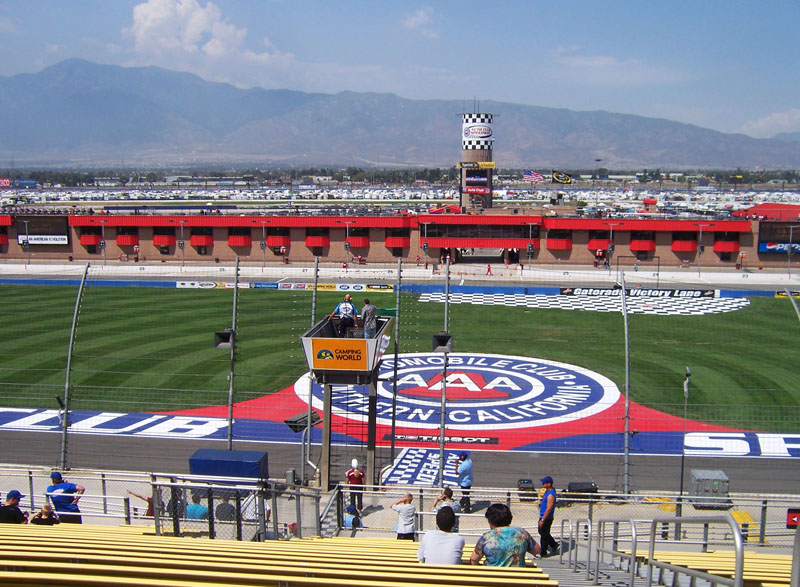


Layout and facilities
The circuit is a long, sweeping oval with comparatively low banking designed to produce high straightaway speeds and close racing. Grandstand seating originally accommodated tens of thousands of spectators, with corporate suites and skyboxes overlooking the frontstretch. Permanent facilities include pit road, garages, media centers and a fan zone area added in the 2000s to enhance the spectator experience. Lighting was installed in the mid-2000s to allow for night racing during expanded race weekends.
History and development
Construction began in the mid-1990s on land that had previously held industrial operations, and the venue opened to national motorsport series shortly afterward. It was initially known as California Speedway before acquiring a new commercial name through sponsorship. The track was developed by a major motorsports ownership group and has been the site of several alterations to seating, paddock arrangements and fan amenities over time to adapt to changing event schedules and audience needs.
Major events and uses
Auto Club Speedway has hosted top-level stock car events run by the NASCAR organization, typically as part of the national touring series calendar. The facility has also served as a venue for open-wheel racing on multiple occasions, including longer-distance oval races that drew international entries. In addition to premier race weekends, the complex has been used for testing, driving schools, club events and occasional non-racing public activities.
Access and location
The speedway is conveniently reached from several major highways, including Interstate 10 and Interstate 15, which link the region to the greater Los Angeles area and inland communities. Public transit options include regional commuter rail service with a station near the venue's backstretch, providing an alternative for fans traveling from the metropolitan area.
Notable facts and distinctions
- The track's two-mile D-shaped oval design differentiates it from shorter speedways and higher-banked superspeedways, offering a mix of speed and handling challenges.
- Its placement on former industrial land is an example of large-scale redevelopment for motorsports and entertainment purposes.
- Over time the venue has adapted event formats—such as adding lighting for night races and modifying fan areas—to reflect changes in series schedules and spectator expectations.
Today Auto Club Speedway remains an important regional facility in American motorsports, noted for its role in hosting national series and for its proximity to Southern California population centers. For schedules, event history and visitor information, consult official event promoters and the track's season announcements.
Questions and answers
Q: What is Auto Club Speedway?
A: Auto Club Speedway is a 2-mile (3.219 km), low-banked D-shaped oval superspeedway that hosts NASCAR and open wheel racing events.
Q: When did Auto Club Speedway start hosting NASCAR races?
A: Auto Club Speedway started hosting NASCAR races in 1997.
Q: Who owns Auto Club Speedway?
A: International Speedway Corporation owns Auto Club Speedway.
Q: What is the capacity of Auto Club Speedway?
A: Auto Club Speedway has a capacity of 68,000 and 28 skyboxes for a total of 28,000.
Q: When were lights added to Auto Club Speedway?
A: Lights were added to Auto Club Speedway in 2004, with the addition of a second annual NASCAR race weekend.
Q: What is the nearest public transportation to Auto Club Speedway?
A: Auto Club Speedway is served by the nearby Interstate 10 and Interstate 15 freeways as well as a Metrolink station located by the backstretch.
Q: What other racing events have been hosted at Auto Club Speedway besides NASCAR races?
A: In addition to NASCAR races, Auto Club Speedway has hosted IndyCar events since 2012 with its season finale, a 500-mile night race. The series previously ran a 400-mile race from 2002 to 2005.
Related articles
Author
AlegsaOnline.com Auto Club Speedway Leandro Alegsa
URL: https://en.alegsaonline.com/art/7586
Sources
- jayski.com : "Jayski's® NASCAR Sprint Cup News - Track News Archive"
- latimes.com : "Thriving Auto Club Speedway has history of peaks, valleys"
- articles.latimes.com : "New Track Is a Steel : California Speedway Will Be Built on Site of Old Fontana Mill"
- worldcat.org : 0458-3035
- articles.latimes.com : "Auto Club Speedway slashes grandstand seating by 26% to 68,000"
- racingcircuits.info : "Auto Club Speedway, Fontana"
- foxsports.com : "10 facts you might not know about Auto Club Speedway" · web.archive.org