
Peptide bond (amide linkage between amino acids)
A peptide bond is the amide linkage that connects amino acids into peptides and proteins. It forms by condensation, has partial double-bond character that constrains geometry, and is cleaved by hydrolysis or proteases.
Overview
A peptide bond is the covalent link that joins two amino acids into a dipeptide and, by repetition, forms polypeptides and proteins. Chemically it is an amide bond formed between the carboxyl group of one amino acid and the amino group of the next. Formation releases a water molecule in a condensation (dehydration) reaction.
Image gallery
3 Images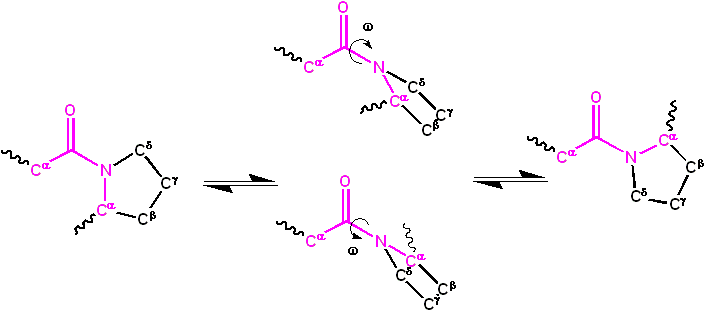

Characteristics
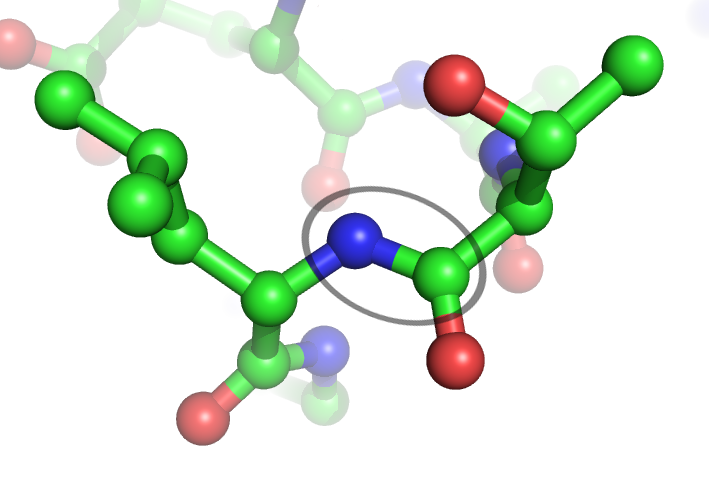
Because the peptide linkage is an amide, its electrons are delocalized across the C–N–O portion. This gives the bond partial double-bond character, makes the bond plane-like, and restricts free rotation about the C–N axis. As a result peptide bonds are usually found in the trans configuration, with a notable exception when proline is involved.
- Key properties: planar geometry, partial double-bond character, restricted rotation, capacity to participate in hydrogen bonds.
- Ends of a chain: an N-terminal (free amino) and a C-terminal (free carboxyl) group determine chain directionality.
Formation and cleavage
In living cells peptide bonds are formed on ribosomes during translation and require energetic input and enzymatic catalysis; spontaneous formation in water is unfavorable. Chemists build peptides using activating reagents and protecting groups in stepwise syntheses. Conversely, peptide bonds are broken by hydrolysis either chemically (acid or base) or enzymatically by proteases and peptidases, which is essential for digestion and protein turnover.
Biological importance and examples
The peptide bond is the backbone connection of all proteins and directly influences higher-level structure. Its planarity and hydrogen-bonding ability enable regular secondary structures such as alpha helices and beta sheets. Short sequences linked by peptide bonds are called peptides and may act as hormones, antibiotics, or signaling molecules; long polymers are proteins with catalytic, structural, or transport functions.
Historically, studies of proteins and synthetic peptides in the 19th and 20th centuries established the central role of the peptide bond in biochemistry. A useful distinction: while all peptide bonds are amide bonds, not all amide bonds occur between amino acids. The peptide bond remains a fundamental concept in molecular biology, medicinal chemistry, and structural biology.
Related articles
Author
AlegsaOnline.com Peptide bond (amide linkage between amino acids) Leandro Alegsa
URL: https://en.alegsaonline.com/art/75719