
Paolo Uccello — Early Renaissance painter and pioneer of perspective
Paolo Uccello (1397–1475), born Paolo di Dono, was a Florentine painter known for pioneering linear perspective and dramatic battle scenes during the Early Renaissance.
Overview
Paolo Uccello (born Paolo di Dono; 1397–10 December 1475) was an Italian painter from Florence who worked during the Early Renaissance. He is widely remembered for his intense interest in geometry and for being among the first painters of the Italian Renaissance to apply systematic perspective to pictorial composition. His nickname "Uccello" ("bird") reportedly came from his fondness for painting animals, especially birds.
Image gallery
10 Images


Style and technique
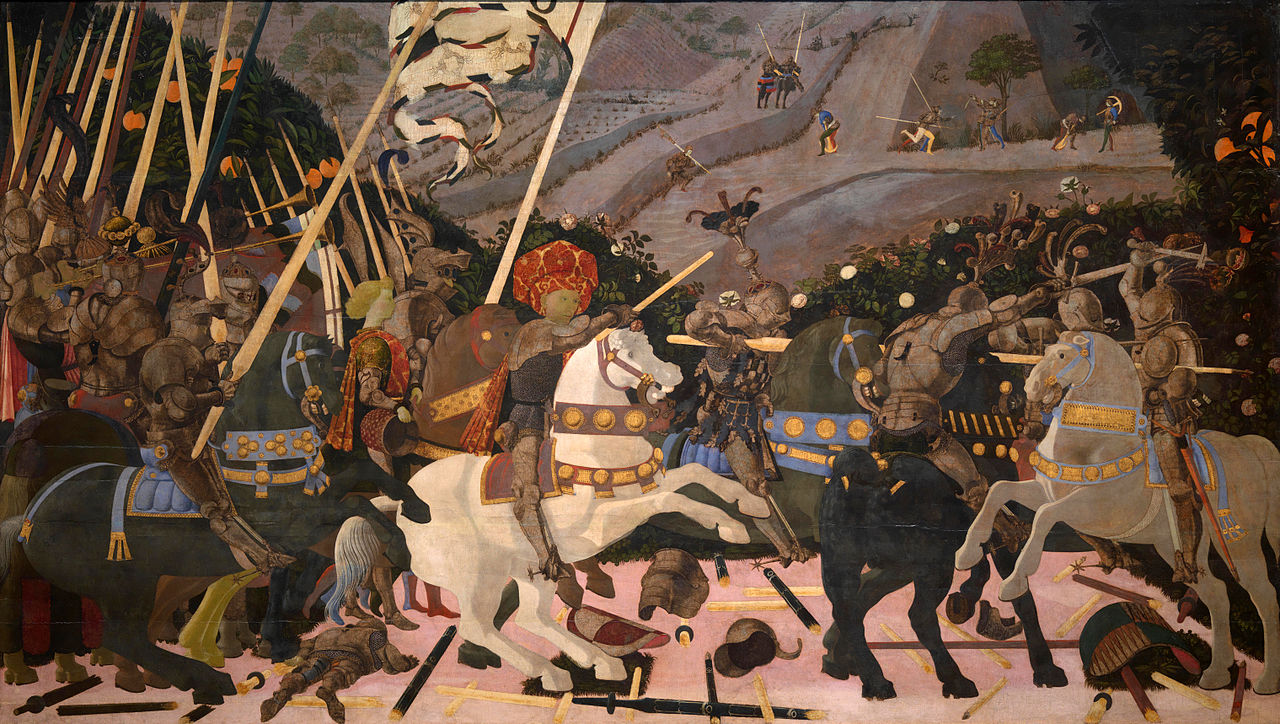
Uccello combined decorative Late Gothic detail with a rigorous, experimental approach to linear perspective. He used orthogonal lines and carefully planned spatial grids to give a sense of depth to crowded scenes, often arranging figures and objects along clear receding planes. His work shows an interest in foreshortening, structural clarity, and strong, sometimes jewel-like color contrasts that enhance spatial illusion.
Major works and subjects
Uccello painted religious subjects, mythic episodes and ambitious battle scenes. He is best known for a series of panels representing a single battle and for a dramatic depiction of a knight and dragon. Surviving pieces illustrate his persistent exploration of perspective and composition.
- The Battle of San Romano — a group of panels portraying a single engagement in a highly constructed spatial format
- Saint George and the Dragon — a narrative scene emphasizing posed figures and diagonal perspective
- Altarpieces and fresco fragments — various devotional works evidencing both ornament and careful spatial design
Life and historical context
Uccello worked largely in his native city and received both civic and ecclesiastical commissions. His lifetime overlapped with major developments in art and architecture in Italy, including the innovations of contemporaries who explored proportion, anatomy, and mathematical systems for representing space. He is often portrayed in later accounts as obsessive about perspective, a characterization that reflects how unusual his methodical experiments appeared to his peers.
Legacy and influence
Though not as universally celebrated as some of his contemporaries, Uccello influenced later artists by demonstrating how mathematical perspective could be used for dramatic and narrative effect. His battle scenes remain prized examples of early Renaissance attempts to reconcile complex figural activity with coherent spatial order. For introductions and further study, consult standard art-historical surveys and museum catalogues that discuss his role in the transition from Gothic to Renaissance pictorial practice.
More information: Florence context, Italian art, Early Renaissance overview, perspective techniques.
Related articles
Author
AlegsaOnline.com Paolo Uccello — Early Renaissance painter and pioneer of perspective Leandro Alegsa
URL: https://en.alegsaonline.com/art/74420