
Palmar (Volar) Plate: Anatomy, Function, and Clinical Significance
A concise overview of the palmar (volar) plate — a fibrocartilaginous structure on the palmar side of finger joints that stabilizes, guides motion, and resists hyperextension; includes anatomy and clinical notes.
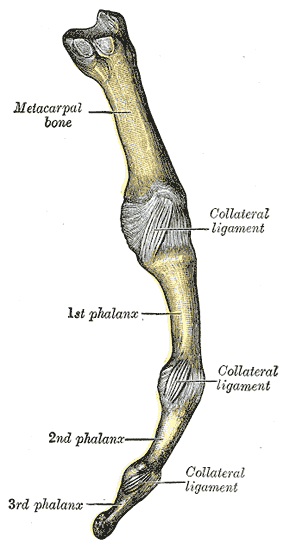
The palmar plate, also called the volar plate, is a band of fibrocartilage on the palm side of the finger joints. It is located where the metacarpals of the palm meet the phalanges (at the metacarpophalangeal joints) and at the interphalangeal joints of the fingers. These structures help stabilize the joints, limit excessive extension, and participate in the smooth gliding of tendons and bones during finger movement. For general context about hand anatomy see the hand.
Image gallery
2 Images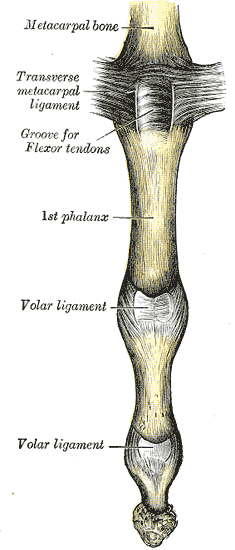
Structure and components
Each palmar plate is a thickened portion of the joint capsule composed mainly of dense fibrous tissue with a fibrocartilaginous surface that faces the joint. The plate is typically broader distally than proximally and is anchored to adjacent bone and soft tissue by fibrous attachments. Important components and relationships include:
- Proximal attachment to the metacarpal or proximal phalanx periosteum.
- Distal extension that overlaps the base of the next bone, creating a check against overextension.
- Fibrous bands or thickenings that link the plate to collateral ligaments, the flexor tendon sheath, and surrounding capsule.
Function and biomechanical role
The palmar plate serves several mechanical and protective roles. Primarily it prevents hyperextension of the finger joints, reducing the risk of dislocation or excessive strain on the joint surfaces. It also provides a smooth, wear-resistant surface inside the joint and helps maintain alignment during gripping and pinching. During flexion the plate glides with the phalanx, and its attachments help transmit forces safely through the joint.
Clinical relevance
Palmar plate injury is a common consequence of forceful hyperextension, such as in sports or a jammed finger. Damage can range from stretching to partial tearing or avulsion (when the plate pulls off a piece of bone). Symptoms typically include pain, swelling, and reduced stability at the affected joint. Management depends on severity: many mild to moderate injuries are treated with immobilization and hand therapy, while severely displaced avulsions or persistent instability may require surgical repair. Awareness of the palmar plate is important in diagnosing joint dislocations and planning reconstruction to restore function.
Distinctions and notable points
The palmar plate is distinct from the collateral ligaments that stabilize the sides of the finger joints and from the articular cartilage that covers joint surfaces. Anatomy texts sometimes use the synonyms palmar and volar; both refer to the same palm-side location. Because the plates are subject to compressive and tensile forces, they show fibrocartilaginous adaptation rather than being purely ligamentous.
Understanding the palmar plate is valuable for clinicians, therapists, and anyone involved in hand injury care. Its role in preventing hyperextension and smoothing joint motion makes it a small but essential component of hand function.
Related articles
Author
AlegsaOnline.com Palmar (Volar) Plate: Anatomy, Function, and Clinical Significance Leandro Alegsa
URL: https://en.alegsaonline.com/art/74232