
Ouest (department, Haiti)
Ouest is one of Haiti's ten departments, home to the capital Port-au-Prince, the island of Gonâve, and a large share of the country's population, coastline, and political institutions.
Ouest (literally West) is one of the ten principal administrative divisions of Haiti, known in French as départements. It contains the national capital, Port-au-Prince, which serves as both the departmental and national seat of government. Ouest combines dense urban areas, coastal lowlands and offshore islands, and it accounts for a substantial portion of Haiti's population and economic activity.
Image gallery
4 Images


Geography and composition
Covering roughly 4,827 km², Ouest is among Haiti's larger departments by area. The department occupies the central-western portion of the island of Hispaniola and fronts on the Gulf of Gonâve, whose waters contain the department's largest offshore landform, the Île de la Gonâve (Gonâve Island). The terrain ranges from coastal plains and bays that support ports and fishing to interior hills and valleys. Because Haiti shares the island of Hispaniola with the Dominican Republic, Ouest participates in the island's larger ecological and cultural landscape, though it is a part of the Haitian state rather than the neighboring country.
History and development
The area now known as Ouest has been a central stage in Haiti's colonial and national history. Port-au-Prince was established as a major settlement during the French colonial period and later grew into the capital. Since independence in the early 19th century, the department has been the political, administrative and commercial heart of Haiti. Its urban and coastal infrastructure expanded over time, concentrating government institutions, foreign missions, major markets and transportation hubs in and around Port-au-Prince.
Administration and subdivisions
Administratively, Ouest is subdivided into arrondissements and communes, the standard tiers of local government in Haiti. The department contains five arrondissements, each of which comprises several communes and localities. The principal arrondissements are:
- Port-au-Prince arrondissement — includes the capital city and immediate metropolitan neighborhoods (Port-au-Prince).
- Croix-des-Bouquets arrondissement — a mix of peri-urban and rural communes to the east of the capital.
- Léogâne arrondissement — to the south-west, with coastal towns and agricultural lands.
- Arcahaie arrondissement — north-west of the capital, historically and agriculturally notable.
- La Gonâve arrondissement — covering the department's main offshore island, the Île de la Gonâve.
Economy, society and notable facts
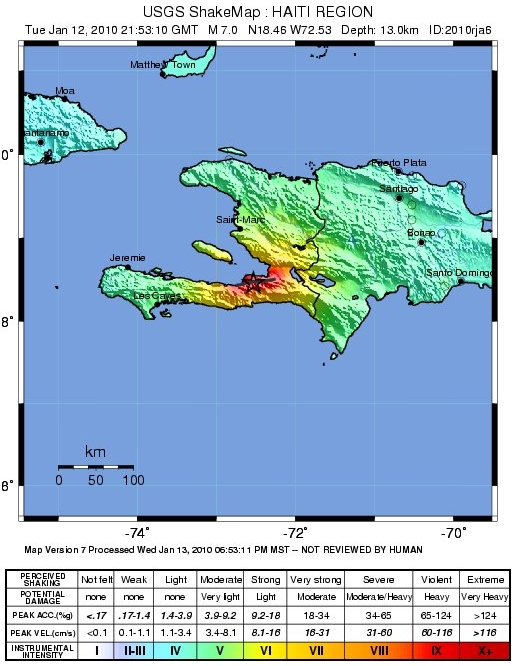
Ouest concentrates much of Haiti's economic, political and cultural life. Port facilities, governmental ministries, larger markets and many of the country's major services are located here. The department's urban zones host educational institutions, media, and cultural venues that influence national life. Ouest is also vulnerable to natural hazards; most notably, the department and its capital were severely affected by the 2010 earthquake, an event that reshaped infrastructure and development priorities.
Demographically, Ouest contains a significant share of Haiti's population and includes both dense metropolitan neighborhoods and more sparsely settled rural communes. Its mix of coastal access, an international port, and proximity to central government make it a focal point for national planning and international assistance. For readers wanting a concise introduction to Haiti's administrative geography, Ouest illustrates how political authority, economic activity and island geography interact on Hispaniola.
Further reading and official statistics are available from national sources and geographic references; for more general context about departmental organization see materials on Haitian departments and the shared island of Hispaniola where Haiti and the Dominican Republic coexist.
Related articles
Author
AlegsaOnline.com Ouest (department, Haiti) Leandro Alegsa
URL: https://en.alegsaonline.com/art/73589