
Ottawa River
Major river forming much of the boundary between Ontario and Quebec, Canada; important for ecology, history, hydroelectricity, navigation and recreation.
The Ottawa River is a principal waterway in eastern Canada that largely defines the border between the provinces of Ontario and Quebec. Flowing across the Canadian landscape toward the Saint Lawrence system, it has shaped local settlement, transportation and industry. The national capital, Ottawa, takes its name from the river, and the waterway lies entirely within Canada.
Image gallery
9 Images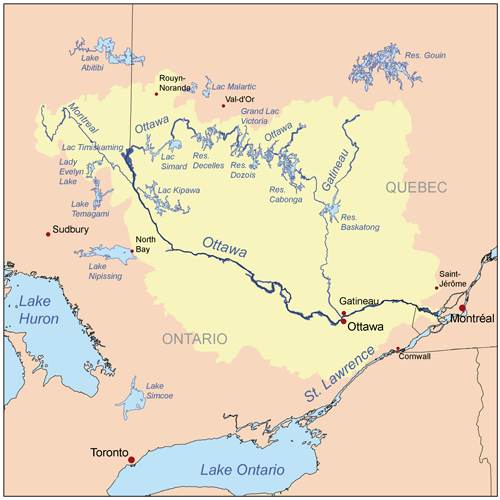


Physical characteristics
The river drains a broad watershed that includes uplands, lowlands and numerous tributaries. It receives water from rivers such as the Gatineau and the Rideau and passes through stretches of rapids, marshes and deep channels. Its course runs through varied geology, including the Laurentian highlands and softer sedimentary plains, producing a mix of islands, riffles and quieter reaches used by wildlife and people alike.
History and cultural significance
For millennia the Ottawa River was central to Indigenous peoples of the region, especially Algonquin nations, who used it for travel, trade and sustenance. With European contact the river became a major route for explorers and fur traders and later a corridor for the timber and logging industries. Settlements and trading posts developed along its banks, following the river's strategic and economic importance.
Uses and economic importance
- Navigation and historical trade routes that connected interior areas to the Saint Lawrence.
- Hydroelectric generation and water control at several dams and reservoirs.
- Recreation: boating, fishing, paddling and shoreline parks support tourism and local leisure.
- Municipal and industrial water supply and regional transportation links.
These uses have evolved over time from log driving and freight to modern energy production and recreation, while maintaining important commercial and municipal functions.
Environment and management
The Ottawa River supports diverse aquatic and riparian ecosystems, including fish, birds and wetland habitats. Human alterations — dams, shoreline development and pollution — have affected habitat connectivity and water quality. Management involves federal, provincial and local agencies working with Indigenous groups to balance energy, navigation, conservation and community needs, and to restore or protect sensitive areas.
Notable facts include its role as a provincial boundary, its influence on regional settlement patterns, and its continuing importance as a cultural and natural corridor. For further regional context see provincial and municipal resources linked above.
Related articles
Author
AlegsaOnline.com Ottawa River Leandro Alegsa
URL: https://en.alegsaonline.com/art/73535