
Optical filter: types, performance and common applications
A concise guide to optical filters: how they shape light by wavelength, principal types (absorptive, interference, neutral density), key performance metrics, development, and main uses.
Overview
An optical filter is a device that selectively transmits, absorbs or reflects portions of the spectrum of light. By altering the spectral composition that passes through an optical system, filters enable color control, contrast enhancement and wavelength selection. Typical specifications describe the transmission curve, cutoff wavelengths, center wavelength and bandwidth.
Image gallery
1 Image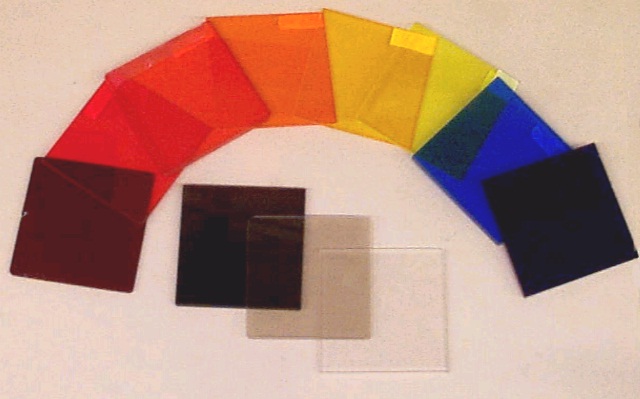
Types and construction
Filters are manufactured in several forms and from different materials. Absorptive filters use colored glass, plastics or gelatin to attenuate specific wavelengths. Interference (dichroic) filters rely on thin-film multilayer coatings that reflect unwanted bands and transmit desired ones. Other common variants include neutral-density filters that reduce overall intensity without strongly altering color, long-pass and short-pass edge filters, band-pass and notch filters, and polarizing filters that combine spectral and polarization control.
Key characteristics and metrics
Important performance metrics include percent transmission, optical density (OD = -log10(transmission)), blocking (out-of-band rejection), full width at half maximum (FWHM) for band-pass profiles, and edge steepness. Interference filters show angular dependence—tilting a filter shifts its effective pass-band—and can exhibit polarization sensitivity. Environmental factors such as temperature and humidity can also alter thin-film and polymer filter behavior.
History and development
Colored glasses were used historically for decorative and basic light control. As optics and materials science progressed in the 19th and 20th centuries, precision glass formulations and vacuum thin-film deposition made it possible to produce filters with defined spectral shapes and high blocking outside the pass-band. These advances expanded scientific, photographic and industrial applications.
Applications and examples
- Laboratory instruments: spectrometers, fluorescence microscopes and colorimeters use filters to isolate wavelengths for measurement and excitation.
- Imaging: in photography and cinematography, photographic filters help with exposure, color correction and creative effects; many consumer and professional cameras include built-in IR/UV cut filters and accept screw-on photographic filters.
- Lighting and theater: gels and coated filters color stage lighting and control mood by selecting particular wavelength bands.
- Specialized uses: astronomy and remote sensing employ narrow-band filters to isolate spectral lines; machine vision and sensor protection use blocking filters to improve contrast and avoid detector saturation.
Practical considerations and distinctions
Filters are available as mounted elements (disks, squares, cubes), unmounted sheets or directly coated on lenses and windows. Choose a filter by matching spectral requirements, angle of incidence, environmental durability and mechanical size. For precision work, verify blocking outside the pass-band and the filter's angular and polarization behavior; for general-purpose photography or lighting, robustness and cost are often primary concerns.
Related articles
Author
AlegsaOnline.com Optical filter: types, performance and common applications Leandro Alegsa
URL: https://en.alegsaonline.com/art/72889