
Okinotorishima
Okinotorishima is a remote, uninhabited Japanese coral atoll in the Philippine Sea. Its low rocks, ecological fragility and contested legal status have made it notable for maritime claims and conservation concerns.
Overview
Okinotorishima (沖ノ鳥島) is a tiny, uninhabited coral atoll administered by Japan and located in the western Pacific Ocean. The feature is commonly described as a low ring of reef and exposed rock that lies in the Philippine Sea. Its name is often translated as "remote bird island," reflecting both its isolation and its occasional use by seabirds.
Image gallery
6 Images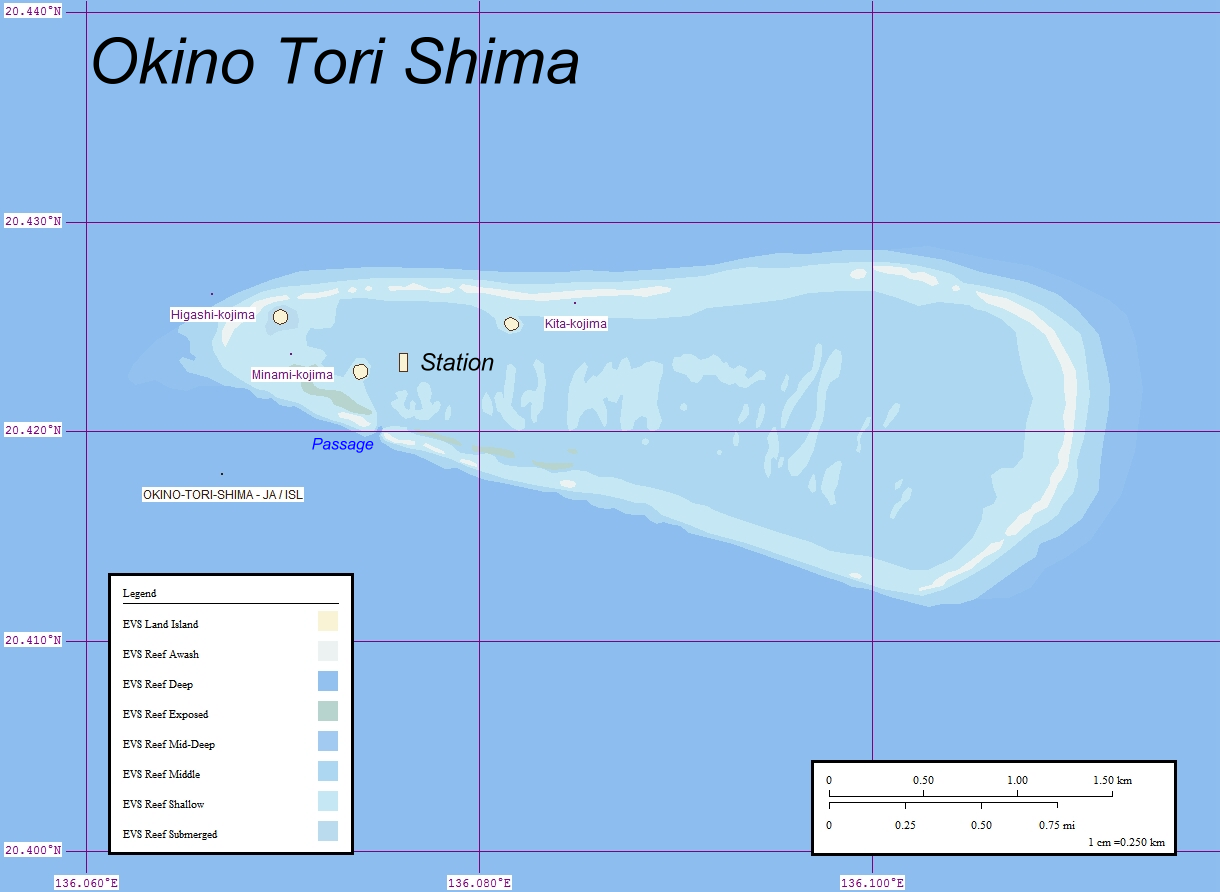


Geography and physical characteristics
The atoll consists of very low-lying coral and rock that is vulnerable to wave action and storm damage. At high tide much of the feature is awash or barely above sea level, so natural vegetation and permanent human habitation are absent. The wider submarine platform and reef system form part of a larger ridge in the area and are of interest for oceanography and marine biology.
Ecology
Although the exposed land area is minimal, Okinotorishima supports marine life typical of coral reef environments and provides resting or nesting sites for some seabirds. Its shallow waters host coral, fish and invertebrates, but the habitat is fragile: erosion, coral bleaching, and sea-level change all threaten the reef and any dependent species.
History, administration and human activity
Japan administers Okinotorishima and has undertaken engineering works to stabilize parts of the rock and to maintain markers and observation facilities. There is no permanent population. Human activity has been confined to occasional visits by researchers, officials and maintenance crews.
Legal status and international issues
The atoll has been the subject of international attention because its classification affects maritime entitlements under the United Nations Convention on the Law of the Sea (UNCLOS). The legal distinction between an "island" that can generate a territorial sea and exclusive economic zone and a "rock" that cannot has been central to debate. Japan asserts maritime rights around Okinotorishima, while other states have questioned how far those rights extend.
Importance and conservation
Okinotorishima is significant for several reasons: it illustrates challenges in applying international maritime law to tiny oceanic features; it highlights the vulnerability of low coral islands to environmental change; and it serves as a case study in balancing sovereignty, resource rights and habitat protection. Efforts to monitor and protect its marine environment continue alongside political and legal discussions.
- Location: western Pacific, part of Japan's administered territories (administrative link).
- Physical: low coral reef and rock (atoll/reef).
- Context: situated in the Philippine Sea and considered within a broader ridge system (geographic link).
For more detailed legal texts, oceanographic studies and official statements, consult government releases and international law analyses that discuss Okinotorishima's status and management.
Related articles
Author
AlegsaOnline.com Okinotorishima Leandro Alegsa
URL: https://en.alegsaonline.com/art/72213
Sources
- nytimes.com : "Japan and China Dispute a Pacific Islet,"
- news.xinhuanet.com : "Japan hopes to build lighthouse on atoll disputed with China,"