
NOR gate — definition, truth table, properties and practical uses
A NOR gate is a digital logic gate that outputs true only when all inputs are false. This article covers its logic, truth table, Boolean relations, implementations, and common applications.
The NOR gate is a fundamental digital logic element that produces a logical 1 (true) only when every input is 0 (false). It is the negation of the OR operation: the output is false if any input is true. Because of its simple truth behavior and algebraic relationships, the NOR gate is widely used in combinational and sequential circuits.
Image gallery
3 Images
Truth table and basic behavior
The simplest illustration of a NOR gate uses two inputs, typically labeled A and B. The relationship between inputs and output Y can be written as Y = NOT (A OR B). For a two-input gate the combinations are:
- A=0, B=0 → Y=1
- A=0, B=1 → Y=0
- A=1, B=0 → Y=0
- A=1, B=1 → Y=0
Multi-input NOR gates generalize the same rule: the output is 1 if and only if every input is 0.
Boolean form and identities
Algebraically the NOR operation is written as Y = ¬(A ∨ B). By De Morgan's laws this is equivalent to Y = ¬A ∧ ¬B, expressing NOR as the conjunction of inverted inputs. The NOR operator is associative in its multi-input extension only through its definition as the negation of a multi-input OR.
Universality and building blocks
NOR is a universal gate: any Boolean function can be implemented using only NOR gates. Common constructions include:
- NOT A = A NOR A
- A OR B = (A NOR B) NOR (A NOR B)
- A AND B = (A NOR A) NOR (B NOR B)
Because of universality, NOR gates can implement inverters, multiplexers, latches and other logic without requiring separate NOT or AND primitives.
Physical implementations and symbols
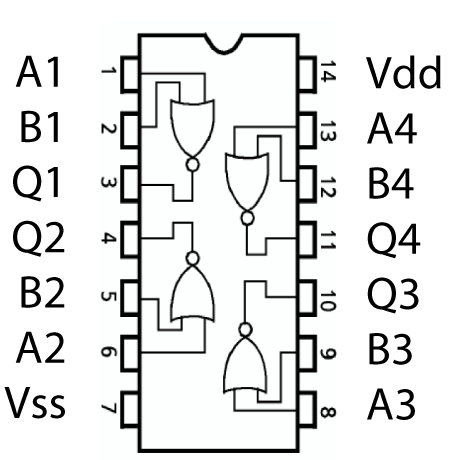
NOR gates are realized in many technologies — transistor–transistor logic (TTL), complementary MOS (CMOS), programmable logic arrays, and even electromechanical relays. In schematic diagrams the NOR symbol is often drawn as an OR gate shape with a small inversion bubble at the output; some graphs show input bubbles for alternative polarities. Integrated circuits often package multiple two- or three-input NOR gates on a single chip.
Applications and notable facts
NOR gates appear in control logic, address decoding, simple state storage, and digital decision circuitry. They are one of the two common universal gates (the other is NAND), and their properties influence logic synthesis and optimization. The term "NOR" is also associated with NOR flash memory, which uses cell arrangements related to NOR-style bit access for random reads. When designing with NOR gates, engineers consider fan-in (number of inputs per gate), propagation delay, and the targeted logic family to meet timing and power budgets.
Understanding NOR behavior and its algebraic role helps when converting Boolean expressions, minimizing logic, or building complex functions from a small set of primitives.
Related articles
Author
AlegsaOnline.com NOR gate — definition, truth table, properties and practical uses Leandro Alegsa
URL: https://en.alegsaonline.com/art/70643