
Noble Eightfold Path (Buddhist path to end suffering)
Central Buddhist teaching prescribing eight interrelated practices—right view, intention, speech, action, livelihood, effort, mindfulness, and concentration—grouped as wisdom, ethical conduct, and concentration.
The Noble Eightfold Path is a foundational framework in Buddhism that outlines practical steps toward the cessation of suffering. Presented by the Buddha as the fourth of the Four Noble Truths, the path is traditionally given the Pali name ariya atthangika magga. Its purpose is not merely belief but a set of interdependent practices intended to transform perception, behavior, and mental discipline.
Image gallery
2 Images
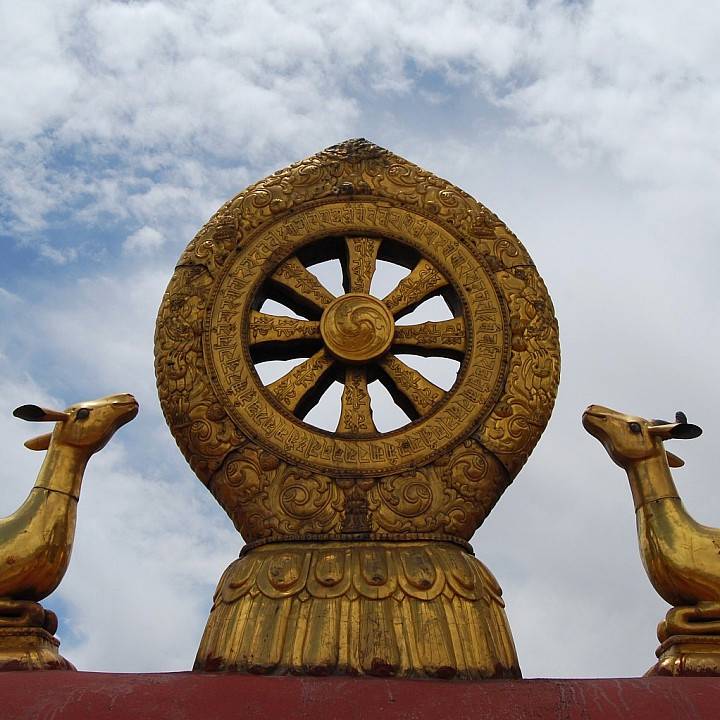
Structure and the eight factors
The teaching groups eight factors into three broad trainings: wisdom, ethical conduct, and concentration. These trainings are sometimes called the three trainings. Wisdom is associated with insight; ethical conduct creates a stable social and personal basis; concentration develops mental clarity.
- Right View — understanding the nature of suffering and its causes.
- Right Intention — commitment to harmless, kind, and non-greedy intentions.
- Right Speech — truthful, beneficial, and timely communication.
- Right Action — ethical behavior that avoids harm to others.
- Right Livelihood — earning a living in ways that do not cause suffering.
- Right Effort — cultivating wholesome states and abandoning unwholesome ones.
- Right Mindfulness — sustained awareness of body, feelings, mind, and phenomena.
- Right Concentration — developing focused, tranquil states of mind.
Key concepts and terminology
In classical accounts the three trainings correspond to wisdom (paññā), ethical conduct (sīla) and concentration (samādhi). The Pali term for wisdom is often written as Pali word 'pañña' in transliteration. The qualifier "right" (sammā/samyak) is also translated as skillful, wholesome, or proper, emphasizing practical effectiveness rather than moral absolutism.
Historically, the Eightfold Path appears in early Buddhist scriptures and has been interpreted and adapted by different schools over centuries. Monastic communities emphasize observance and meditative development, while lay teachers often stress ethical living and mindfulness practices that are accessible in daily life.
Practical uses of the path range from guiding formal meditation and ethical codes to informing contemporary mindfulness and psychotherapy approaches. A notable feature is its non-linear emphasis: the eight factors are meant to support and reinforce one another rather than be followed as a strict sequence. Readers studying the path will find both concise lists and extended commentarial traditions that expand each factor into detailed practices and stages of progress.
For further introductory readings and canonical discussions, many resources and translations exist that explore how the Eightfold Path functions as an integrated map for personal development and social responsibility within the broader Buddhist teaching.
Related articles
Author
AlegsaOnline.com Noble Eightfold Path (Buddhist path to end suffering) Leandro Alegsa
URL: https://en.alegsaonline.com/art/70492