
Nmap — network scanner and port discovery tool
Nmap is a widely used open-source utility for discovering hosts and services on computer networks, performing port scans, OS detection, scripting and basic network inventory.
Overview
Nmap is a network scanning and host discovery program originally written by Gordon Lyon (also known as Fyodor). It is designed to probe computer systems to discover open ports, running services, and basic characteristics of hosts on a network. Administrators, security professionals and researchers use it to map networks, verify device configurations, and detect potential security issues. The project is maintained openly and accepts community contributions; details and downloads are listed on the official project pages.
Image gallery
4 Images


Capabilities and common techniques
Nmap operates by sending crafted packets and interpreting responses to infer state and properties of remote systems. It supports a variety of probe methods including TCP and UDP scans, SYN/half-open scans, TCP connect scans, ACK and FIN probes, and ICMP-based host discovery. The tool can perform service and version detection by interacting with application-layer protocols and can attempt operating system fingerprinting. It also includes a scripting engine that automates specialized checks and extends functionality.
Typical uses
- Network inventory and mapping — finding which machines are active and what ports they expose.
- Security auditing and vulnerability reconnaissance — identifying unexpected services or misconfigurations.
- Troubleshooting — checking firewall rules, reachable services, and network segmentation.
- Automation and integration — running scripts to collect or correlate service data.
Because Nmap inspects how a computer communicates and how other systems respond, it is a flexible tool for both defensive and research tasks. Documentation often describes the underlying packet flows and expected responses in more detail; see materials on network communication and network concepts for background.
Platforms and distribution
Nmap runs on a wide range of operating systems. It is distributed as open-source software and can be built or installed on many platforms; general platform information is available from the project site. Commonly supported systems include those in the family of Unix-like operating systems, as well as Microsoft Windows and historical ports for Solaris. Popular distributions provide packaged builds for Linux, macOS and various BSDs.
History and ecosystem
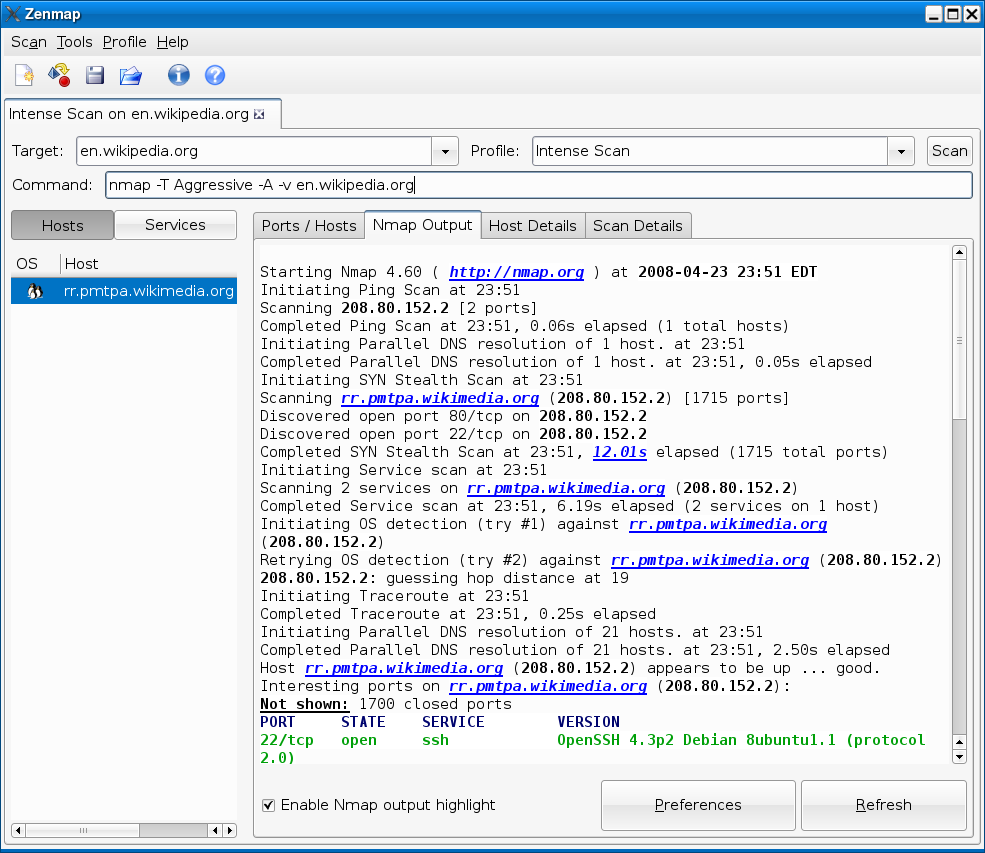
First released in the late 1990s, Nmap has evolved from a simple port scanner to a full-featured toolkit with multiple output formats, a scripting environment, and third-party front ends. A graphical front-end has been offered to make the tool more approachable to users who prefer visual interfaces. The extensible design has encouraged a large library of scripts and integrations used in automated workflows.
Important considerations
While Nmap is a legitimate administrative and research tool, scanning networks without authorization can be illegal or violate policies. Users should obtain permission before probing systems they do not own. For more information about licensing, project governance and responsible use, consult the project pages on open-source licensing and community guidance. Additional resources on scanning ethics and best practices are available from technical and legal overviews linked from the project site.
Further reading and downloads: official project, community tutorials and protocol references on networking.
Related articles
Author
AlegsaOnline.com Nmap — network scanner and port discovery tool Leandro Alegsa
URL: https://en.alegsaonline.com/art/70411