
Night (memoir) by Elie Wiesel
Night is Elie Wiesel's short, powerful memoir about his experience during the Holocaust, a foundational work of Holocaust literature that examines survival, faith, and memory.
Night is a brief memoir by Elie Wiesel, a writer and Nobel Peace Prize laureate, that recounts his experiences as a teenager during the Holocaust. The book is written as a tightly focused personal testimony rather than a comprehensive history. It is widely read in many languages and has helped shape public understanding of the concentration camp experience. For more on the author see Elie Wiesel.
Image gallery
10 Images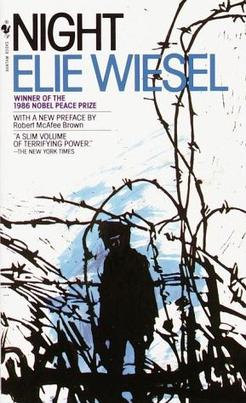


Content and form
The narrative follows Wiesel's deportation from his hometown, his life in Nazi camps, and the struggle to survive amid systematic brutality. The prose is spare and concentrated, emphasizing sensory detail and moral consequence over documentary exposition. Memorable scenes—such as a description of a thin, bitter bowl of soup that the narrator says seemed to "taste of death"—serve as condensed symbols of dehumanization and loss.
Themes and style
Major themes include the collapse of faith, the bond between father and son, the moral limits of language after atrocity, and the responsibility to remember. Stylistically, the work uses short, direct sentences and vivid imagery to convey horror and exhaustion. Readers and teachers often note its suitability for introducing ethical and historical discussions about genocide, complicity, and survivor testimony.
Publication and translations
Night originally appeared in a European language and was subsequently published in several translations. It reached a broad international audience through editions in French and English, and has been made available in many other languages for readers and classrooms worldwide. Editions and translations remain widely cited; for typical publication details see editions in French, English, and earlier language editions such as Yiddish (Yiddish).
Importance and reception
Night is regarded as a central text in Holocaust literature and in 20th-century witness writing. It has been both praised for its emotional power and studied for its literary techniques. While debates have occasionally arisen about precise factual aspects of memory and memoir, scholars, educators, and survivors emphasize the work's value as a moral and historical testament. Wiesel's broader public influence, including his Nobel Prize recognition, helped keep survivor testimony in the international conversation.
Uses and legacy
The book is frequently taught in secondary schools and universities as an entry point to discussions about the Holocaust, ethics, and human rights. It is used in curricula, reading groups, and memorial programs to foster reflection on individual responsibility and the consequences of hatred. Night remains a compact, powerful example of how personal narrative can preserve memory and provoke moral inquiry.
Related articles
Author
AlegsaOnline.com Night (memoir) by Elie Wiesel Leandro Alegsa
URL: https://en.alegsaonline.com/art/70122