
Nidovirales: biology, families, and significance
Nidovirales is an order of enveloped positive-sense RNA viruses that produce nested subgenomic mRNAs; it includes coronaviruses and related families that infect animals, humans, and arthropods.
Overview
Nidovirales is an order of RNA viruses known for producing a characteristic nested set of 3'-co-terminal subgenomic messenger RNAs during infection. The group contains several families of enveloped, positive-sense single-stranded RNA viruses and includes agents that infect a wide range of animal hosts, from mammals and birds to crustaceans and insects. The name derives from the Latin word for "nest," reflecting their transcription strategy; see the etymology at nidus (Latin). For a general reference to the order, consult Nidovirales overview.
Image gallery
5 Images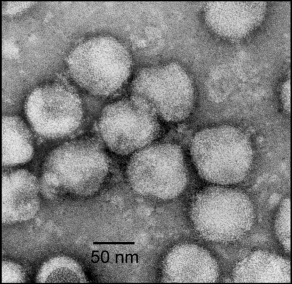


Characteristics and genome
Nidoviruses are enveloped and carry positive-sense single-stranded RNA genomes, which encode large replicase polyproteins and several structural proteins. Compared with many other RNA viruses, some nidoviruses—most notably coronaviruses—have relatively large genomes. Replication occurs in the cytoplasm and involves an RNA-dependent RNA polymerase and associated enzymes. A defining molecular feature is the production of a nested set of subgenomic mRNAs with common 3' ends; this transcriptional organization underlies the group's name and can be explored via general resources on positive-sense RNA viruses.
Major families and hosts
The order comprises multiple families, including but not limited to Coronaviridae, Arteriviridae, Roniviridae, and Mesoniviridae. Members infect diverse hosts: coronaviruses include species that infect humans, bats, and livestock; arteriviruses infect mammals such as horses and pigs; roniviruses are known from crustaceans; mesoniviruses have been found in mosquitoes. See material on host range and zoonotic potential at hosts and reservoirs.
Examples and impact
Prominent examples illustrate the order's importance. Coronaviruses include agents responsible for severe respiratory diseases in humans and animals, while arteriviruses cause economically significant infections in livestock. In aquaculture and insect ecology, roniviruses and mesoniviruses are notable for their effects on shrimp and mosquito populations respectively. The capacity for certain nidoviruses to jump between species has major public-health and veterinary implications.
Replication, research, and control
Research into nidovirus replication centers on the replicase complex, mechanisms of subgenomic mRNA synthesis, and virus–host interactions. Understanding these processes supports vaccine and antiviral development, as well as surveillance for emerging zoonoses. Control measures depend on the host and virus, ranging from biosecurity in animal production to human public-health interventions and vaccination where available.
Notable distinctions and outlook
What sets Nidovirales apart is the nested transcription strategy and often large, complex genomes encoding multifunctional replicase proteins. Ongoing taxonomic and genomic studies continue to refine relationships within the order and to discover new nidoviruses in diverse hosts. For introductory reading and taxonomic summaries consult general resources listed above: order overview, host information, RNA virus basics, and the etymology link nidus.
Questions and answers
Q: What is Nidovirales?
A: Nidovirales is an order of viruses.
Q: Who carries Nidovirales?
A: Nidovirales is carried by animals and humans.
Q: What are the families of viruses included in Nidovirales?
A: The families included in Nidovirales are Coronaviridae, Arteriviridae, Roniviridae, and Mesoniviridae.
Q: What type of virus are Nidoviruses?
A: Nidoviruses are enveloped positive-sense single-stranded RNA viruses.
Q: What is the meaning of the name Nidoviruses?
A: The name Nidoviruses comes from the Latin word nidus, which means nest, as all viruses in this order produce a 3' co-terminal nested set of subgenomic mRNAs during infection.
Q: What is the significance of the 3' co-terminal nested set of subgenomic mRNAs produced by Nidoviruses?
A: The 3' co-terminal nested set of subgenomic mRNAs produced by Nidoviruses during infection is significant because it is the basis for their name and it is a unique characteristic of viruses in this order.
Q: How does Nidovirales affect animals and humans?
A: Nidovirales can cause diseases in animals and humans. For example, some strains of Coronaviridae cause respiratory infections in humans and animals.
Related articles
Author
AlegsaOnline.com Nidovirales: biology, families, and significance Leandro Alegsa
URL: https://en.alegsaonline.com/art/70040
Sources
- citeseerx.ist.psu.edu : 10.1.1.462.1825
- doi.org : 10.1006/smvy.1997.0104