
NGC 7049 — early-type galaxy with a striking dust ring in Indus
NGC 7049 is an early-type galaxy in the southern constellation Indus, notable for a dark dust ring and a polar gas cloud. It lies at roughly 100 million light-years and illustrates external gas accretion.
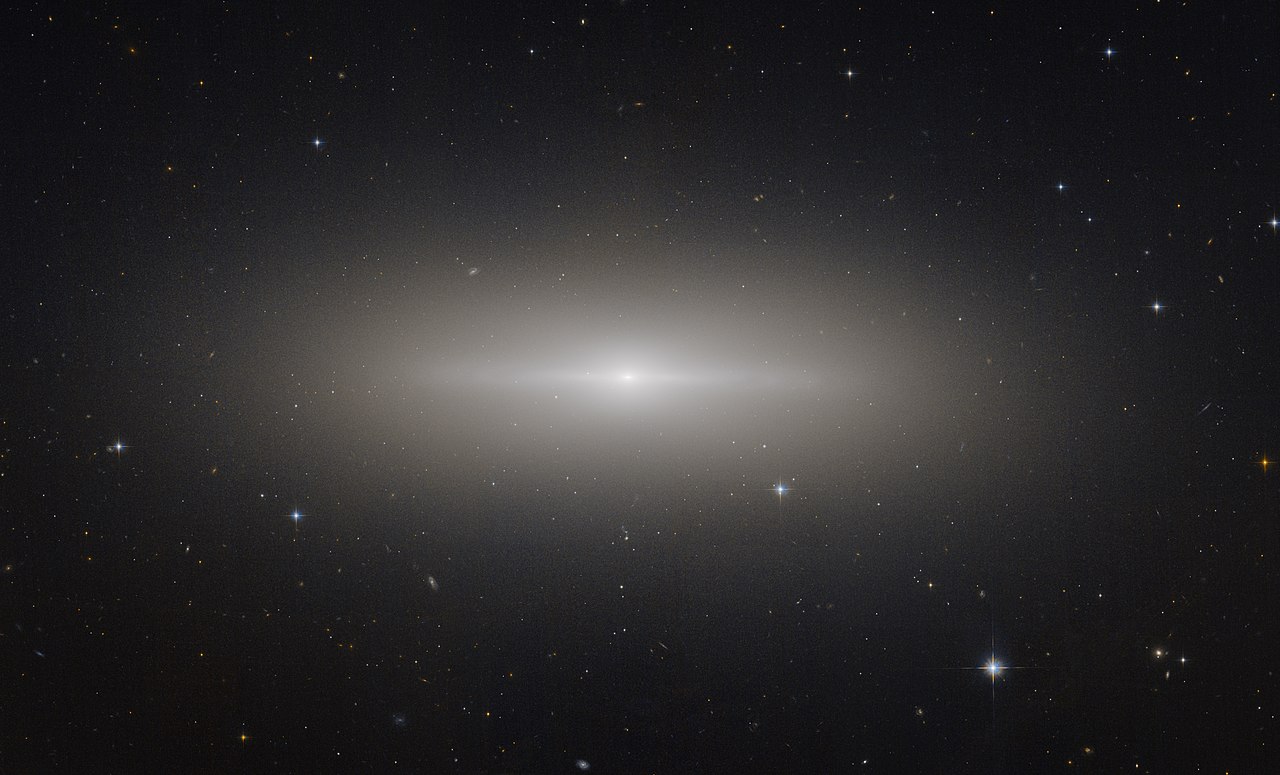
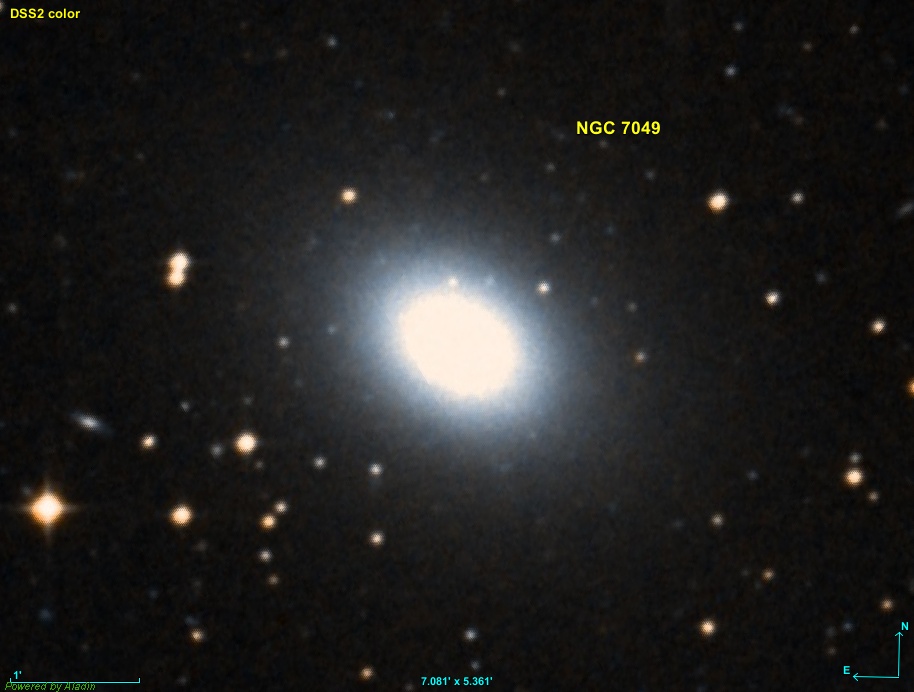
NGC 7049 is an early-type galaxy in the southern constellation Indus that combines the smooth appearance of an elliptical system with a striking dark dust ring visible in silhouette around its bright central bulge. It lies at a distance of about 100 million light-years (roughly 30 megaparsecs). Basic catalogue and identification details are available in the NGC 7049 entry.
Image gallery
4 Images
Characteristics
Classified broadly among ellipticals or lenticulars, NGC 7049 displays an extended, old stellar population that gives the main body a smooth, spheroidal look. Superimposed on that stellar light is a well-defined dust ring that encircles the core; dust lanes appear as sharp silhouettes against the stars. The nucleus is associated with a polar cloud of gas and dust that lies out of the plane of the main ring, creating a non-planar structure that is of particular interest to observers and modelers.
Dust ring and polar gas
The visible dust ring is photogenic and relatively uncommon in otherwise quiescent early-type galaxies. Such rings may contain cold gas and dust dense enough to produce localized extinction and, in some cases, modest star formation. The polar gas component—gas orbiting roughly perpendicular to the stellar major axis—indicates a complex dynamical history and misaligned angular momentum between stars and interstellar material.
Formation and evolution
Astrophysicists interpret these features as evidence that NGC 7049 reacquired gaseous material after its main epoch of star formation. Likely channels include the accretion of a gas-rich satellite, tidal capture of intergalactic material, or the settling of externally supplied gas into resonant orbits that form rings. Such externally acquired gas can fuel low levels of star formation or feed central activity, altering the late evolution of an otherwise mature galaxy.
Observations and study
NGC 7049 has been imaged in optical wavelengths from ground-based observatories and included in surveys of early-type galaxies. Observers refer to regional guides and catalogues for locating the object in Indus: see the Indus constellation overview and general observational listings. Distance estimates and archival data are available through databases and survey resources summarized at distance and data resources.
Importance and notable facts
- Prominent dust ring: a clear, dark lane that contrasts with the galaxy's smooth stellar body.
- Polar gas cloud: evidence for misaligned, externally acquired material around the nucleus.
- Use in research: a nearby example of how early-type galaxies can regain gas and evolve through minor accretion events.
Because it combines the characteristics of an old stellar system with clear signs of recent or ongoing accretion, NGC 7049 helps astronomers study the interplay of dynamics, gas physics, and star formation during the late stages of galaxy evolution.
Related articles
Author
AlegsaOnline.com NGC 7049 — early-type galaxy with a striking dust ring in Indus Leandro Alegsa
URL: https://en.alegsaonline.com/art/69878