
Indus (constellation)
Indus is a modern southern constellation representing an indigenous person. Introduced in the Age of Discovery, it is faint, lacks bright stars, and is best observed from southern latitudes.
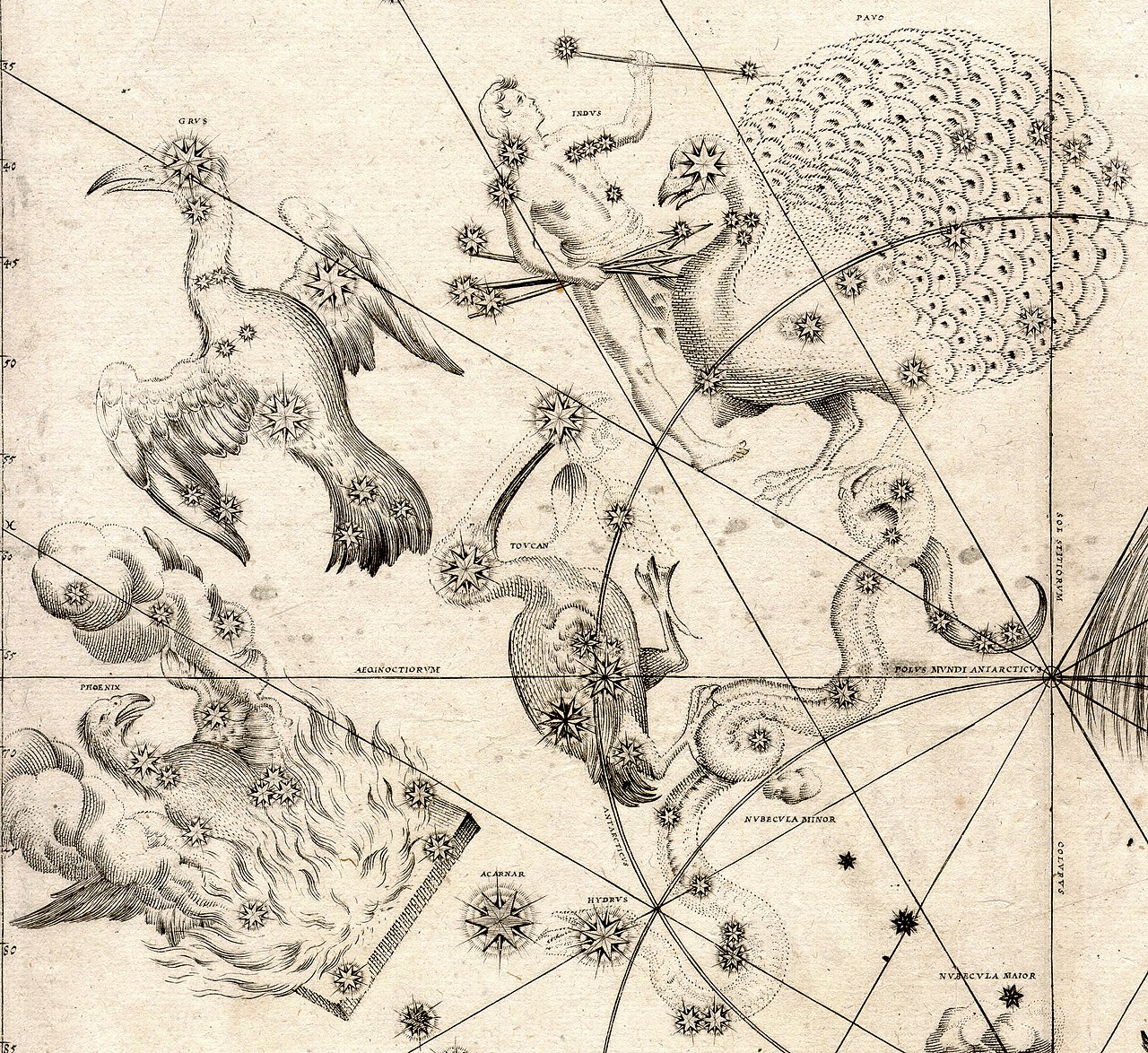
Indus is a constellation of the southern celestial hemisphere whose Latin name means "the Indian." It does not belong to the classical Ptolemaic set of constellations but was established during the European exploration of the southern skies. Indus is relatively faint to the unaided eye and is most visible from temperate and tropical southern latitudes. Today it is one of the 88 constellations recognized by the International Astronomical Union.
Image gallery
5 Images



Characteristics
The pattern of Indus contains no very bright (first-magnitude) stars; its member stars are mostly of moderate apparent brightness and several are orange or red giants. Because of the lack of standout stars, the shape of Indus is subtle in the sky and often identified with the aid of a star chart or a small telescope. It contains a number of telescopic targets: variable stars, binary systems, and faint galaxies and star clusters that are of interest to amateur observers.
- Location: southern celestial hemisphere, best seen from the southern hemisphere.
- Visibility: faint; requires dark skies or optical aid for many of its features.
- Deep-sky content: modest — mainly distant galaxies and weak star clusters.
History and name
Indus was created in the late 16th century from observations by navigators and astronomers mapping the previously uncharted southern sky. Dutch cartographers and globe-makers popularized several of these new figures; the constellation was later adopted in printed celestial atlases of the 17th century. The name refers to an "Indian" figure as imagined by European map-makers of the period, intended to represent a native person rather than a figure from classical mythology.
Observing and significance
For modern observers Indus has a modest role: it helps complete the pattern of southern constellations and offers faint telescopic targets rather than showpiece naked-eye objects. It can be located using nearby, better-known southern constellations and star-hopping techniques. For up-to-date charts and observation guides see resources such as observational catalogs that cover southern constellations and their deep-sky objects.
Although Indus is not prominent in folklore outside the era of European exploration, it remains a standard constellation in contemporary astronomy, used for star maps, identification of celestial coordinates, and as a field for amateur astrophotography focused on faint galaxies and variable stars.
Related articles
Author
AlegsaOnline.com Indus (constellation) Leandro Alegsa
URL: https://en.alegsaonline.com/art/47229
Sources
- amsmeteors.org : "Meteor Showers"