
NGC 7090 — an edge-on spiral galaxy in Indus
NGC 7090 is a nearby, edge-on spiral galaxy in the southern constellation Indus, located at roughly 30 million light-years. It is studied for disk structure, star formation and extraplanar gas.
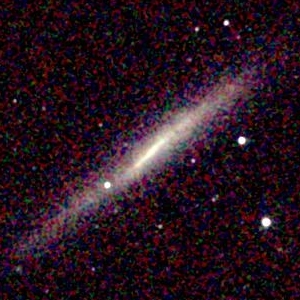
NGC 7090 is a spiral galaxy visible from the southern hemisphere that lies in the constellation Indus. At optical wavelengths it appears nearly edge-on, presenting a thin disk and lanes of obscuring dust that silhouette against the starlight. The galaxy is one of the nearer examples of a late-type spiral and serves as a useful target for studies of disk structure and star-forming regions.
Image gallery
4 Images


Characteristics
Observed properties include a flattened, disk-like shape seen at high inclination, bright knots associated with star formation, and dust features tracing the plane. Emission from the galaxy has been examined across optical, infrared and radio bands to map young stellar populations and the interstellar medium. Its proximity makes it easier to resolve individual H II regions and dust lanes than more distant spirals.
Location and distance
NGC 7090 lies in the southern constellation of Indus. Modern estimates place it at about 30 million light-years from Earth (roughly 9 megaparsecs), a distance that situates it among nearby galaxies accessible to medium-sized telescopes. For general reference, further information is available from catalog entries such as NGC 7090 data and constellation guides like Indus.
Observation and scientific importance
Because it is edge-on, NGC 7090 is especially valuable for examining vertical structure in galactic disks, the distribution of dust, and extraplanar ionized gas. Studies using H-alpha, ultraviolet and infrared observations aim to quantify star formation rates and how feedback from young stars influences surrounding gas. The galaxy is listed in classical catalogs compiled in the 19th and 20th centuries and appears in many modern surveys.
- Constellation: Indus.
- Distance: about 30 million light-years.
- Orientation: seen nearly edge-on, useful for disk and dust studies.
NGC 7090 is representative of nearby late-type spirals used to compare resolved star-forming structures with those in the Milky Way and other galaxies. Its relative closeness and edge-on appearance make it a frequent subject of imaging and spectroscopic follow-up when researchers investigate how star formation and interstellar material are organized in thin galactic disks.
Related articles
Author
AlegsaOnline.com NGC 7090 — an edge-on spiral galaxy in Indus Leandro Alegsa
URL: https://en.alegsaonline.com/art/69879