
Never Gonna Give You Up
1987 dance-pop single by Rick Astley, produced by Stock Aitken Waterman; a global chart hit and later the centerpiece of the rickrolling internet meme.
Overview
"Never Gonna Give You Up" is a dance-pop song first recorded by English singer Rick Astley and released in 1987. Written and produced by the British team Stock Aitken Waterman, it was issued as a single from Astley’s debut album, Whenever You Need Somebody. The track's combination of a memorable chorus, polished 1980s production and Astley’s distinctive baritone helped it become an immediate commercial success.
Image gallery
2 Images
Writing and production
The song was developed within the hit‑making pop factory atmosphere that characterized Stock Aitken Waterman’s work in the mid‑1980s. Musically it uses synthesized percussion and keyboard hooks common to mainstream dance‑pop of that era. Lyrically it expresses a straightforward promise of devotion and reliability, delivered in a direct, singable style that contributed to its broad radio appeal.
Release and reception
Released as a commercial single, the recording became a worldwide hit and established Astley as an international pop artist. In the United Kingdom it reached number one and held that position for five weeks, becoming one of the year’s best‑selling singles. The song also performed strongly in many other territories and received heavy airplay, though precise chart detail varies by country and source.
Music video and internet phenomenon
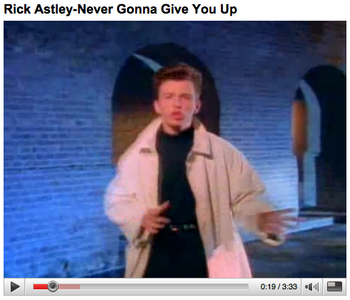
The promotional clip for the track, often referenced simply as the music video, is a straightforward performance and location video typical of the period. Beginning in the mid‑2000s the video acquired a new cultural role through the online prank known as rickrolling, in which people are unexpectedly redirected to the clip. That practice turned the recording into a persistent element of internet culture and a widely recognized meme, giving the song renewed visibility decades after its initial release.
Legacy and cultural impact
- The song is often cited as an emblematic example of late‑1980s pop production and of Astley’s vocal identity.
- Its later life online led to references and uses in television shows, advertising, public stunts and live events, reflecting how older media can be recontextualized by digital culture.
- Astley has performed the song in many live settings since its release; the track is regularly included in retrospectives of 1980s pop and in compilations of well‑known singles from that decade.
Performances, covers and credits
Over the years the recording has been covered, sampled and parodied in a variety of styles; these interpretations, along with Astley’s own live performances, have helped maintain the song’s presence in public awareness. Production and songwriting credit is generally given to Stock Aitken Waterman, with Astley as the recording artist. For listeners and students of pop music, the track illustrates both the commercial sound of its moment and the ways a single song can acquire layered meanings across different cultural periods.
The history of this recording therefore spans conventional commercial success and an unusual second act online, making it a notable case study in popular music and media reception.
Further reading and archival material can be found through music databases and retrospectives that discuss the recording, its makers, and the later phenomenon of rickrolling as an example of viral reuse of popular culture.
Music Sales Awards
| Country/Region | Awards for music sales | Sales |
|
|
| 45.000 |
|
|
| 250.000 |
|
|
| 250.000 |
|
| 50.000 | |
|
|
| 100.000 |
|
|
| 25.000 |
|
| 500.000 | |
|
| 500.000 | |
| Total |
| 1.720.000 |


Questions and answers
Q: Who originally made the song "Never Gonna Give You Up"?
A: Rick Astley originally made the song "Never Gonna Give You Up".
Q: From which album was "Never Gonna Give You Up" released as a single?
A: "Never Gonna Give You Up" was released as a single from Astley's multi-million selling debut album, Whenever You Need Somebody.
Q: Who wrote and produced the album Whenever You Need Somebody?
A: The album Whenever You Need Somebody was written and produced by Stock Aitken Waterman.
Q: In which year was "Never Gonna Give You Up" a worldwide number-one hit?
A: "Never Gonna Give You Up" was a worldwide number-one hit in 1987.
Q: How long did the song stay at number one in the UK?
A: The song stayed at number one in the singer's native United Kingdom for five weeks.
Q: What was the best-selling single of 1987?
A: "Never Gonna Give You Up" was the best-selling single of 1987.
Q: What is the music video for "Never Gonna Give You Up" known for becoming the basis of?
A: The music video for "Never Gonna Give You Up" has become the basis for the "Rickrolling" internet meme.
Related articles
Author
AlegsaOnline.com Never Gonna Give You Up Leandro Alegsa
URL: https://en.alegsaonline.com/art/69430
Sources
- cria.ca : cria.ca
- chartsinfrance.net : Chartsinfrance.net
- musikindustrie.de : musikindustrie.de
- ifpi.se : Ifpi.se
- bpi.co.uk : Bpi.co.uk
- riaa.com : riaa.com
- lescharts.com : "Rick Astley - Never Gonna Give You Up"
- radio538.nl : "De Nederlandse Top 40, week 41, 1987"
- charts-surfer.de : "Suchergebnis"
- irishcharts.ie : "The Irish Charts - All there is to know"
- hitparadeitalia.it : "Hit Parade Italia - Top Annuali Single: 1987"
- everyhit.com : "Top 40 Hits of Late August 1987"
- allmusic.com : "Rick Astley"
- hitparade.ch : "1987 Swiss Singles Chart"
- aria.com.au : "Top 50 Singles 1988"