
Nepal Standard Time (NPT)
Nepal Standard Time (NPT) is the civil time for Nepal, set at UTC+05:45 to approximate Kathmandu mean time. It is one of the few time zones with a 45-minute offset and does not use daylight saving.
Nepal Standard Time (NPT) is the official time used across the country of Nepal. It is defined as five hours and forty-five minutes ahead of Coordinated Universal Time (UTC), written UTC+05:45. This offset was chosen to approximate the local mean solar time for Kathmandu, which lies slightly west of that meridian; Kathmandu mean time is roughly UTC+05:41:16.
Image gallery
1 Image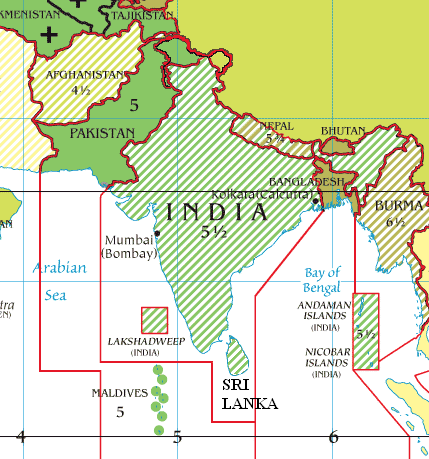
Characteristics
NPT is unusual because it uses a 45-minute offset rather than whole hours or half hours. When it is 12:00 UTC, Nepal Standard Time is 17:45. Nepal does not observe daylight saving time, so this offset remains constant throughout the year. Timekeeping systems and digital devices typically represent the zone using the IANA time zone identifier "Asia/Kathmandu" and convert times with the fixed +5:45 offset.
History and adoption
The offset was established to provide a single, country-wide civil time that aligns closely with the solar time of the national capital. Selecting an offset offset from UTC that reflected Kathmandu's longitude reduced the daily discrepancy between clock time and apparent solar time for most of the populated areas. The decision created a uniform standard for administration, transportation, broadcasting and public life.
Uses and practical effects
NPT is used for all official, commercial and social scheduling in Nepal. It affects international travel, aviation, telecommunications and software scheduling. Because the offset differs by 15 minutes from neighboring India (UTC+05:30) and by 15 minutes from Bangladesh (UTC+06:00), cross-border coordination requires attention to quarter-hour differences. Time servers and databases typically list the zone under the Asia region; see related technical references via time zone resources.
- Offset: UTC+05:45 (fixed)
- No daylight saving time
- IANA zone name: Asia/Kathmandu
Notable facts and comparisons
NPT is one of only a very small number of time zones worldwide that use a 45-minute increment. Others include Chatham Island Standard Time (UTC+12:45) and an unofficial Australian Central Western Time (UTC+08:45). For further context about neighboring systems and unusual offsets, see general overviews of time zones and regional practice via Australian Central Western Time and additional references at UTC information and local Kathmandu resources. Technical and scheduling guidelines are available through time authorities and regional timekeeping documentation (country information).
Questions and answers
Q: What is Nepal Standard Time?
A: Nepal Standard Time (NPT) is the time zone for Nepal.
Q: What is the time offset of Nepal Standard Time from Coordinated Universal Time (UTC)?
A: The time offset of Nepal Standard Time from Coordinated Universal Time (UTC) is +5:45.
Q: How does Nepal Standard Time compare to other time zones in terms of offset from UTC?
A: Nepal Standard Time is one of three time zones with a 45-minute offset from UTC, the others being Chatham Island Standard Time and the unofficial Australian Central Western Time.
Q: What is the significance of the time offset of Nepal Standard Time?
A: The time offset of Nepal Standard Time is unique and not commonly used.
Q: How is Nepal Standard Time calculated?
A: Nepal Standard Time is an approximation of Kathmandu mean time, which is 5:41:16 ahead of UTC.
Q: What is the time difference between Nepal Standard Time and UTC?
A: The time difference between Nepal Standard Time and UTC is 5 hours and 45 minutes.
Q: What is the purpose of having different time zones?
A: Different time zones enable people in different parts of the world to coordinate activities and schedules based on their local time. It helps to avoid confusion and ensure that people are not working in the middle of the night or sleeping during the day.
Related articles
Author
AlegsaOnline.com Nepal Standard Time (NPT) Leandro Alegsa
URL: https://en.alegsaonline.com/art/69176
Sources
- bna.com : "A Brief Legal History of Time: Part One of Two"
- nepalitimes.com.np : "15 minutes of fame"