
Mundari language
Mundari is an Austroasiatic language of the Munda branch, spoken by the Munda people in eastern India. It has oral traditions, several regional varieties, and efforts exist to maintain its use and script.
The Mundari language is a member of the Munda branch of the Austroasiatic family. It is the traditional language of the Munda people and is concentrated in central-eastern India. While largely transmitted orally, Mundari remains an important marker of cultural identity and is used in everyday conversation, folklore and ritual contexts.
Image gallery
3 Images

Geographic distribution and speakers
Mundari is spoken across parts of Jharkhand, Odisha, West Bengal, Chhattisgarh and adjacent areas of Bihar. Speakers are often multilingual, using regional state languages such as Hindi, Bengali or Odia for education, administration and wider communication. The language exists in several regional varieties that differ in pronunciation and some vocabulary but form a recognizable linguistic group.
Linguistic characteristics
Mundari displays features typical of Munda languages. It largely follows a subject–object–verb (SOV) order and is morphologically rich, using affixation to mark grammatical relations. Nouns and verbs show a range of suffixes for number, case and aspect, and verbs encode person and tense-aspect distinctions. Phonology and specific grammatical patterns vary across varieties, but the language is generally described as agglutinative with productive word formation.
Writing, literature and media
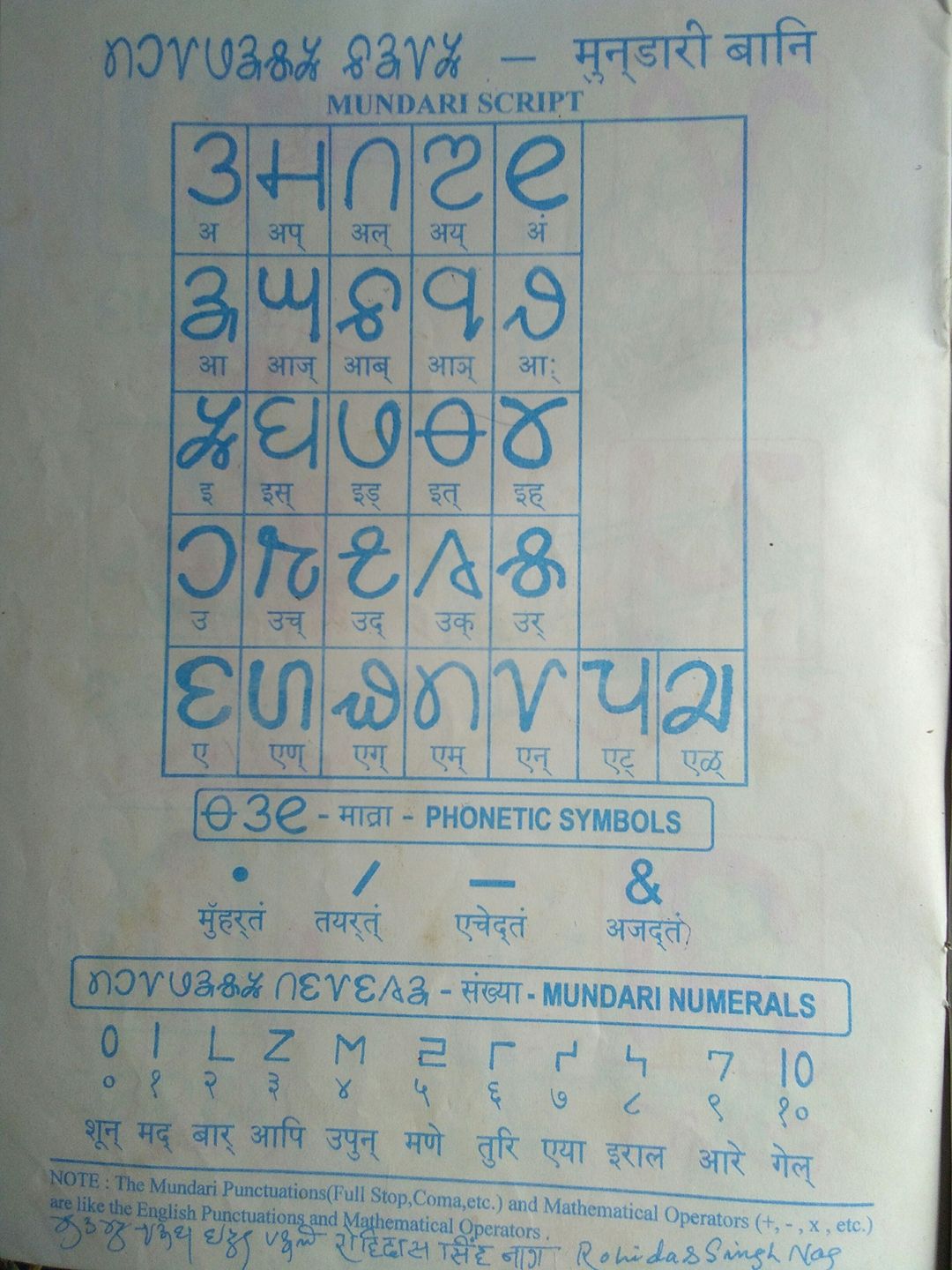
Traditionally an oral language, Mundari now appears in several scripts. In addition to adaptations of regional scripts (Devanagari, Odia and Latin-based orthographies), a script known as Mundari Bani was developed for the language in the late 20th century. Written use remains limited compared with oral practice, but there are growing efforts to record folktales, songs and educational materials in Mundari.
Origins and relationships
As part of the Austroasiatic family, Mundari is related to other Munda languages such as Santali and Ho and more distantly to Austroasiatic languages of Southeast Asia. Historical and linguistic evidence suggests that the Munda branch represents an early movement of Austroasiatic-speaking communities into the Indian subcontinent, though the precise details and timing are subjects of ongoing research.
Status and cultural importance
Mundari remains central to social and ritual life among its speakers, but pressures from dominant regional languages have reduced monolingual communities in many areas. Community-led education, documentation projects and the use of distinct orthographies aim to strengthen transmission to younger generations. The language’s role in expressing traditional knowledge, oral literature and group identity makes its maintenance culturally significant.
- Key features: SOV order, agglutinative morphology, rich suffixation.
- Main regions: Jharkhand, Odisha, West Bengal, Chhattisgarh, Bihar.
- Writing: primarily oral, Mundari Bani and adaptations of regional alphabets.
Related articles
Author
AlegsaOnline.com Mundari language Leandro Alegsa
URL: https://en.alegsaonline.com/art/67523
Sources
- censusindia.gov.in : "Statement 1: Abstract of speakers' strength of languages and mother tongues - 2011"
- glottolog.org : "Mundari"