
Monte Carlo algorithm
A Monte Carlo algorithm uses randomness and statistical sampling to estimate solutions for problems that are difficult or impossible to solve deterministically. Common in simulation, integration and probabilistic modeling.
The Monte Carlo algorithm family refers to computational methods that employ random sampling and probability to estimate numerical results. Rather than producing an exact symbolic solution, a Monte Carlo approach runs many randomized trials and uses their statistical aggregate as an approximation. These algorithms are valued for solving problems with high dimensionality, complex geometry, or stochastic inputs where deterministic algorithms are inefficient or unavailable. Overview and basics computational context
Image gallery
7 Images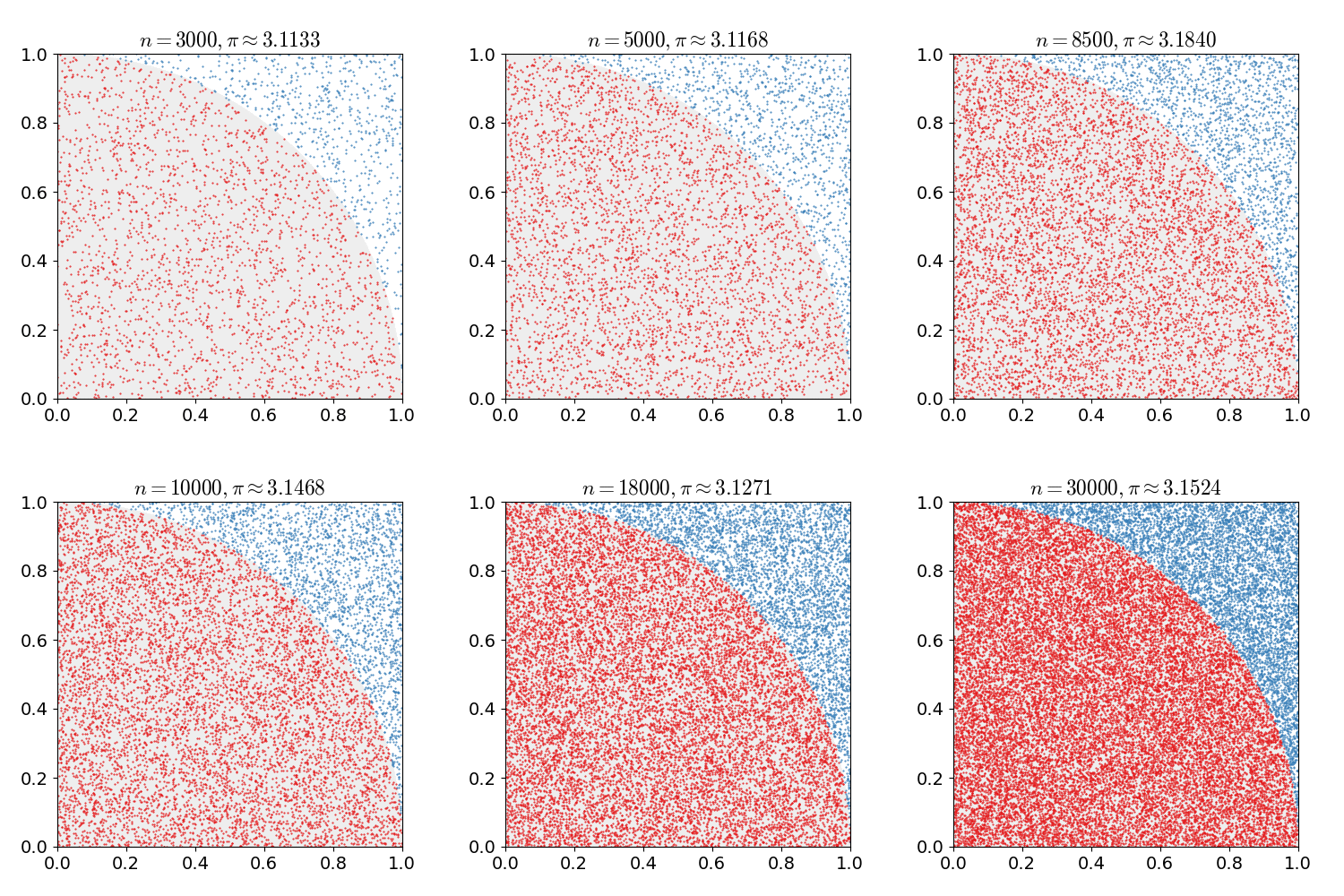


Key characteristics and components
Monte Carlo methods replace fixed inputs with probability distributions and generate an output distribution from repeated sampling. Each run uses pseudo-random or quasi-random numbers and records outcomes to build empirical estimates of quantities of interest. Error typically decreases as the inverse square root of the number of samples, so improving precision often requires many trials. Common elements include random number generation, sampling design, aggregation of results, and uncertainty quantification. For introductions and technical material, see introductory notes and randomness sources.
Techniques and variance reduction
Practical Monte Carlo work relies on techniques that improve accuracy without a proportional increase in sample count. These include:
- Importance sampling — biasing samples toward more influential regions and reweighting to reduce variance.
- Stratified sampling — partitioning the input space and sampling each stratum separately.
- Antithetic variates — using negatively correlated samples to cancel noise.
- Control variates — leveraging known quantities to improve estimates.
Readers seeking algorithmic descriptions and code patterns may consult statistical references and computational guides.
History and development
The Monte Carlo idea emerged in the mid-20th century as scientists sought practical ways to model complex physical processes. Early proponents at Los Alamos used random sampling to study neutron transport and nuclear interactions; Stanislaw Ulam and collaborators framed the approach in the 1940s and early 1950s. Subsequent developments produced structured variants, most notably Markov chain Monte Carlo (MCMC), which builds dependent samples via stochastic transitions. The Metropolis algorithm and later Metropolis–Hastings extensions formalized this class; for historical accounts see historical notes and MCMC origins.
Applications and examples
Monte Carlo algorithms appear across science, engineering and finance. Typical uses include numerical integration in many dimensions, solving integral equations, option pricing and risk analysis in finance, radiation transport in physics, and Bayesian inference in statistics via MCMC. A simple pedagogical example is estimating π by sampling points in a unit square and checking how many fall inside a quarter circle; the fraction approximates the circle’s area ratio. Communications engineers also use Monte Carlo simulation to model noise effects, such as additive white Gaussian noise, when analyzing system performance; see communications simulation and noise modeling.
Variants, trade-offs and notable facts
Monte Carlo algorithms are probabilistic: some yield answers that are correct with high probability (Monte Carlo proper), while others, called Las Vegas algorithms, always produce a correct result but with random execution time. A related deterministic alternative, quasi-Monte Carlo, uses low-discrepancy sequences to improve convergence in many integration problems. For technical distinctions and advanced methods consult algorithmic literature and method comparisons. Monte Carlo remains a flexible, widely used toolkit whenever uncertainty, complexity, or dimensionality make exact methods impractical.
Related articles
Author
AlegsaOnline.com Monte Carlo algorithm Leandro Alegsa
URL: https://en.alegsaonline.com/art/66285