
Multiplication table: definition, structure, history and educational uses
An overview of the multiplication table: what it is, common layouts and patterns, historical origins, uses in teaching and arithmetic, and notable properties such as symmetry and square numbers.
A multiplication table is a tabular arrangement that displays the products of pairs of numbers. It is most often used to learn and quickly recall the result of multiplying two integers. Typical classroom versions list products for factors from 1 up to 10 or 12, but tables can be extended to any range. The table both records results and highlights regular patterns in multiplication, making it a compact reference and a teaching tool.
Image gallery
10 Images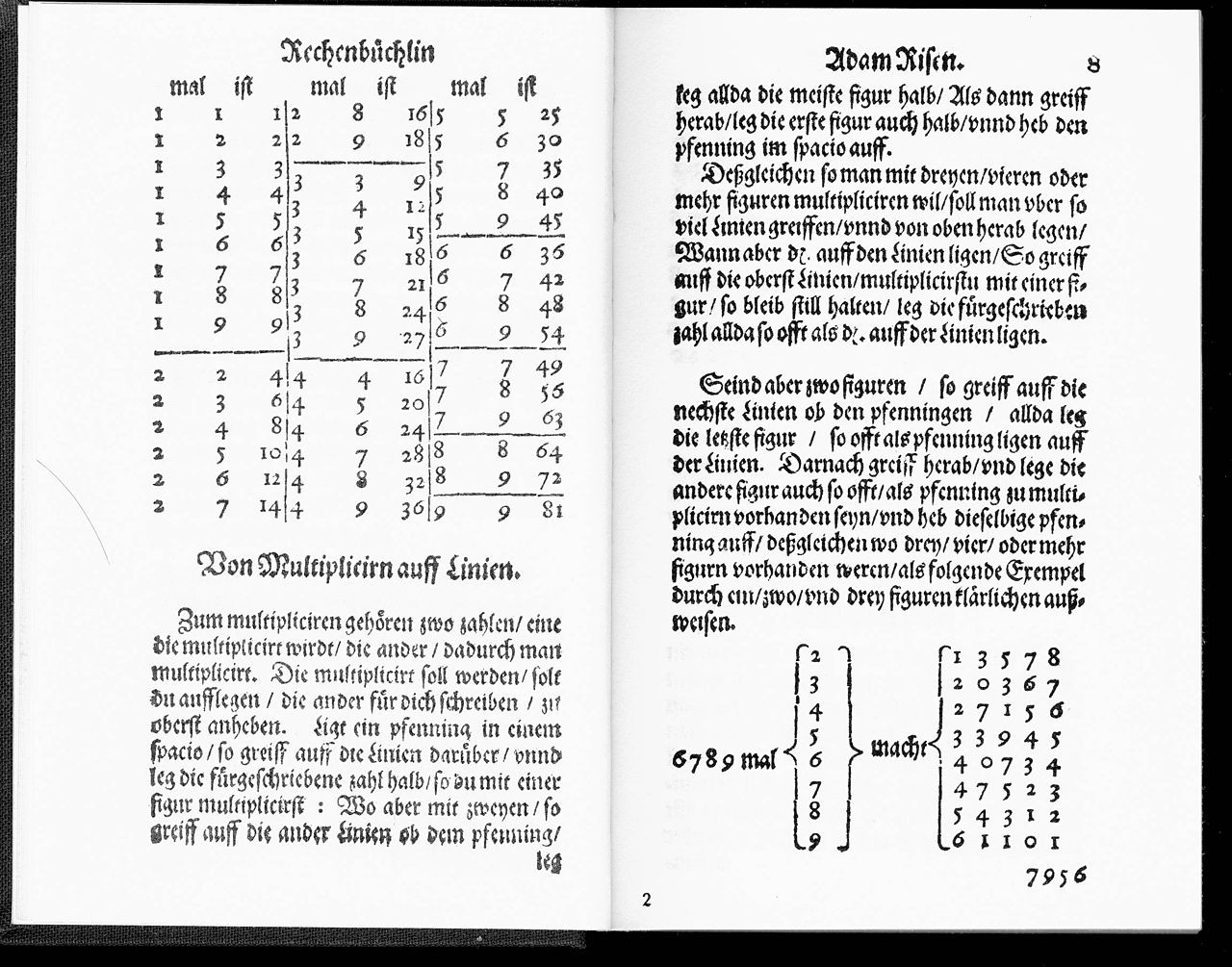


Structure and basic properties
The table is organized with one set of factors across the top row and another down the first column. A cell where row and column meet contains their product. Because multiplication is commutative (a × b = b × a), the table is symmetric across its main diagonal. That diagonal itself shows the square numbers (numbers multiplied by themselves) and is often emphasized when teaching. The table also makes it easy to spot multiples, factors and simple divisibility patterns.
Common patterns and simple techniques
- Symmetry: the upper-right triangle mirrors the lower-left triangle.
- Squares: entries like 4×4, 5×5 lie on the diagonal and identify perfect squares.
- Multiples of 10: end in zero, easy to extend by appending a zero.
- Rules of 2, 5 and 10 are straightforward (doubling; ending in 0 or 5).
- Tricks: for the 9×n table there are simple finger or subtraction methods that help mental recall.
History and development
Recording multiplication products has a long history. The earliest known tables are very old—records from Mesopotamia show that scribes compiled multiplication lists thousands of years ago. For example, scholars note multiplication tables among Babylonian clay tablets, which were used for calculation and teaching Babylonians. Over time, different cultures developed compact tabular forms and mnemonic methods; in Europe a rectangular multiplication chart is sometimes called a Pythagorean table because it was studied in antiquity and in medieval arithmetic texts.
Educational use and examples
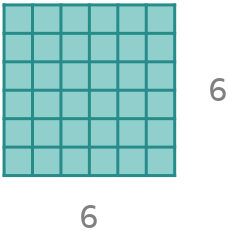
Multiplication tables are central to elementary arithmetic instruction. Teachers often expect students to memorize the tables up to 10×10 or 12×12 so that more complex calculations can be performed mentally or reduced to simpler steps. Beyond rote memorization, teachers use the table to explain concepts such as repeated addition, the area model of multiplication, and how multiplication relates to division and factors.
As an example of reading the table: to find 21 × 18 you locate 21 in the column and 18 in the row (or vice-versa); the intersecting cell gives the product 378. The diagonal entries can be highlighted to show squares; some editions of the table mark those numbers in bold to make that property obvious squares.
Variants, extensions and notable facts
There are many pedagogical and computational variations. The lattice (or gelosia) method and the area model use the table concept to break larger multiplications into grid cells. In modern classrooms, digital tools and calculators reduce the need to consult printed tables, but educators still value the table for building number sense. Studies of learning errors sometimes identify particular cells—like 6×8—as commonly misremembered, which influences how teachers sequence practice.
In summary, the multiplication table is both a historical artifact and a practical learning device. It organizes multiplication results, reveals algebraic and arithmetic patterns, and remains a foundational resource for early mathematics education.
Related articles
Author
AlegsaOnline.com Multiplication table: definition, structure, history and educational uses Leandro Alegsa
URL: https://en.alegsaonline.com/art/67485
Sources
- nature.com : "Ancient times table hidden in Chinese bamboo strips"
- doi.org : 10.1038/nature.2014.14482