
Moment of inertia
Measure of an object's resistance to changes in its rotation; depends on mass distribution and axis. Expressed in kg·m² and used in mechanics, engineering, and dynamics.
The moment of inertia is a scalar or tensor quantity that measures how difficult it is to change the rotational motion of a body about a chosen axis. It is often described as the rotational analogue of mass: a larger moment of inertia means a body resists angular acceleration more strongly. In the SI system the unit is kilogram square metre (kg·m2). The concept links the body's distributed mass and the distances of its parts from the axis of rotation.
Image gallery
10 Images






Mathematical definition and basic properties
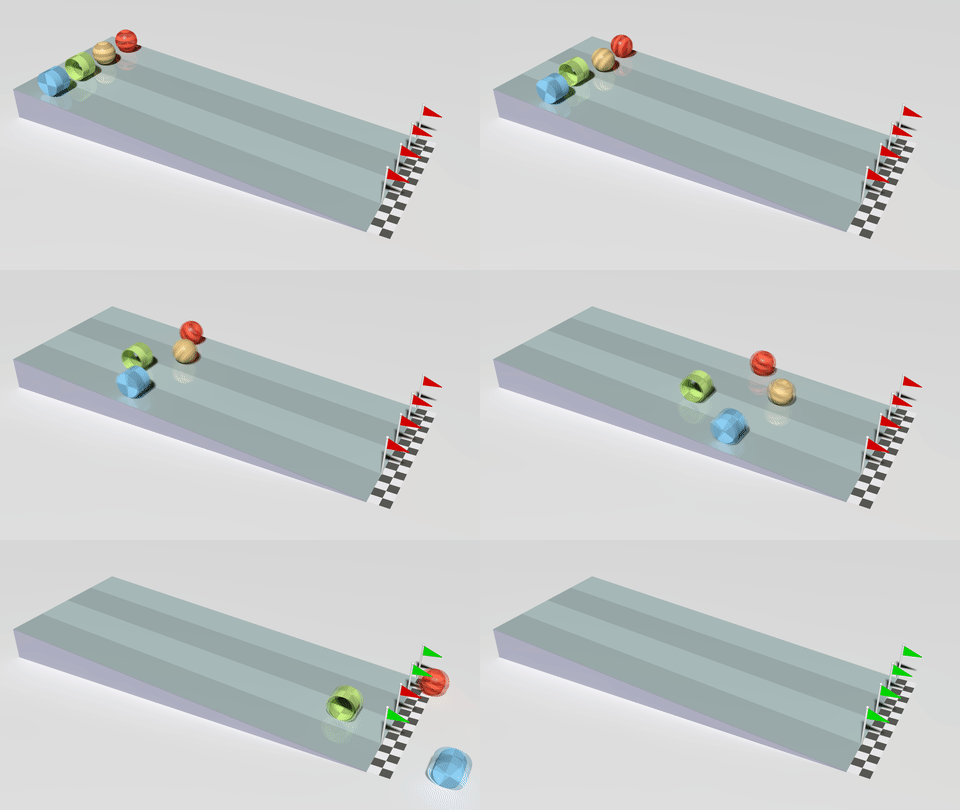
For a discrete set of particles the moment of inertia about a specified axis is the sum I = \u03a3 m_i r_i^2, where m_i are point masses and r_i are their perpendicular distances to the axis. For a continuous body this generalises to the integral form I = \u222b r^2 dm, integrating r^2 over the mass distribution. The dependence on the square of distance means that mass far from the axis contributes disproportionately. This is why two objects with the same total mass can have very different moments of inertia.
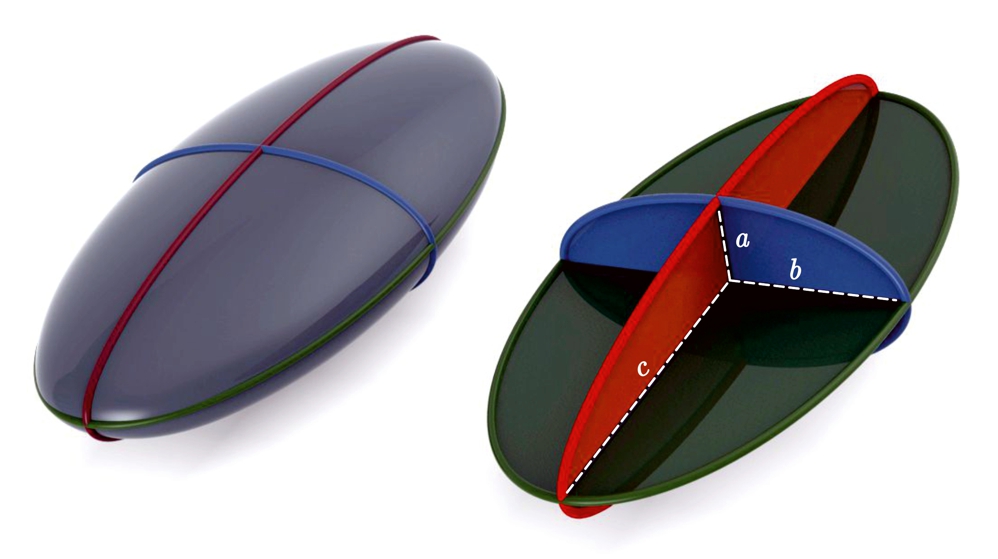
Because orientation matters, the moment of inertia is properly treated as a second-order tensor for general three-dimensional bodies; diagonalising that tensor yields principal moments about mutually perpendicular principal axes. Important relations include the parallel-axis theorem (also called Steiner's theorem), I = I_cm + M d^2, which shifts an axis by distance d, and the perpendicular-axis theorem for flat laminae, Iz = Ix + Iy.
Common formulas and examples
- Thin rod about centre (perpendicular to length): I = (1/12) M L^2.
- Thin rod about end: I = (1/3) M L^2.
- Solid cylinder about its symmetry axis: I = (1/2) M R^2.
- Thin spherical shell: I = (2/3) M R^2; solid sphere: I = (2/5) M R^2.
- Rectangular plate about central axis normal to plane: I = (1/12) M (a^2 + b^2).
These closed‑form expressions are widely used in engineering and physics to estimate rotational behaviour for common geometries. When shapes are complex, numerical integration, finite element analysis, or CAD tools compute the inertia tensor.
In dynamics the moment of inertia appears directly in Newtonian rotation laws: torque equals moment of inertia times angular acceleration, τ = I α, and the rotational kinetic energy is K = (1/2) I ω^2. A body with larger I requires more torque to achieve the same angular acceleration. Because I depends on the axis, careful selection of pivot points and mass distribution is fundamental in mechanical design, robotics, vehicle dynamics, and aerospace.
The idea developed historically from studies of pendulums and rigid body motion; mathematicians and physicists formalised it in the theory of classical mechanics. Practical measurement methods include torsion pendulum tests and balancing procedures. Distinct from scalar mass, the moment of inertia encodes geometry: designers alter shapes or redistribute mass to tune rotational response and stability, reduce vibrations, or optimise energy use.
For further conceptual context see discussions of inertia, the mechanics of rotation, measures of mass, and geometric definitions of radius. Computational and experimental resources are available for applied calculations and advanced tensor analysis. Inertia and its rotational role remain central to understanding and engineering moving systems.
Questions and answers
Q: What is moment of inertia?
A: Moment of inertia is the inertia of a rotating body with respect to its rotation.
Q: What is another name for moment of inertia?
A: Another name for moment of inertia is "angular mass".
Q: What is the unit of measurement for moment of inertia?
A: The unit of measurement for moment of inertia is kg·m2.
Q: What is the significance of moment of inertia?
A: Moment of inertia represents a rotating body's resistance to angular acceleration or deceleration.
Q: What is the equation for calculating moment of inertia?
A: The equation for calculating moment of inertia is I = mr^2, where m is the mass of the rotating body and r is the radius measured perpendicularly to the axis of rotation.
Q: How does the mass affect moment of inertia?
A: The mass of the rotating body affects moment of inertia directly, as it is a part of the equation for calculating moment of inertia.
Q: How does the radius affect moment of inertia?
A: The radius of the rotating body affects moment of inertia indirectly, as it is multiplied by the square of its value in the equation for calculating moment of inertia.
Related articles
Author
AlegsaOnline.com Moment of inertia Leandro Alegsa
URL: https://en.alegsaonline.com/art/65911
Sources
- books.google.com : Feedback Control Theory for Engineers