
Ashoka: Mauryan emperor, promoter of Dhamma, and legacy in India
Ashoka (c. 268–232 BCE) was a Mauryan emperor whose conversion after the Kalinga War shaped his rule, inscriptions, public works and the spread of Buddhism across Asia. His symbols endure in modern India.
Emperor Ashoka (reigned c. 268–232 BCE) is one of ancient India's best-known rulers. A grandson of the Mauryan dynasty's founder and the son of Bindusara, Ashoka extended Mauryan control over much of the subcontinent before adopting a policy of moral governance often described by the Pali term Dhamma. His reign is documented by a network of stone inscriptions and monumental pillars carved across South Asia, which record his ideals, public measures and administrative directives.
Image gallery
10 Images




Early life and rise to power
Ashoka came to the throne after a period of consolidation and conflict within the Mauryan empire. The dynasty had created a centralized state with a sophisticated bureaucracy and standing army. By the time Ashoka became emperor, the Mauryan realm already controlled large territories and had contacts with contemporary Hellenistic kingdoms to the west and regional states in the east. Modern sources and his own inscriptions indicate that Ashoka was an energetic military leader before the events that shifted his priorities.
Kalinga War and turning point
The conquest of Kalinga (in present-day Odisha) is widely cited as the watershed moment of Ashoka's life. Contemporary inscriptions attributed to Ashoka describe the severe human cost and suffering caused by the campaign and express his remorse at the consequences of violent conquest. After this experience he embraced Buddhist principles more openly and sought to shape state policy around moral welfare rather than expansion by force. While some details of casualties and deportations are debated by historians, Ashoka's own edictal record makes clear that the war affected his outlook profoundly.
Policies, public works and administration
Ashoka promoted an ethical program called Dhamma (often translated as "the law of righteousness" or "moral way") that emphasized non-violence, respect for living beings, truthfulness, compassion and social welfare. He did not impose a single religious orthodoxy but supported Buddhist monks and institutions while urging tolerance among different communities. Archaeological and inscriptional evidence credits his government with practical public works and reforms, such as:
- Establishment of hospitals and care for humans and animals, and support for medical practitioners.
- Construction of rest-houses, wells and shaded wayside trees to ease travel and commerce.
- Instructions for officials (dhamma-mahamattas) to promote moral education and mediate disputes.
- Patronage of Buddhist establishments — including stupas and monasteries — while encouraging ethical behavior across faiths.
Inscriptions, monuments and symbolism
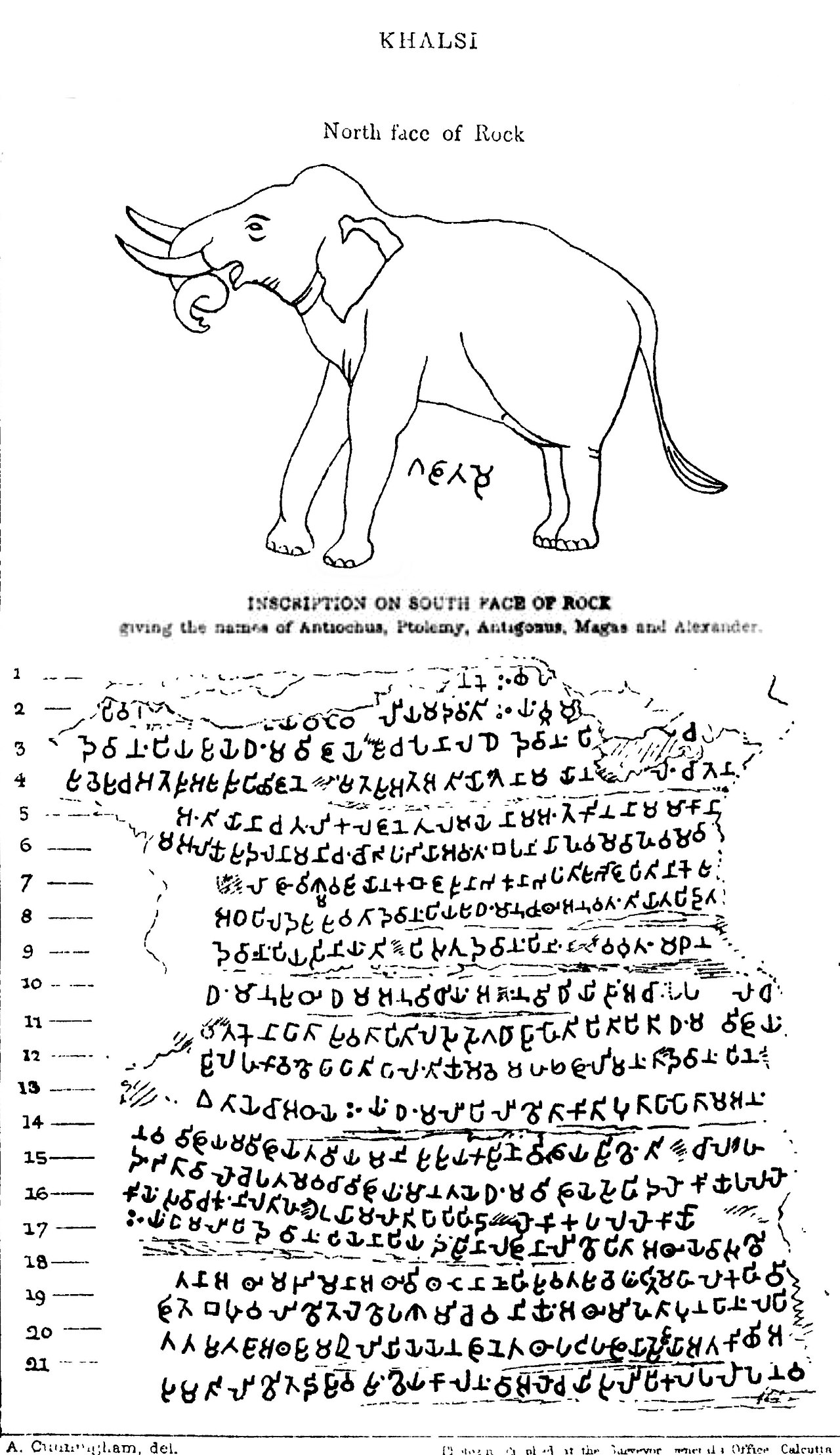
Ashoka's message survives primarily in a corpus of inscriptions carved on rocks and freestanding pillars found across the subcontinent and beyond. These edicts, written mainly in Prakrit in the Brahmi script (with some bilingual texts near western frontiers), were intended for wide public reading. The most famous sculptural legacy is the lion capital from one of Ashoka's pillars; its stylized wheel or chakra motif later inspired the Ashoka Chakra, which appears on the modern Indian flag, and the lion capital became the national emblem of India. Several architectural sites, such as the great stupa at Sanchi and other Buddhist monuments, are associated with Ashokan patronage or later expansion of foundations he supported.
Spread of Buddhism and diplomatic contacts
Following his conversion, Ashoka is traditionally credited with supporting missionary activity that carried Buddhist teachers to neighboring regions. Historical and later religious sources describe missions to Sri Lanka and parts of Central and Southeast Asia, and Ashoka's inscriptions indicate communication with several contemporary foreign polities. His support contributed to Buddhism's institutional growth and its transmission along trade routes across Asia.
Legacy and modern reception
Ashoka's image has been reshaped over centuries: in South Asian traditions he is remembered as a wise, moral ruler and a patron of Buddhism; in modern times his inscriptions have been studied as early examples of governmental communication and moral reform. His pillars and edicts are key archaeological evidence for understanding Mauryan administration, imperial ideology and the early spread of Buddhism. Symbols associated with him — the lion capital and the wheel — have been adopted into national iconography and remain potent reminders of his historical influence. For further reading on the Mauryan context and Ashoka's inscriptions, see resources on the Mauryan dynasty and Ashoka's edicts: Mauryan dynasty overview and Ashoka and his edicts.
Related articles
Author
AlegsaOnline.com Ashoka: Mauryan emperor, promoter of Dhamma, and legacy in India Leandro Alegsa
URL: https://en.alegsaonline.com/art/6588
Sources
- kamat.com : "Emperor Ashoka and Spread of Buddhism"
- wikidata.org : wikidata.org/wiki/Q8589
- authority.bibsys.no : 90658787
- catalogue.bnf.fr : cb12145542z
- data.bnf.fr : (data)
- d-nb.info : 118504703
- isni.org : 0000 0001 1477 1875
- id.loc.gov : n50002053
- aleph.nkp.cz : xx0004667
- uli.nli.org.il : 000012406
- data.bibliotheken.nl : 069820724
- idref.fr : 029935318
- trove.nla.gov.au : 1081053
- viaf.org : 300985478
- worldcat.org : lccn-n50002053