
Minesweeper (video game)
Minesweeper is a single-player logic puzzle video game in which players clear a grid of hidden mines using numeric clues. It has been bundled with many desktop systems and exists in many variants.
Overview
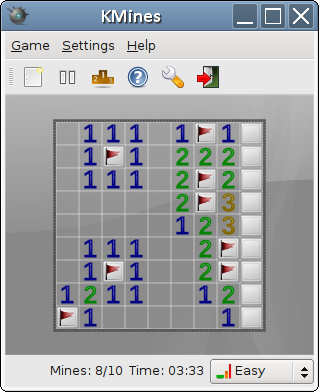
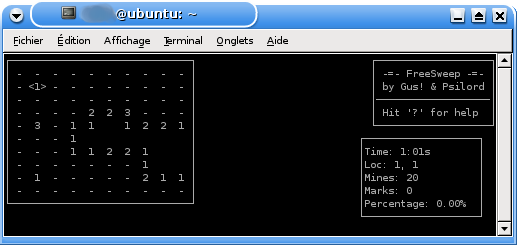
Minesweeper is a single-player puzzle game in which the player clears a rectangular grid of covered squares while avoiding hidden mines. Revealing a square either exposes a mine (and ends the game) or shows a number indicating how many mines lie in the surrounding eight squares. Numbers and revealed empty regions allow logical deduction to mark likely mine locations and safely uncover the rest of the field.
Image gallery
10 Images




Basic mechanics
The core rules are simple and consistent across most versions. Left-click (or tap) uncovers a square; right-click flags a suspected mine; flagged squares are ignored for safe-reveal operations. A blank (zero) square typically expands automatically to reveal adjacent squares. Modern implementations often include a safety rule that the first click cannot hit a mine.
- Numbers: Each revealed number counts mines in all eight neighboring cells.
- Flags: Players can mark suspected mines to avoid uncovering them accidentally.
- Chording: A middle-click or simultaneous left+right click can reveal surrounding squares when the correct flags are placed.
Difficulty presets and variants
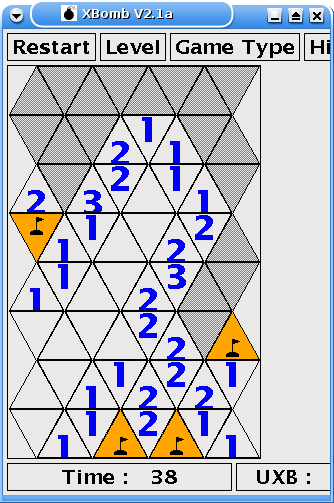
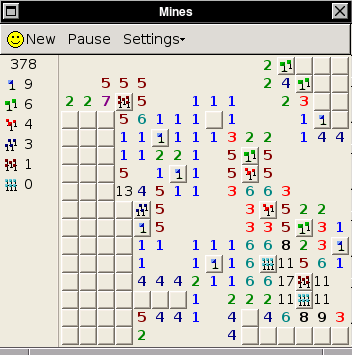
Standard desktop versions commonly offer difficulty presets with typical grid sizes and mine counts: Beginner, Intermediate and Expert. Commonly cited presets include 9×9 with 10 mines, 16×16 with 40 mines, and 30×16 with 99 mines. Variants change board shape, mine density, or add mechanics such as multiple mine types, progressive levels, or real-time elements for mobile and web play.
Strategy, puzzles and complexity
Minesweeper emphasizes deduction over reflexes: players use local constraints to infer where mines must or cannot be. Some positions force guessing because local information is insufficient; probabilistic reasoning becomes necessary. From a computational perspective, several decision problems derived from Minesweeper have been shown to be algorithmically hard, which explains why constructing perfect solvers can be challenging.
History, distribution and versions
Minesweeper traces its roots to early computer puzzle programs and became widely known after being bundled with many desktop operating systems in the late 20th century. Since then it has been implemented on numerous platforms: desktop environments, mobile apps, web browsers, and dedicated puzzle sites. Different editions add features such as leaderboards, timed scoring, themed skins, and accessibility options.
Uses, community and notable facts
Beyond casual play, Minesweeper is used as a teaching example for logic, probability and algorithmic thinking. Competitive players pursue fast completion times and low-mistake solutions; online communities publish records and solving techniques. For reference reading and versions see rules and tips, historical notes, and platform releases. For implementations and puzzles consult open-source projects, community archives at puzzle repositories, or collections and apps listed at application stores and dedicated fan sites.
Minesweeper remains a compact, enduring puzzle: simple to learn, often hard to master, and widely reproduced in many digital forms.
Related articles
Author
AlegsaOnline.com Minesweeper (video game) Leandro Alegsa
URL: https://en.alegsaonline.com/art/65183