
Milky Way–Andromeda collision
The predicted merger of the Milky Way and Andromeda galaxies in about four billion years: observations, dynamics, stages, and likely consequences for stars, gas, and the Local Group.
Overview
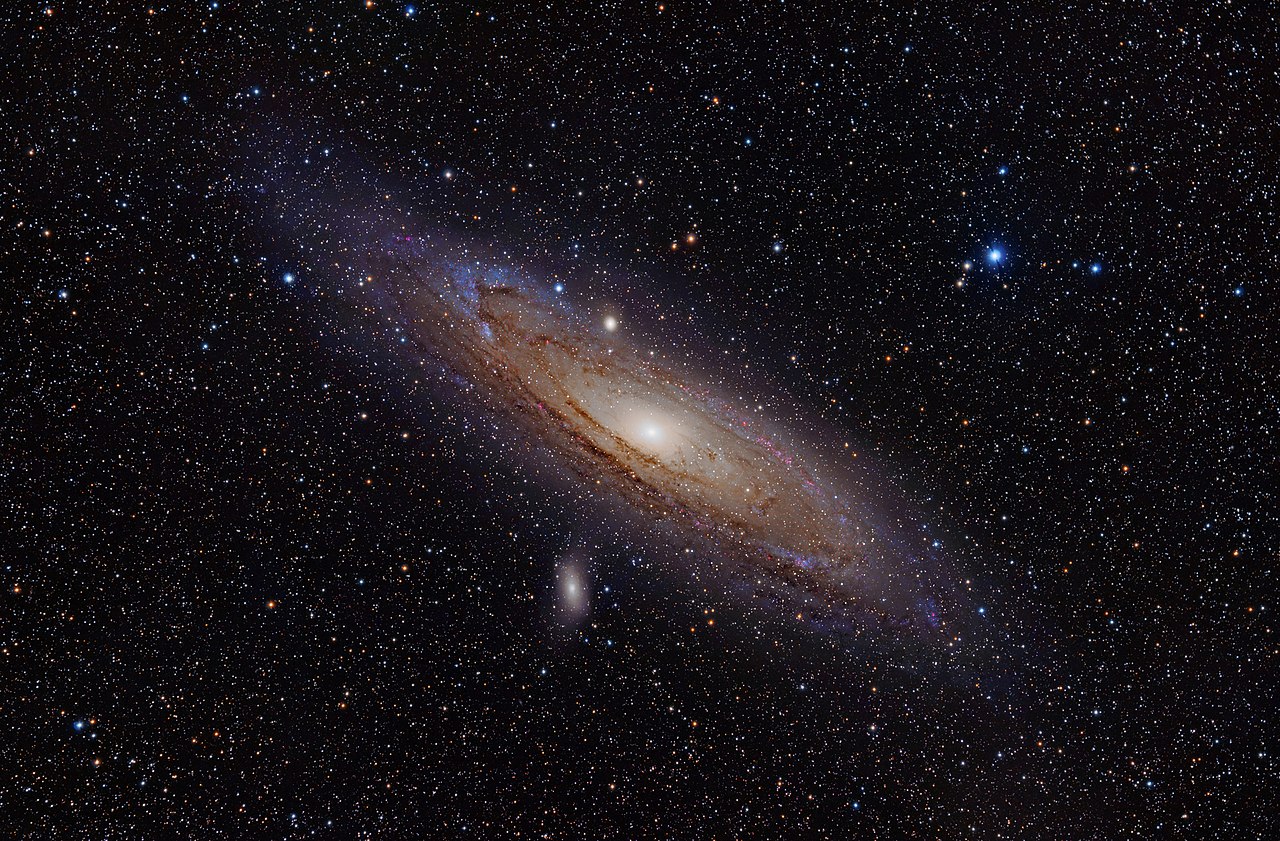
The Milky Way–Andromeda collision refers to the future encounter and eventual merger between our galaxy, the Milky Way, and the neighboring spiral galaxy Andromeda. Current measurements indicate that Andromeda is moving toward the Milky Way at roughly 110 kilometres per second, producing a blueshift in its spectrum. Combining this radial approach with small measured sideways motion suggests a close approach and eventual merger in about four billion years.
Image gallery
5 Images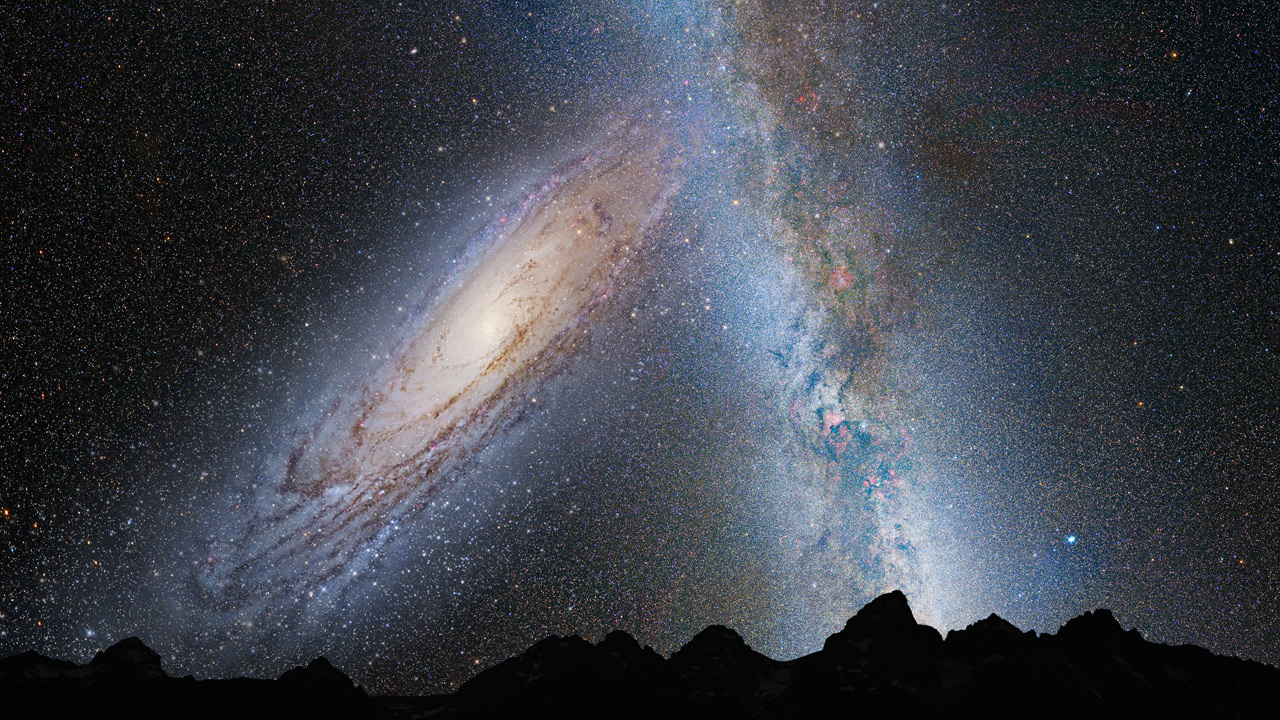



How the prediction was established
Until the early 2010s, the outcome was uncertain because Andromeda's proper motion — its tangential velocity across the sky — was too small to measure precisely. Observations with the Hubble Space Telescope tracked stars in Andromeda over several years and showed that its sideways motion is small compared with its inward velocity. That result, together with models of the Local Group's gravitational dynamics, led researchers to conclude that a collision and merger are very likely. Key dynamical factors include the galaxies' dark matter halos, relative mass, and the influence of nearby group members such as the Triangulum galaxy.
Stages and time scale
The interaction will unfold over billions of years rather than as a single instant. Typical stages in a major galaxy merger are:
- First approach and tidal interaction: gravitational forces distort the disks and create tidal tails.
- Close passages: repeated passes over a few billion years exchange orbital energy and angular momentum.
- Final coalescence: the cores merge and the system settles into a new, typically more spheroidal galaxy.
Simulations show the process may take several billion years from first pericenter to final relaxation, with several close encounters before full merger.
Physical effects and importance
Although called a collision, star–star collisions are unlikely because of the vast distances between individual stars. The most significant effects come from gravitational perturbations and gas dynamics: tidal forces can trigger bursts of star formation as gas clouds compress; large-scale rearrangement of stellar orbits will transform disk structure; and the two central supermassive black holes may eventually form a binary and merge. Smaller companions such as dwarf galaxies are already being accreted by the Milky Way, and Andromeda itself has signs of past mergers. The encounter will therefore reshape the Local Group over cosmological time.
Context and notable examples
Major galaxy mergers are common in the universe and are a fundamental channel for galaxy evolution. Observed interacting systems such as the Antennae galaxies illustrate the tidal tails and starburst activity produced by roughly equal spiral collisions. The Milky Way–Andromeda event is a nearby example of a typical hierarchical growth process that builds larger galaxies from smaller pieces.
Consequences for the Solar System and uncertainties
For the Solar System, a direct hit is unlikely; however, gravitational interactions may alter the Sun's orbit within the merged system or, in a minority of simulated outcomes, eject it to a more distant orbit or into intergalactic space. Precise timing and details depend on uncertain factors: the exact masses and extent of each galaxy's dark matter halo, Andromeda's tangential velocity, and the role of other Local Group members. Continued observations and improved simulations refine these predictions, but the broad expectation of a merger remains robust.
For further reading and data sources see studies based on proper motion measurements and dynamical simulations carried out in recent decades, and observational examples that illuminate merger physics such as proper motion investigations and extended surveys of local interacting systems.
Questions and answers
Q: When will the collision between the Milky Way and Andromeda happen?
A: The collision will happen about four billion years in the future.
Q: How fast is Andromeda approaching the Milky Way?
A: Andromeda is approaching the Milky Way at about 110 kilometres per second (68 mi/s) as shown by its blueshift.
Q: Was it known before 2012 whether or not the collision between the Milky Way and Andromeda was going to happen?
A: Until 2012, it was not known whether the possible collision was definitely going to happen or not, because its proper motion was too small to measure.
Q: How did researchers conclude that the collision between the Milky Way and Andromeda is sure to happen?
A: Researchers concluded that the collision is sure to happen in 2012. They used the Hubble Space Telescope to track the motion of stars in Andromeda between 2002 and 2010 with great accuracy.
Q: Has Andromeda collided with another galaxy in the past?
A: Yes, Andromeda has collided with at least one other galaxy in the past.
Q: What is expected to happen when Andromeda collides with the Milky Way?
A: It is expected that Andromeda will collide with the Milky Way in around 4 billion years.
Q: Are collisions between galaxies common?
A: Yes, such collisions are relatively common.
Related articles
Author
AlegsaOnline.com Milky Way–Andromeda collision Leandro Alegsa
URL: https://en.alegsaonline.com/art/64998
Sources
- nedwww.ipac.caltech.edu : M31 in the database NED
- nature.com : "Andromeda on collision course with the Milky Way"
- doi.org : 10.1038/nature.2012.10765
- iopscience.iop.org : "The M31 velocity vector. III. Future Milky Way-M31-M33 orbital evolution, merging, and fate of the Sun"
- arxiv.org : 1205.6865
- ui.adsabs.harvard.edu : 2012ApJ...753....9V
- doi.org : 10.1088/0004-637X/753/1/9
- doi.org : 10.1088/0004-637X/753/1/7
- msnbc.msn.com : "Andromeda involved in galactic collision" · web.archive.org