
Matilda (novel)
Matilda is a children's novel by Roald Dahl about a highly intelligent girl who overcomes neglect and cruelty using wit and a mysterious telekinetic ability. It has inspired film and stage adaptations.
Overview
Matilda is a children’s novel written by Roald Dahl that tells the story of a remarkably bright and resourceful young girl who faces neglect and hostility at home and later confronts cruelty at school. First published in the late 20th century, the book is notable for its mixture of sharp humor, darkly comic cruelty, and a strong sympathy for children who think and read for pleasure. The narrative centers on the title character’s intellectual gifts and her gradual development from passive cleverness to active resistance against the adults who misuse their power.
Image gallery
3 Images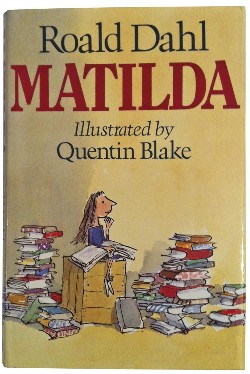


Plot and structure
The novel follows Matilda Wormwood from infancy through her early school years. She grows up in a household where her parents, who are shown as small-minded, dishonest, and dismissive of learning, neglect and belittle her. Left largely to her own devices, Matilda teaches herself to read and devours literature well beyond what is expected of a child her age. Her love of books and learning becomes a defining quality.
On beginning school, Matilda meets Miss Jennifer Honey, a gentle and nurturing teacher who recognizes and values Matilda’s intellect. The school is dominated by the terrifying headmistress Miss Agatha Trunchbull, a larger-than-life figure whose brutal punishments and authoritarian rule make her the novel’s principal antagonist. Much of the book’s dramatic energy derives from the contrast between the warmth and decency that Matilda finds in Miss Honey and the cruelty embodied by Miss Trunchbull.
As the story progresses, Matilda discovers she has an unusual power: with intense concentration she can move small objects without touching them. This ability emerges alongside her increasing impatience with the injustices done to children, and she uses it to defend her friends and to enact a plan that ultimately forces a confrontation with Miss Trunchbull. The novel resolves by restoring justice for Miss Honey and allowing Matilda to find a new, loving home.
Main characters and notable episodes
- Matilda Wormwood — The protagonist, a precocious and bookish girl whose intellectual curiosity and strong moral sense drive the action.
- Miss Jennifer Honey — Matilda’s teacher and a maternal figure who suffers under the shadow of her own difficult past and the domineering Miss Trunchbull.
- Miss Agatha Trunchbull — The school headmistress, infamous for her cruelty and theatrical punishments; she functions as the primary antagonist.
- Mr. and Mrs. Wormwood — Matilda’s parents, portrayed as boastful, dishonest and indifferent to their daughter’s needs.
- Lavender and Bruce Bogtrotter — Schoolmates who are involved in memorable incidents, including pranks and the famous cake episode in which discipline turns into comic revolt.
Several episodes are particularly well known and often cited when discussing the book: the classroom scene in which a newt is placed in a headmistress’s glass, Matilda’s first demonstrations of telekinetic power, the chalk-on-the-blackboard message that exposes Miss Trunchbull’s misdeeds, and the sequence in which a classmate defiantly eats an enormous slice of cake as an act of resistance. These episodes combine Dahl’s taste for the grotesque and the comic with an undercurrent of moral vindication for the children.
Style and themes
Roald Dahl’s style in the novel blends whimsical nonsense with a sharper, often caustic tone aimed at adult failings. He writes in clear, direct sentences well suited to younger readers while inserting irony and rhetorical devices that adults can appreciate. The book’s humor often rests on exaggeration and caricature—especially in its depiction of adults who are either buffoonish, cruel, or both.
Key themes include the value of reading and education, the dignity of the child, and the subversion of unjust authority. Matilda’s intelligence is celebrated not merely as an intellectual accomplishment but as a source of moral clarity: she recognizes unfairness and takes action to remedy it. The novel also explores different forms of power, contrasting the physical intimidation and institutional authority of people like Miss Trunchbull with Matilda’s quieter, intellectual, and ultimately supernatural agency.
Origins, publication, and reception
Matilda was written by the British author Roald Dahl, who had an established reputation as a writer of imaginative and sometimes unsettling children’s fiction. The book appeared toward the later part of Dahl’s career and quickly became one of his most popular titles for young readers. Critics and readers praised its humor, moral clarity, and the memorable personality of its heroine, and Matilda has since become a staple of children’s literature in many English-speaking countries.
Over time, the book has attracted commentary for both its virtues and its darker moments. Some readers point to the novel’s vivid depictions of adult cruelty and to Dahl’s willingness to celebrate transgressive actions taken by children. Others value the book’s affirmation of literacy, curiosity, and the idea that a child can be the moral center of a story despite adult wrongdoing. Its enduring popularity is visible in the range of editions, translations, and reprints that continue to make the novel available to new generations.
Adaptations and cultural impact
Matilda has been adapted into several other media. A feature film adaptation released in the 1990s introduced the story to a wide international audience and remains a common way many readers first encounter the tale. The novel has also inspired an award-winning stage musical that premiered in the early 21st century and has been produced in multiple countries, praised for its choreography, inventive staging, and the way it translates Dahl’s dark humor to the stage. Both the film and the musical have contributed to Matilda’s presence in popular culture and brought renewed attention to the original novel.
The book’s themes—empowerment through knowledge, resistance to bullying and abuse, and the celebration of imagination—have made it a frequent choice in educational contexts and reading lists. Teachers and librarians often use Matilda to discuss the pleasures of reading, the ethics of authority, and strategies for handling unfair treatment, while also recognizing the story’s sometimes exaggerated and stylized portrayals of adults.
Distinctions and notable facts
- Matilda stands out among Dahl’s works for centering a female child protagonist whose intelligence and moral courage define the narrative.
- The novel combines realistic social detail—such as neglect at home and the structure of a primary school—with a single, unexplained supernatural element, Matilda’s telekinesis, which serves a symbolic as well as plot function.
- Roald Dahl’s use of dark comedy and moral simplicity—good children versus abusive adults—has been both celebrated for its clarity and discussed for its moral binary.
- The book has inspired long-term engagement across media, including a widely seen film and a stage musical that made the story accessible to theater audiences worldwide.
For readers seeking primary sources or further information, editions of the novel are widely available from publishers and libraries. The author’s life and other works are frequently cited in biographies and literary studies. General information is also available through publisher pages and summaries: publisher information, profiles of the author Roald Dahl, and details about screen adaptations film and stage versions. These links can serve as starting points for readers who wish to explore editions, adaptations, and critical discussions of the novel.
Matilda remains a durable work in children’s literature: simple in premise yet rich in tone, it invites readers to value intelligence, compassion, and a willingness to challenge injustice. Its combination of playful language, memorable characters, and clear ethical center helps explain why the story continues to be read, adapted, and discussed decades after its first publication.
Related articles
Author
AlegsaOnline.com Matilda (novel) Leandro Alegsa
URL: https://en.alegsaonline.com/art/62829