
Arsenic trisulfide (orpiment)
Arsenic trisulfide (As2S3), known as orpiment, is a yellow arsenic sulfide mineral and compound used historically as a pigment and today in chalcogenide glasses; it is chemically toxic and semiconducting.
Overview
Arsenic trisulfide is an inorganic compound with the formula As2S3, commonly occurring in nature as the yellow mineral orpiment. Its systematic name is arsenic(III) sulfide, reflecting the +3 oxidation state of the arsenic atoms. For basic chemical context see As2S3 and general information about arsenic and sulfide.
Image gallery
2 Images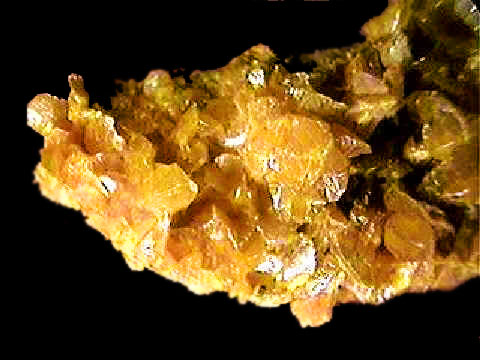

Physical and chemical characteristics
As2S3 is a bright yellow to orange solid that can appear as radiating crystals or as an amorphous glass. Structurally it consists of arsenic atoms bonded to sulfur in a pyramidal environment typical of trivalent arsenic. It is insoluble in water but can be transformed or dissolved by strong alkaline or sulfide-containing solutions. The compound is a semiconductor and shows useful optical properties in the infrared when made as a glassy chalcogenide.
Occurrence and historical use
Orpiment has been known since antiquity and was widely used as a yellow pigment in paintings and manuscripts. It occurs naturally in hydrothermal veins and in volcanic fumaroles, often associated with other arsenic sulfide minerals such as realgar. Because of its vivid color it featured in artworks from Egypt, China and medieval Europe, although its toxicity limited some uses.
Modern uses and importance
Today arsenic trisulfide is mainly of interest in materials science: amorphous As2S3 is used in chalcogenide glasses for infrared optics, photonics and certain photosensitive devices, where its combination of transparency and photosensitivity is valuable. Historically it also found limited use in medicine and agriculture, but these uses declined due to safety concerns.
Preparation, reactions and safety
Laboratory preparation typically involves direct combination of elemental arsenic and sulfur at elevated temperature or precipitation from arsenic(III) solutions by adding sulfide. It can be oxidized to other arsenic species and reacts with strong bases and sulfide donors. Arsenic trisulfide is toxic and potentially carcinogenic; handling requires appropriate protective equipment and controls. For basic chemical classification see arsenic oxidation states.
Distinctions and related compounds
- Orpiment (As2S3) vs. realgar (As4S4): similar color family but different composition and crystal structure.
- Arsenic trisulfide vs. arsenic triselenide (As2Se3): both are chalcogenide glasses but have different optical windows and chemical behavior.
Questions and answers
Q: What is arsenic trisulfide?
A: Arsenic trisulfide is a chemical compound with the chemical formula As2S3.
Q: What is another name for arsenic trisulfide?
A: Another name for arsenic trisulfide is orpiment or arsenic(III) sulfide.
Q: What types of ions are found in arsenic trisulfide?
A: Arsenic trisulfide contains arsenic and sulfide ions.
Q: What is the oxidation state of arsenic in arsenic trisulfide?
A: The oxidation state of arsenic in arsenic trisulfide is +3.
Q: Is arsenic trisulfide a naturally occurring chemical compound?
A: Yes, arsenic trisulfide is a naturally occurring chemical compound.
Q: What are some common uses of arsenic trisulfide?
A: Arsenic trisulfide has been used as a pigment in traditional Chinese medicine and as a pesticide.
Q: Is arsenic trisulfide safe to handle?
A: Arsenic trisulfide is toxic and can be harmful if ingested or inhaled, so it should be handled with care.
Related articles
Author
AlegsaOnline.com Arsenic trisulfide (orpiment) Leandro Alegsa
URL: https://en.alegsaonline.com/art/6196
Sources
- rruff.geo.arizona.edu : "Refinement of the crystal structures of realgar, AsS and orpiment, As2S3"
- doi.org : 10.1524/zkri.1972.136.1-2.48