
Mario & Sonic at the Olympic Games (2008 crossover sports game)
A 2007–2008 crossover sports video game that brought Nintendo's Mario and Sega's Sonic together to compete in Olympic-style events on the Wii and Nintendo DS.
Overview
Mario & Sonic at the Olympic Games is a crossover sports video game that pairs characters from Nintendo and Sega in a series of Olympic-style competitions. Developed by Sega Sports R&D and published by Nintendo, it was the first title to officially feature Mario and Sonic together. Released for the Wii in November 2007 and for the Nintendo DS in January 2008, the game served as a licensed tie-in to the 2008 Summer Olympic Games.
Image gallery
4 Images


Gameplay and features
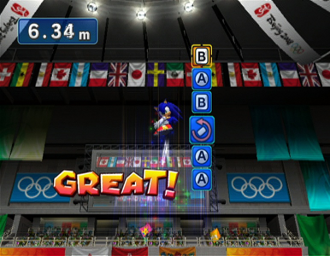
The game assembles roughly two dozen events that mimic real Olympic disciplines, organized into categories that emphasize different player strengths. Events include sprinting, swimming, gymnastics, archery and equestrian-style challenges; controls and rules vary by platform. Players choose from a roster of familiar characters grouped into the four classes: all-around, speed, power and skill. In the Wii version, players can also play as a personalized avatar using the Mii system.
Controls and platform differences
The Wii release emphasizes motion-based input, using the Wii Remote and Nunchuk to simulate running, throwing and swinging motions. The DS version adapts many activities to touch and stylus controls or button presses and includes some events that differ from the Wii lineup to suit the handheld’s hardware. Both versions support local multiplayer, allowing friends and family to compete in single events or tournament sequences.
Development, release and context
Conceived as a family-oriented sports party title, the game emerged from collaboration between Sega and Nintendo after long-standing rivalry between their flagship mascots. As the official licensed video game linked to the Beijing 2008 Olympics, it combined licensed Olympic sports with the distinctive characters and cartoonish presentation typical of both franchises. Its cross-company nature and marketing helped it attract attention beyond typical sports-game audiences.
Reception and legacy
Critics and players responded to the novelty of seeing Mario and Sonic together, but reviews were mixed regarding depth and longevity. Praise generally focused on accessible multiplayer fun and inventive uses of platform controls; criticisms most often cited shallow event design and limited single-player challenge. The title nevertheless established a new series of Olympic-themed games featuring both franchises and influenced subsequent party and licensed sports titles.
Notable facts
- The roster consists of many iconic characters from both universes, each placed in a class that affects event performance.
- The Wii edition supports Mii integration, allowing players to compete as their console avatar.
- Events are modeled after standard Olympic disciplines but presented with arcade-style twists and character-specific animations.
- Because the Wii and DS hardware differ, each platform offers a distinct selection and control scheme, making the two versions complementary rather than identical.
For further details on development teams, lists of playable characters, and the event roster, follow official sources and platform-specific game guides. The title remains notable as a cultural milestone in video game crossovers, bringing two longstanding mascots into the same competitive arena.
Related articles
Author
AlegsaOnline.com Mario & Sonic at the Olympic Games (2008 crossover sports game) Leandro Alegsa
URL: https://en.alegsaonline.com/art/61957