
Mario Party 10
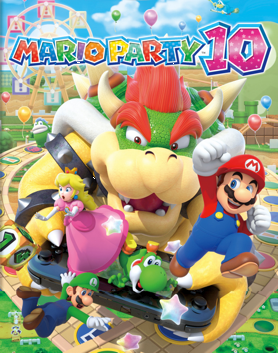
Mario Party 10 is a 2015 party video game for Wii U by Nd Cube and Nintendo, featuring board-game play, minigames, an asymmetrical Bowser mode, and amiibo-enhanced features.
Overview
Mario Party 10 is a party video game developed by Nd Cube and published by Nintendo for the Wii U. It is the tenth main entry in the long-running Mario Party series and was released worldwide in March 2015. The game continues the franchise’s blend of board-game style movement and competitive minigames while introducing modes that make distinctive use of the Wii U GamePad and amiibo accessories.
Image gallery
4 Images


Gameplay and modes
The core gameplay follows the series tradition of moving around themed boards and competing in minigames to gain an advantage. Mario Party 10 retains the vehicle-based progression first seen in a previous entry, where all players often travel together along a route and minigames determine outcomes rather than free solo movement. Players can choose from a roster of familiar Nintendo characters, and matches are structured into rounds of board play punctuated by short, often frantic minigames.
Mario Party 10 offers several distinct modes:
- Mario Party mode – the primary multiplayer board experience with turns and minigames.
- Bowser Party – an asymmetrical mode in which one player uses the Wii U GamePad as Bowser against up to four other players on the television screen. This mode emphasizes uneven power and strategy, pitting a single powerful player against a team of challengers.
- Amiibo Party – an amiibo-enhanced mode that uses scanned figures on the GamePad to personalize or modify gameplay elements and board layouts.
Development and release
Nd Cube, which had been handling the series since the previous main entries, developed Mario Party 10. Nintendo published the title exclusively for the Wii U, making it the series’ first and only game on that console. During development the team prioritized touchscreen functionality and asymmetrical play options to leverage the GamePad’s unique capabilities.
Reception and legacy
Upon release, Mario Party 10 received mixed reviews. Critics and players often praised the inventive Bowser Party for its novelty and the accessibility of minigames, but some criticized the game’s board design and the vehicle-style progression for reducing individual control and the strategic depth that earlier fans expected. The amiibo integration was recognized as a notable experiment in bringing physical toys into board gameplay, though opinions varied on its long-term appeal.
Notable facts
The title is part of a franchise that began in the late 1990s and has continued to evolve its format from free-roaming boards to more structured, minigame-focused rounds. For further reading on the series, development, and modes, see Nintendo’s pages and related coverage: Japanese title and local details, transliteration and naming, developer and publisher information, platform-specific material, and series overview and entries.
Mario Party 10 remains a notable entry for its attempts to experiment with asymmetrical multiplayer and toy integration, and it is frequently discussed in retrospectives about how party games adapt to new hardware features.
Related articles
Author
AlegsaOnline.com Mario Party 10 Leandro Alegsa
URL: https://en.alegsaonline.com/art/61985