
Marina Ratner (1938–2017), mathematician known for Ratner's theorems
Marina Ratner was a Russian‑American mathematician whose work in ergodic theory produced Ratner's theorems on unipotent flows, with major consequences for homogeneous dynamics and number theory.
Marina Evseevna Ratner was a Russian‑American mathematician noted for deep contributions to ergodic theory and homogeneous dynamics. Born in Moscow in 1938, she built a research program that culminated around 1990 in a set of landmark results now called Ratner's theorems. These results transformed the understanding of the behaviour of unipotent flows on homogeneous spaces and established rigorous classifications that had long been conjectured.
Image gallery
1 Image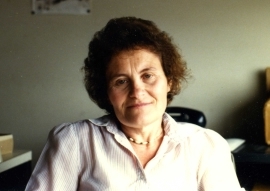
Biographical background
Ratner grew up in Moscow and received her early mathematical training there before eventually moving to the United States and taking a faculty position at the University of California, Berkeley. Her name in Russian is often rendered as Мари́на Евсе́евна Ра́тнер. She spent the principal part of her career at UC Berkeley, where she taught and supervised research. Ratner was of Jewish descent and maintained strong connections with the international mathematical community until her death in Berkeley, California, in 2017 from a stroke at age 78; she passed away in Berkeley.
Mathematical work and Ratner's theorems
Ratner's theorems concern actions of unipotent subgroups on homogeneous spaces of Lie groups. Informally, a unipotent flow is generated by matrices whose eigenvalues are all 1; these flows can produce intricate orbit behavior. Ratner proved a series of rigorous statements that classify invariant measures, describe orbit closures, and establish equidistribution properties for these flows. Her theorems provided a unified, powerful framework that resolved several longstanding conjectures in the area of homogeneous dynamics.
Impact and applications
The implications of Ratner's work reach beyond the abstract theory of dynamical systems. Her measure classification and orbit closure results have been applied in number theory, ergodic theory, and geometry. They underpin later advances in the study of arithmetic problems that can be recast in terms of flows on homogeneous spaces, and they offer tools for proving equidistribution or rigidity phenomena where previously only partial results were known.
Awards and recognition
- Election to the American Academy of Arts and Sciences (1992).
- Ostrowski Prize (1993), awarded for outstanding achievements in pure mathematics.
- Election to the National Academy of Sciences (1993).
- John J. Carty Award from the National Academy of Sciences (1994).
These honors reflect both the technical depth of her proofs and the wide significance of her conclusions. Colleagues often describe her work as introducing a new level of rigidity into the study of flows on homogeneous spaces; that rigidity in turn opened new directions of research and fostered connections across disciplines.
Notable facts and legacy
- Ratner's theorems are now standard references in modern treatments of homogeneous dynamics and appear in many surveys and textbooks.
- Her results are celebrated examples of how ergodic-theoretic methods can resolve problems with arithmetic and geometric content.
- Though highly technical, the core ideas emphasize classification and rigidity, themes that continue to inspire research in dynamics and number theory.
For readers seeking further information, standard introductions discuss ergodic theory, Lie groups, and homogeneous spaces before approaching Ratner's original papers and subsequent expositions. Biographical notes and memorials recount both her mathematical achievements and her role as a mentor and teacher at UC Berkeley. For the Russian spelling and other primary-language sources see the Russian form, and for details of her life and death see reports noting her Moscow origins (Moscow) and later passing in Berkeley due to a stroke.
Related articles
Author
AlegsaOnline.com Marina Ratner (1938–2017), mathematician known for Ratner's theorems Leandro Alegsa
URL: https://en.alegsaonline.com/art/61928
Sources
- agnesscott.edu : "Biography of Marina Ratner"
- citeseerx.ist.psu.edu : 10.1.1.240.444
- worldcat.org : 57965722
- amacad.org : "Membership list"
- nasonline.org : "John J. Carty Award for the Advancement of Science"
- math.berkeley.edu : "In Memoriam"