
Arsenic pentafluoride (AsF5)
Arsenic pentafluoride (AsF5) is a molecular inorganic fluoride of arsenic in the +5 oxidation state; a reactive Lewis acid used in fluorine chemistry and as a precursor to hexafluoroarsenate salts.
Overview
Arsenic pentafluoride is an inorganic chemical compound with the formula AsF5. It is a molecular species in which arsenic is bonded to five atoms of fluorine. The compound is often encountered as a colorless gas under ambient conditions and is notable for strong Lewis acidity and high reactivity toward nucleophiles and moisture.
Image gallery
2 Images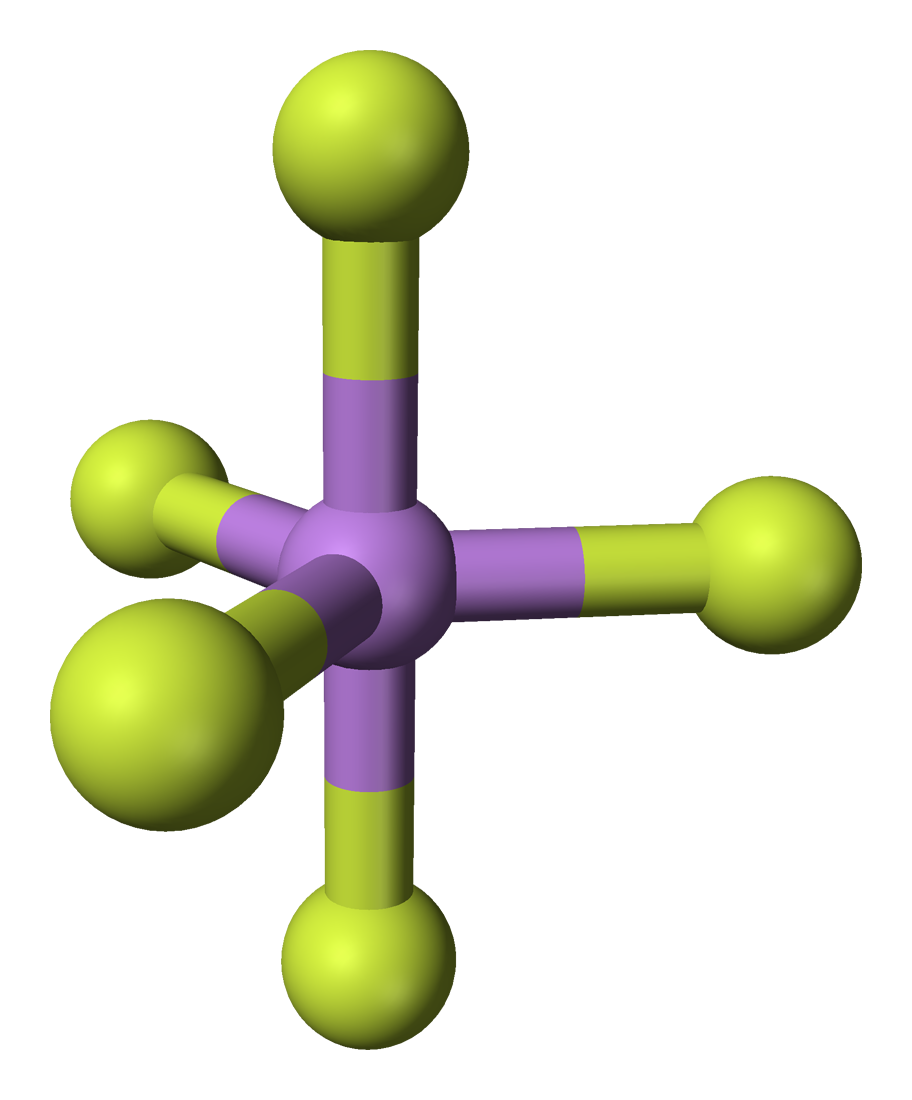

Structure and bonding
AsF5 adopts a trigonal bipyramidal geometry with five As–F bonds; two positions are axial and three are equatorial. The arsenic center is in the formal +5 oxidation state, making the molecule electron-poor and able to accept electron pairs from donors. The distinct axial and equatorial contacts lead to slightly different bond environments and reactivity at those sites.
Preparation and reactions
The compound is prepared commercially and in the laboratory by direct fluorination of arsenic or by oxidation/fluorination of lower-valent arsenic fluorides. AsF5 hydrolyzes readily in the presence of water to give arsenic oxides and hydrogen fluoride, and it reacts with fluoride donors to form salts containing the hexafluoroarsenate anion (AsF6−).
Uses and applications
In research and industrial contexts AsF5 serves as a powerful Lewis acid and fluorinating agent. It is used to generate non-coordinating anions and to stabilize cationic species in studies of inorganic and organometallic chemistry. The ability to form five arsenic–fluorine bonds and to accept additional fluoride is central to its role in producing hexafluoroarsenate salts and related complexes.
Safety and handling
AsF5 is highly toxic, corrosive, and reacts with moisture to produce hydrogen fluoride and toxic arsenic-containing products. Handling requires specialized fluorine-compatible materials, containment, and trained personnel. Exposure risks and waste disposal demand strict regulatory and laboratory controls.
Context and related compounds
Arsenic pentafluoride belongs to the group 15 pentafluorides alongside phosphorus and antimony analogues and shares characteristics with agents such as SbF5. It is of interest for fundamental studies of bonding, Lewis acidity, and the chemistry of highly fluorinated anions. For further chemical properties and safety details see sources and databases: compound entry, elemental context, halogen chemistry, and specific reagent guides at oxidation-state references and anion formation notes.
Questions and answers
Q: What is arsenic pentafluoride?
A: Arsenic pentafluoride is a chemical compound with the formula AsF5.
Q: How many arsenic-fluorine bonds does arsenic pentafluoride have?
A: Arsenic pentafluoride has five arsenic-fluorine bonds.
Q: What is the oxidation state of the arsenic in arsenic pentafluoride?
A: The arsenic in arsenic pentafluoride is in its +5 oxidation state.
Q: What is the chemical formula of arsenic pentafluoride?
A: The chemical formula of arsenic pentafluoride is AsF5.
Q: What is another name for arsenic pentafluoride?
A: Arsenic pentafluoride is also known as arsenic(V) fluoride.
Q: How many atoms are in a molecule of arsenic pentafluoride?
A: A molecule of arsenic pentafluoride contains six atoms: one arsenic atom and five fluorine atoms.
Q: What is the significance of the +5 oxidation state of arsenic in arsenic pentafluoride?
A: The +5 oxidation state of the arsenic in arsenic pentafluoride indicates that it has lost five electrons and formed five bonds with fluorine atoms, resulting in a stable compound.
Tags
Related articles
Author
AlegsaOnline.com Arsenic pentafluoride (AsF5) Leandro Alegsa
URL: https://en.alegsaonline.com/art/6188