
Arsenic trichloride (arsenic(III) chloride)
Arsenic trichloride (AsCl3) is a volatile inorganic liquid used as a chemical reagent and precursor to organoarsenic compounds; it is corrosive and highly toxic and hydrolyzes in water.
Overview: Arsenic trichloride, commonly called arsenic(III) chloride, is an inorganic molecular compound with the formula AsCl3. At room temperature it is a volatile, typically colorless to pale yellow liquid with a pungent odor. The arsenic atom is in the +3 oxidation state and is bound to three chlorine atoms, giving the molecule its name. For general reference and identification see compound listings.
Image gallery
1 Image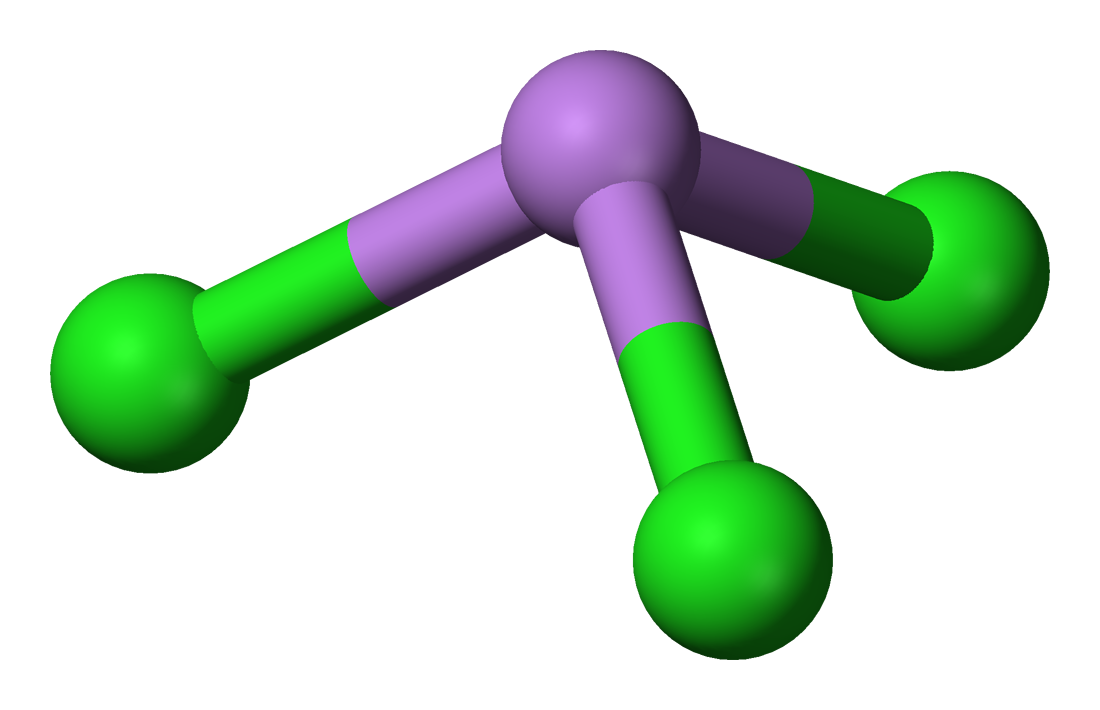
Structure and bonding
Structurally AsCl3 has three As–Cl single bonds and one lone pair on arsenic, producing a trigonal pyramidal geometry rather than a planar arrangement. This shape influences its polarity and reactivity: the lone pair can participate in coordination chemistry and the molecule behaves as a Lewis acid in many reactions. For more on bonding models consult bonding summaries.
Physical and chemical properties
AsCl3 hydrolyzes in the presence of water to give acidic products and evolves hydrogen chloride; it fumes in moist air. It reacts with nucleophiles and with oxygen or reducing agents under suitable conditions. The compound is soluble in many organic solvents but reacts with protic solvents. Typical physical data and safety parameters are documented in chemical safety sources such as safety datasheets.
Preparation and reactions
Arsenic trichloride can be prepared by direct chlorination of elemental arsenic or by chlorination of other arsenic-containing precursors. It serves as a precursor to a range of organoarsenic reagents and can be converted into higher oxidation-state chlorides or to arsenides under controlled conditions. Its role as a chlorinating and alkylating intermediate is described in synthetic protocols and reagent compendia: preparation notes.
Uses and significance
Historically used in the synthesis of other arsenic compounds, arsenic trichloride has found niche applications in organic and inorganic synthesis and, in some semiconductor processes, as a precursor to arsenic-containing materials. Modern use is limited by the availability of safer alternatives and stringent controls on arsenic compounds. For applications and industrial context see technical references.
Safety and handling: AsCl3 is highly toxic, corrosive, and poses inhalation and ingestion hazards. It should be handled only in a fume hood with appropriate personal protective equipment and emergency procedures in place. Because it hydrolyzes to acidic and toxic products, spills require specialized neutralization and disposal. This compound is regulated in many jurisdictions and handled under strict occupational and environmental controls.
Questions and answers
Q: What is arsenic trichloride?
A: Arsenic trichloride is a chemical compound that is also known as arsenic(III) chloride.
Q: What is the chemical formula for arsenic trichloride?
A: The chemical formula for arsenic trichloride is AsCl3.
Q: How many arsenic-chlorine bonds are in arsenic trichloride?
A: There are three arsenic-chlorine bonds in arsenic trichloride.
Q: What is the oxidation state of the arsenic in arsenic trichloride?
A: The arsenic in arsenic trichloride is in its +3 oxidation state.
Q: Is arsenic trichloride a naturally occurring compound?
A: No, arsenic trichloride is not a naturally occurring compound.
Q: What are some common uses of arsenic trichloride?
A: Arsenic trichloride is used in the production of semiconductors, as a reagent in organic synthesis, and as a Lewis acid catalyst.
Q: What are some safety precautions that should be taken when handling arsenic trichloride?
A: Arsenic trichloride is highly toxic and should only be handled in a well-ventilated area with appropriate protective equipment. Contact with skin, eyes, or inhalation of arsenic trichloride can cause severe health problems.
Tags
Related articles
Author
AlegsaOnline.com Arsenic trichloride (arsenic(III) chloride) Leandro Alegsa
URL: https://en.alegsaonline.com/art/6192