
Magnetic levitation (maglev): principles, types, and applications
Magnetic levitation suspends objects using magnetic fields. This article explains basic physics, main methods (EMS, EDS, superconducting, diamagnetic), practical uses and engineering challenges.
Magnetic levitation, often called maglev or magnetic suspension, is a technique that supports an object solely by magnetic forces so that it floats with no mechanical contact. In practical systems the magnetic field provides an upward force that balances gravity and any applied loads while control systems or material properties provide stability. For a simple definition and related concepts see magnetic suspension.
Image gallery
10 Images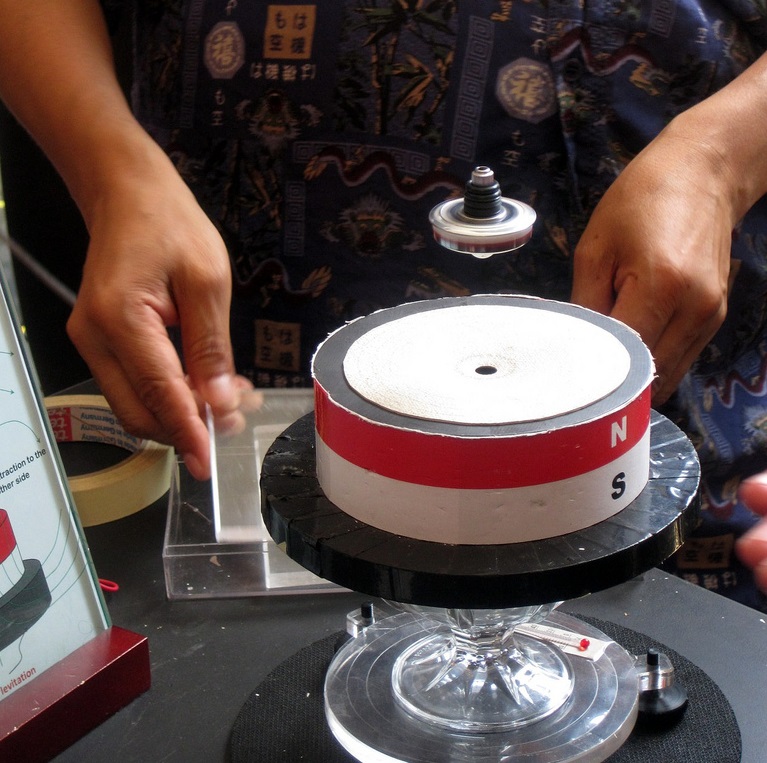


Basic principles and limits
At the core of levitation is the interaction between magnetic fields and materials or currents. A magnetic field can attract or repel, and moving conductors can generate currents that in turn produce fields that oppose motion. Any design must solve two problems: produce enough lift to support the mass, and ensure the floating state is stable. Earnshaw's theorem shows that a collection of static classical charges or magnets interacting only by inverse-square laws cannot produce a stable equilibrium, so practical levitation relies on workarounds: active electronic feedback, time-varying fields, induced currents, diamagnetic materials, or superconductors that pin flux lines. In brief, the same phenomenon that creates lift must be arranged so the levitated object resists tipping, sliding, or collapsing into contact.
Common levitation methods
- Electromagnetic suspension (EMS) — uses attractive forces between electromagnets on a track and ferromagnetic elements on the vehicle. Sensors and rapid feedback control maintain a small air gap; this approach is used in some commercial maglev prototypes and offers precise position control.
- Electrodynamic suspension (EDS) — uses relative motion to induce currents in conductors or superconducting coils, creating repulsive forces. EDS can be inherently stable at speed because induced currents oppose changes; many high-speed concepts use variations of this idea.
- Superconducting levitation — superconductors exclude magnetic fields (the Meissner effect) and can trap flux lines, producing strong, passive stability and allowing persistent currents with low loss; cryogenic cooling is required.
- Diamagnetic levitation — certain materials exhibit a weak repulsion in magnetic fields. With sufficiently strong fields (or highly diamagnetic materials like pyrolytic graphite) small objects can float stably without active control.
Applications and examples
Magnetic levitation appears across scales from classroom demonstrations to industrial and transportation systems. The best-known application is maglev trains, where vehicles glide above guideways to reduce rolling friction and enable high speeds; for general information see maglev trains. In manufacturing, contactless melting and processing use levitation to melt or hold metal and glass without crucible contamination—an approach often referenced as contactless melting. Other uses include magnetic bearings for turbines and flywheels, vibration isolation platforms for sensitive instruments, novelty product displays and anti-friction transport stages for precision machines.
Advantages, engineering challenges and outlook
Levitation reduces mechanical wear and enables very low friction motion, precise non-contact positioning, and contamination-free processing. It can also reduce noise compared with conventional wheel-rail contact and permit high acceleration and speeds in dedicated systems. Challenges include the energy and infrastructure cost of magnets, power electronics and cooling systems for superconductors; the complexity of high-speed switching and feedback needed for active stability; and the difficulty of retrofitting existing networks. Public and private research continues to improve materials, control algorithms, and cryogenic systems, making some applications more practical over time.
Notable facts and distinctions
- Stable levitation without active control is possible with superconductors or diamagnetic materials, but most large-scale transport systems rely on dynamic methods and active stabilization.
- Electrodynamic methods can provide passive stability only when there is relative motion or persistent currents; at zero speed they often require additional support or control.
- Choice of method depends on trade-offs among cost, complexity, efficiency, payload, and environmental conditions.
Magnetic levitation remains an active field of engineering and physics, combining electromagnetism, materials science and control theory. Its most visible results are high-speed transit demonstrations and laboratory tools, while ongoing advances in superconductors and power electronics may broaden practical deployments in the coming decades. For further technical background on the forces involved see magnetic force.
Related articles
Author
AlegsaOnline.com Magnetic levitation (maglev): principles, types, and applications Leandro Alegsa
URL: https://en.alegsaonline.com/art/60626