
Lyndon LaRouche: American political activist and founder of the LaRouche movement
Lyndon LaRouche (1922–2019) was an American political activist, organizer and writer. He led the LaRouche movement, ran for U.S. president multiple times, and remained a polarizing public figure.
Lyndon Hermyle LaRouche, Jr. (September 8, 1922 – February 12, 2019) was an American political activist, organizer and writer best known as the founder of what became the LaRouche movement. Over several decades he promoted a blend of economic, scientific and historical ideas through books, pamphlets, periodicals and public campaigns. Critics and supporters alike described him as a polarizing figure whose followers were active in electoral politics, public advocacy and international networks. LaRouche movement
Image gallery
9 Images




Early life and education
LaRouche was born in Rochester, New Hampshire, and his early life included military service and involvement in political organizing. He attended Northeastern University in Boston, Massachusetts, where he continued to read widely on economics, history and science and began developing the themes that would recur in his later writing.
Political activity and ideas
Beginning in the 1960s and 1970s, LaRouche built a complex network of organizations, committees and publications to promote his views. He emphasized large-scale economic development, long-term credit policies, high-technology infrastructure and a historical approach to political economy. His followers contested mainstream economic theories and accused financial and political elites of conspiratorial behavior. LaRouche also sought influence within established political parties; he mounted multiple bids for the U.S. presidency, usually seeking the Democratic nomination and campaigning on an idiosyncratic platform. Presidential campaigns and efforts to shape public debate were central to his public life, and he frequently endorsed major infrastructure programs and scientific research as priorities.
Organizations, publications and methods
- He organized groups that combined political activism, study circles and door-to-door campaigning.
- His movement produced periodicals and intelligence-style briefing materials intended for policymakers and supporters.
- LaRouche proponents often used direct mail, public events and publications to spread their analyses and to recruit.
Examples of the kinds of outlets associated with him and his followers include investigative journals and institutes formed to promote a strategic political agenda; these organs were central to how his ideas were disseminated. Democratic Party contests were a recurring arena for those efforts.
Controversies and legal issues
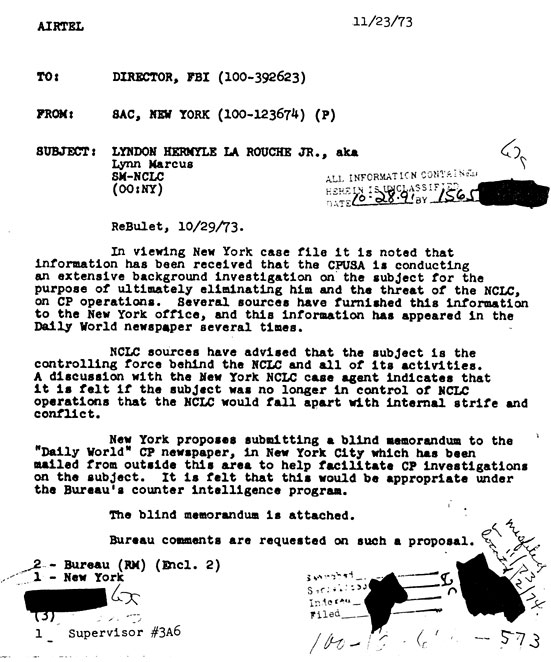
Throughout his career LaRouche attracted intense controversy. His movement and rhetoric provoked accusations of cult-like behavior from some former associates and strong political opposition from others. In the late 1980s he faced criminal prosecution: he was convicted on charges connected with fundraising and financial dealings and served a federal prison sentence. These legal issues, together with confrontations with the press and political opponents, helped to cement his reputation as a contentious and highly debated public figure.
Personal life and legacy
LaRouche's private life included two marriages: he was married to Janice Neuberger from 1954 until their divorce in 1963, and later married Helga Zepp (often known as Helga Zepp-LaRouche) in 1977. He had a son, Daniel, with Neuberger. In later years he continued to write and receive visitors at his Virginia home. He died in Leesburg, Virginia, in February 2019 at the age of 96.
Observers of American political movements consider LaRouche an influential example of a long-lived, personally driven political enterprise: a mixture of campaigning, publication and organizational work that persisted for decades. Assessments of his impact vary widely, from those who credit him with innovative economic proposals to those who emphasize the movement's confrontational tactics and conspiratorial claims.
For further reading and archival materials see related organizational sites and published collections of his essays. State context, educational background and historical timelines of his campaigns are commonly used entry points for researchers. Additional reference material may be found through contemporary reporting, books on American fringe movements and collections of his own writings. Boston connections, Massachusetts ties and links to movement publications remain part of the public record. Birthplace, movement overview, and archival summaries of his trial and sentence constitute essential background for a fuller study.
Related articles
Author
AlegsaOnline.com Lyndon LaRouche: American political activist and founder of the LaRouche movement Leandro Alegsa
URL: https://en.alegsaonline.com/art/60117
Sources
- larouchepac.com : Lyndon H. LaRouche, Jr.: 1922-2019, A Talent Well Spent