
Los Alamos, New Mexico
Los Alamos is a town on the Pajarito Plateau in New Mexico, known for the Los Alamos National Laboratory, its Manhattan Project origins, high-tech economy, and nearby natural and cultural sites.
Los Alamos is a small town located on four mesas of the Pajarito Plateau in northern New Mexico. The community — sometimes referenced by its Spanish form Los Álamos — takes its name from local trees, a phrase rendered in translations such as "The Cottonwoods" or "The Poplars". As the county seat of Los Alamos County, and within the state of New Mexico, the town functions as one of two main population centers in the county and is officially cataloged with nearby settlements among census-designated places (CDPs). The town proper has about 12,019 residents and is adjacent to the community of White Rock.
Image gallery
7 Images




Geography and settlement
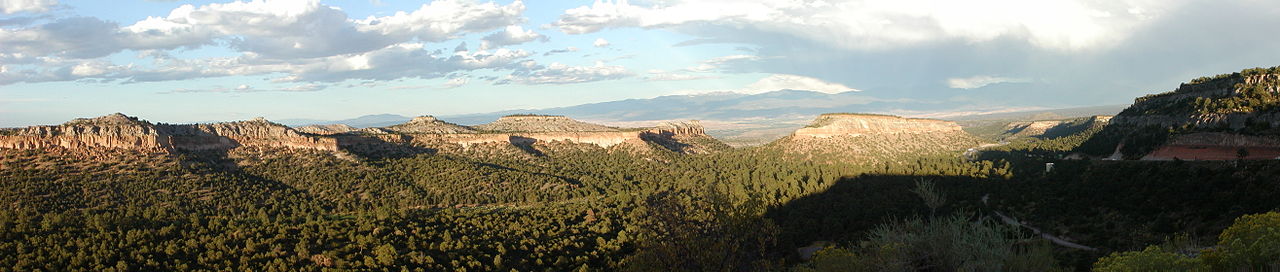
Perched on mesas cut by canyons, Los Alamos enjoys a high-desert climate with wide views, piñon-juniper woodlands, and a network of trails. The mesa landscape shaped how the town was laid out: residential areas, research facilities, and community services are sited on relatively flat expanses separated by steep ravines. Proximity to springs, groundwater, and forested uplands has long influenced local ecology and human use.
History and the Manhattan Project
The modern town grew rapidly during World War II when the U.S. government selected the remote mesas for a top-secret laboratory and community to design atomic weapons. That wartime enterprise established the Los Alamos National Laboratory (LANL), which continues to be an important scientific and engineering center. The town’s history is often discussed in the context of 20th-century science, national security, and the ethical debates surrounding nuclear technology.
Economy, institutions, and culture
Today the local economy is dominated by the national laboratory and firms connected to scientific research, defense, and high technology. LANL is the town’s principal employer and supports a concentration of scientists, engineers, and technical staff. Public facilities include schools, a science museum that interprets laboratory history and research, and civic amenities that reflect a community shaped by intellectual work.
Recreation, environment, and nearby sites
Los Alamos serves as a gateway to outdoor recreation: hiking, mountain biking, and climbing are common on the Pajarito Plateau. Nearby cultural and natural attractions include archaeological sites and protected lands that preserve ancestral Puebloan ruins and volcanic and canyon landscapes. Because of the mesa topography and forested surrounds, local land and water resources are susceptible to wildfire and erosion, issues that have influenced management and planning.
Notable characteristics and distinctions
- Scientific heritage: the town is widely known for its central role in the Manhattan Project and for the ongoing research at a major national laboratory.
- Demography and economy: a relatively small population with a high concentration of technical professionals and research activity.
- Landscape: distinctive mesa-and-canyon topography on the Pajarito Plateau.
- Community life: a mix of scientific institutions, local schools, museums, and outdoor opportunities that define local identity.
For further information about the county, governance, and demographic classification, see references to the town’s status as county seat and its relationship to surrounding CDPs. Local and regional histories, scientific outreach programs, and visitor resources provide more detailed perspectives on how Los Alamos evolved from a remote wartime installation into a contemporary research town with notable cultural and environmental links to the broader Southwest.
Related articles
Author
AlegsaOnline.com Los Alamos, New Mexico Leandro Alegsa
URL: https://en.alegsaonline.com/art/59286