
Library classification
Systems that arrange library materials by subject to support shelving, discovery and management; includes notation, hierarchies, faceted and enumerative approaches and major schemes.
Overview
A library classification is a systematic method for arranging resources by subject so that items on similar topics are grouped together on shelves and in catalogs. Classification supports physical shelving, subject browsing, and the organization of bibliographic records, enabling users and staff to find, retrieve and manage materials efficiently. A classification links a conceptual scheme to a practical notation that becomes the item's call number within a library's order. For more on the idea of a classification system, see general introductions used by libraries and information services.
Image gallery
2 Images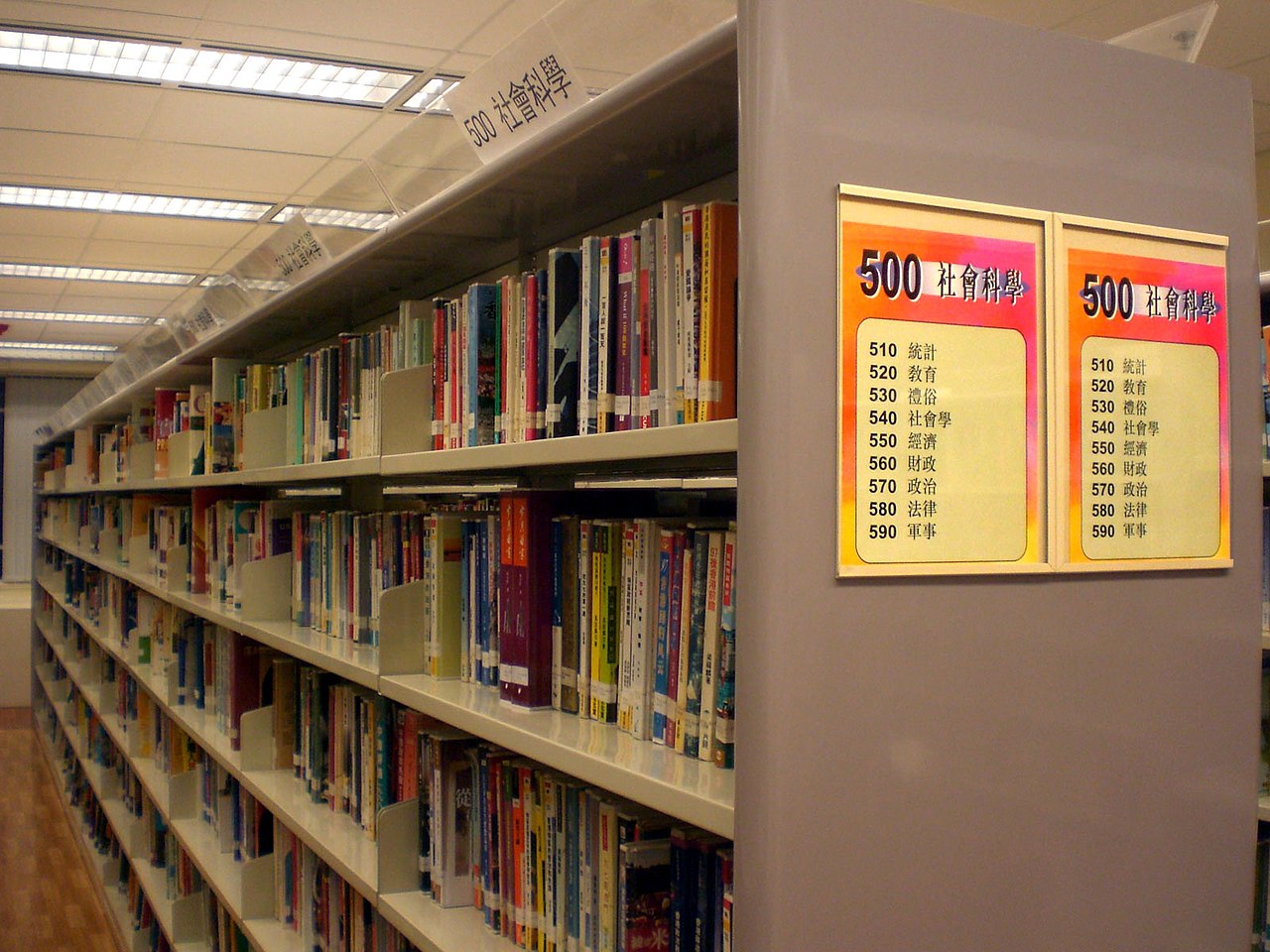

Key elements and structure
Most schemes share a few core components that turn intellectual subjects into usable shelf locations:
- Classes or categories: the named subject divisions (for example history, science, literature).
- Notation or call numbers: symbols (numbers, letters, or mixed) that represent a place in the hierarchy.
- Schedules: the published lists of classes and rules for building numbers.
- Hierarchy and syntax: principles that show broader and narrower terms and how to combine facets.
- Indexes and relative indexes: tools that help users find the correct class for a topic.
History and development
Systematic classification grew with modern libraries in the 19th century. Widely used universal schemes include the Dewey Decimal Classification and the Library of Congress Classification; national and specialized systems also exist. Indian librarian S. R. Ranganathan contributed important ideas about faceted classification and the practical laws of librarianship. His work influenced systems that allow subjects to be built from independent facets rather than fixed, single-position notations.
Uses and examples
Classification enables shelf arrangement, subject browsing, interlibrary cooperation, collection analysis, and automated sorting. It is applied to print collections and to digital resources through mapped classmarks or metadata. Libraries typically choose a scheme that matches their size and user needs: universal schemes for large mixed collections, enumerative lists for small or specialized libraries, and faceted systems when flexibility is required.
Distinctions and notable facts
Classification is distinct from cataloging and from subject heading systems: classification assigns a position in a subject order, while subject headings provide controlled vocabulary terms for indexing and retrieval. Notation styles vary—decimal (hierarchical numeric), enumerative (pre-coordinated lists), and faceted (constructive, combinable elements). Practical practice often blends international standards with local adaptations to reflect language, curriculum, or community priorities. For discussions of organizational principles and practice see resources on organization in libraries.
Related articles
Author
AlegsaOnline.com Library classification Leandro Alegsa
URL: https://en.alegsaonline.com/art/57770
Sources
- newworldencyclopedia.org : "New World Encyclopædia : Library classification"
- wikidata.org : wikidata.org/wiki/Q48473
- catalogue.bnf.fr : cb126474572
- data.bnf.fr : (data)
- id.loc.gov : sh85026721
- id.ndl.go.jp : 00573383