
Areopagitica — John Milton's 1644 Defense of Unlicensed Printing
Areopagitica (1644) is John Milton's prose tract arguing against prior restraint and for liberty of unlicensed printing; it remains a foundational rhetorical defense of freedom of expression.
Areopagitica is a prose tract written in 1644 by the English poet and polemicist John Milton. Addressed to the English Parliament, its full title begins "Areopagitica: A speech of Mr. John Milton for the liberty of unlicensed printing to the Parliament of England." Written at a moment of intense political and religious conflict, the work protests a new system of prior censorship and urges that books be judged after publication rather than suppressed beforehand. Over subsequent centuries it has been widely admired as one of the most eloquent early defenses of press freedom in the English-speaking world.
Image gallery
5 Images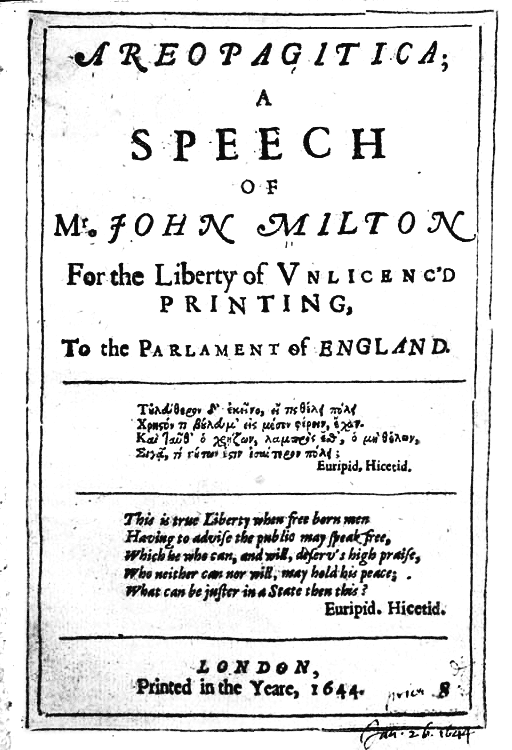




Title and historical context
The title refers to the Areopagus, a prominent hill and ancient council site in Athens, and echoes a classical speech-form tradition associated with the Greek orator Isocrates. Milton borrowed the name to invoke classical authority and the idea of public deliberation. The immediate target of his argument was the Licensing Order of 1643, which revived a system of pre-publication approval and required authors and printers to obtain official permission before printing. Milton himself had experienced government disapproval for other controversial pamphlets, and he grounded his appeal in a mixture of classical learning, biblical example, and practical argument about how truth and learning flourish.
Main arguments and rhetorical method
Areopagitica is not a legal brief but a vigorous rhetorical essay. Its central claims include opposition to prior restraint, the value of open discussion for discovering truth, and the practical idea that wrongdoing can be punished after publication without preventing legitimate speech in advance. Milton argued that licensing chilled learning, discouraged honest inquiry, and placed undue power in the hands of censors. He supported a system in which publications carried the name or imprint of an author or printer so that libel or illicit works could be identified and dealt with after the fact.
- Against prior restraint: censorship before publication is corrosive to liberty and learning.
- For post-publication accountability: objectionable works may be suppressed or punished after they appear.
- Classical and biblical appeal: Milton drew on Greco-Roman models and scripture to bolster his case.
- Practical safeguards: imprint and accountability as alternatives to licensing.
Reception and influence
At the time, Areopagitica did not immediately overturn the Licensing Order, but it entered the intellectual conversation about censorship, liberty, and the role of the press. Scholars and commentators have since treated it as a landmark statement in the development of free-speech thought in the Anglo-American tradition. Its rhetorical power lies in the fusion of humanist learning, theological reference, and forceful prose; later advocates for freer expression frequently cited Milton's themes when arguing against state controls on publishing.
Distinctions and notable features
Several features make Areopagitica notable: its use of classical allusion combined with Protestant theology; Milton's insistence that freedom of expression supports moral and intellectual improvement; and its influence on the evolving idea that open debate is necessary for truth. The tract is also an expression of Milton's wider career as a writer engaged with politics, religion, and poetry—he later produced major works of epic and polemic that continued to shape English letters.
Further reading and resources
- Full text and editions of Areopagitica
- Biographical background on John Milton
- Milton's other writings and poetry
- Contemporary accounts of 17th-century censorship
- Treatises and tracts in the period
- Isocrates and classical oratory
- The Areopagus and Athenian institutions
- Parliamentary debates about the press in the 1640s
- Studies on the Licensing Order of 1643
- Milton's use of biblical material in his prose
- Analyses of Areopagitica's legacy for free-speech thought
Areopagitica remains a frequently cited historical exemplar when discussing the balance between regulation and liberty in publishing. Its language and core ideas continue to be read by students, historians, and advocates as a formative statement about why open inquiry and accountability are central to a free society.
Tags
Related articles
Author
AlegsaOnline.com Areopagitica — John Milton's 1644 Defense of Unlicensed Printing Leandro Alegsa
URL: https://en.alegsaonline.com/art/5428