
John Frost Bridge (Arnhem)
Road bridge over the Lower Rhine in Arnhem, Netherlands, noted for its key role in the 1944 Battle of Arnhem; rebuilt after wartime damage and preserved as a wartime memorial.
Overview
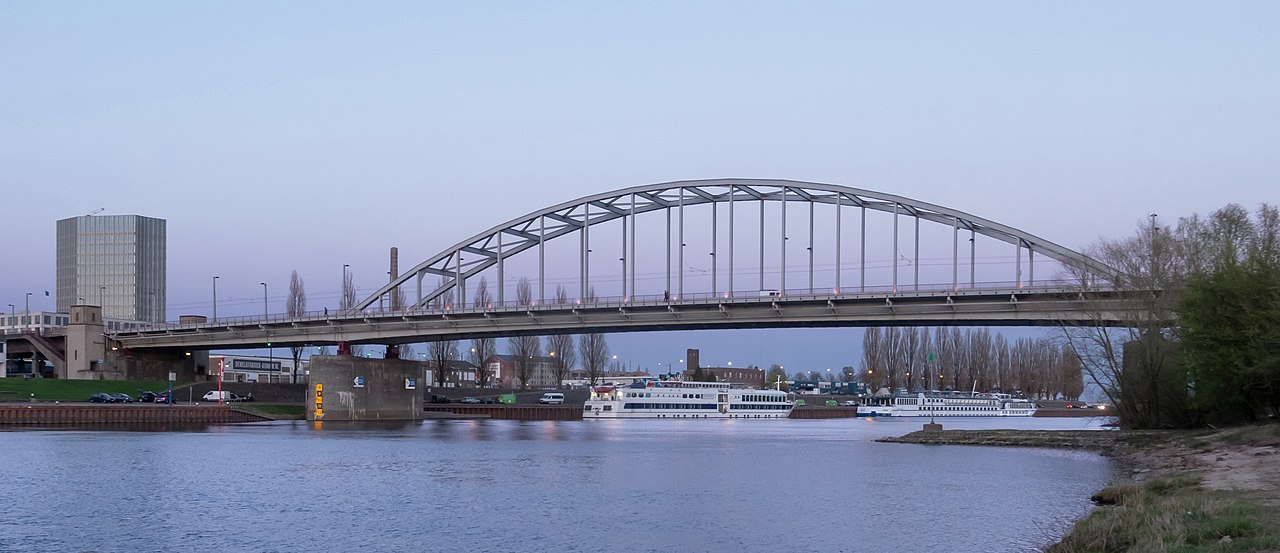
The John Frost Bridge is a road bridge spanning the Lower Rhine at the Dutch city of Arnhem. It forms an important local crossing for vehicular and pedestrian traffic and is widely recognised as a landmark because of its prominent role in World War II. The structure today combines post‑war reconstruction with surviving elements from the fighting, and it is closely associated with the memory of the Battle of Arnhem.
Image gallery
6 Images



History
The bridge was a strategic objective during Operation Market Garden in September 1944, when Allied airborne forces sought to secure river crossings in the Netherlands. British paratroopers fought to hold the bridge against German forces, an episode that became known as the Battle of Arnhem. The structure suffered severe damage during and after the fighting and was subsequently repaired and rebuilt in the postwar years.
Design and surviving fabric
The bridge is a steel crossing typical of mid‑20th century river bridges in the region. While most of the current superstructure dates from reconstruction after the war, several visible sections and fittings remain from the wartime period and have been preserved as tangible reminders of 1944; visitors can see original fragments and plaques alongside restored elements. More detailed information about preserved sections is available via related local resources and memorial sites (original sections).
Commemoration and cultural importance
Beyond its transport function, the bridge serves as a focal point for remembrance. Annual commemorations, battlefield tours and museum exhibits in Arnhem recall the airborne landings and the fighting to control the crossing. The bridge was later named in honour of Lieutenant Colonel John D. Frost, who commanded British forces that reached and held the northern end during the battle.
Today
- The crossing remains in regular use for local traffic and pedestrians.
- It is integrated into educational routes and remembrance trails in Arnhem.
- Visitors can learn about the battle and view preserved parts of the bridge at nearby museums and memorials.
As an element of both urban infrastructure and wartime memory, the John Frost Bridge continues to attract attention from residents, historians and visitors interested in World War II history and the reconstruction of postwar Europe.
Related articles
Author
AlegsaOnline.com John Frost Bridge (Arnhem) Leandro Alegsa
URL: https://en.alegsaonline.com/art/50635