
Jobi manucode (Manucodia jobiensis)
A medium-sized, glossy bird-of-paradise from Jobi Island and northern New Guinea; frugivore-insectivore, relatively common, with crow-like silhouette, red eyes, and distinctive vocalizations.
Overview
The Jobi manucode (Manucodia jobiensis) is a medium-sized member of the birds-of-paradise family known for a subdued but glossy plumage and a relatively plain, crow-like profile. Unlike the highly ornate and sexually dimorphic species in the same family, manucodes are more uniformly colored and show less dramatic sexual differences. The Jobi manucode is one of the more common birds-of-paradise within its range.
Image gallery
2 Images
Identification and characteristics
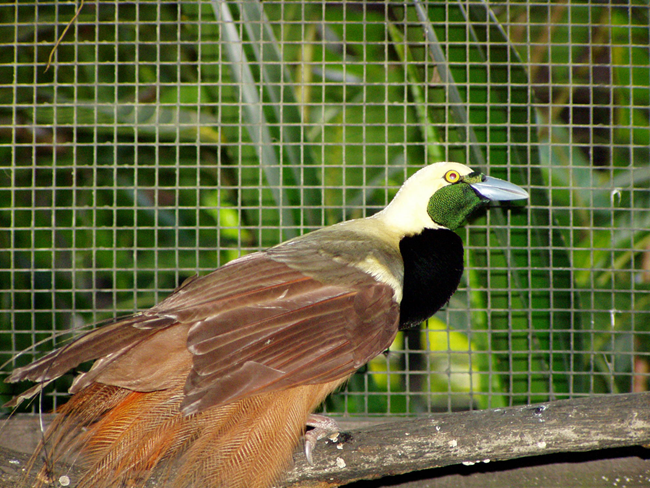
Adults reach roughly 30–34 cm in length and are notable for their iridescent dark feathers that can appear greenish-blue, black or purple under different lighting. Key field marks include a red iris, short crinkled bluish feathers on the upper breast and neck, and an overall compact, crow-like silhouette. The species' plumage is glossy rather than ornate, and males and females look similar to casual observers.
- Size: medium for the family (up to about 34 cm).
- Plumage: glossy black with greenish-blue and purple sheen.
- Eyes: red iris is distinctive.
- Feather texture: short, slightly crinkled upper breast and neck feathers.
Distribution and habitat
The Jobi manucode is native to lowland forest habitats on and around Jobi Island (Jobi Island) and parts of northern New Guinea (northern New Guinea). It favors primary and secondary rainforest, forest edges and tall riverine growth where fruiting trees and arthropod prey are available. Its tendency to inhabit dense canopy and mid-storey layers makes it more often heard than seen.
Behavior, diet and breeding
Diet consists mainly of fruit supplemented by insects and other small invertebrates; manucodes play a role in seed dispersal in their ecosystems. Vocal behavior is important for communication: the species produces loud, far-carrying calls used in territory defense and pair bonding. Compared with many birds-of-paradise, Jobi manucodes tend toward monogamy and simple courtship, lacking the elaborate display dances and plumage-flaring typical of other genera.
Conservation and notable facts
Because it is locally common across much of its limited range, the Jobi manucode is not regarded as one of the most threatened birds-of-paradise; populations are generally stable where forest habitat remains intact. Its relatively plain appearance and crow-like form distinguish it from its more spectacular relatives, a contrast sometimes summarized by field guides that note its "crow-like" body shape and glossy sheen (crow-like appearance).
As a conspicuous component of lowland forest avifaunas, the Jobi manucode illustrates the diversity of life-history strategies within Paradisaeidae, ranging from showy, lekking species to more cryptic, pair-bonded forms that rely on vocal and behavioral signals rather than extravagant plumage.
Related articles
Author
AlegsaOnline.com Jobi manucode (Manucodia jobiensis) Leandro Alegsa
URL: https://en.alegsaonline.com/art/50412
Sources
- iucnredlist.org : Manucodia jobiensis