
Jumping Spider (Salticidae): Overview, Behavior, and Distribution
Jumping spiders (Salticidae) are active, visually acute hunters found worldwide except Antarctica. About 5,000 described species inhabit diverse habitats and capture prey by leaping, often using a silk safety line.
Overview
Jumping spiders belong to the family Salticidae, the largest family of spiders by number of described species. Unlike many spiders that rely on webs to trap prey, salticids are active hunters that locate, stalk and leap onto their prey. They are widely noted for their compact bodies, agile movement and unusually well-developed vision among spiders.
Image gallery
10 Images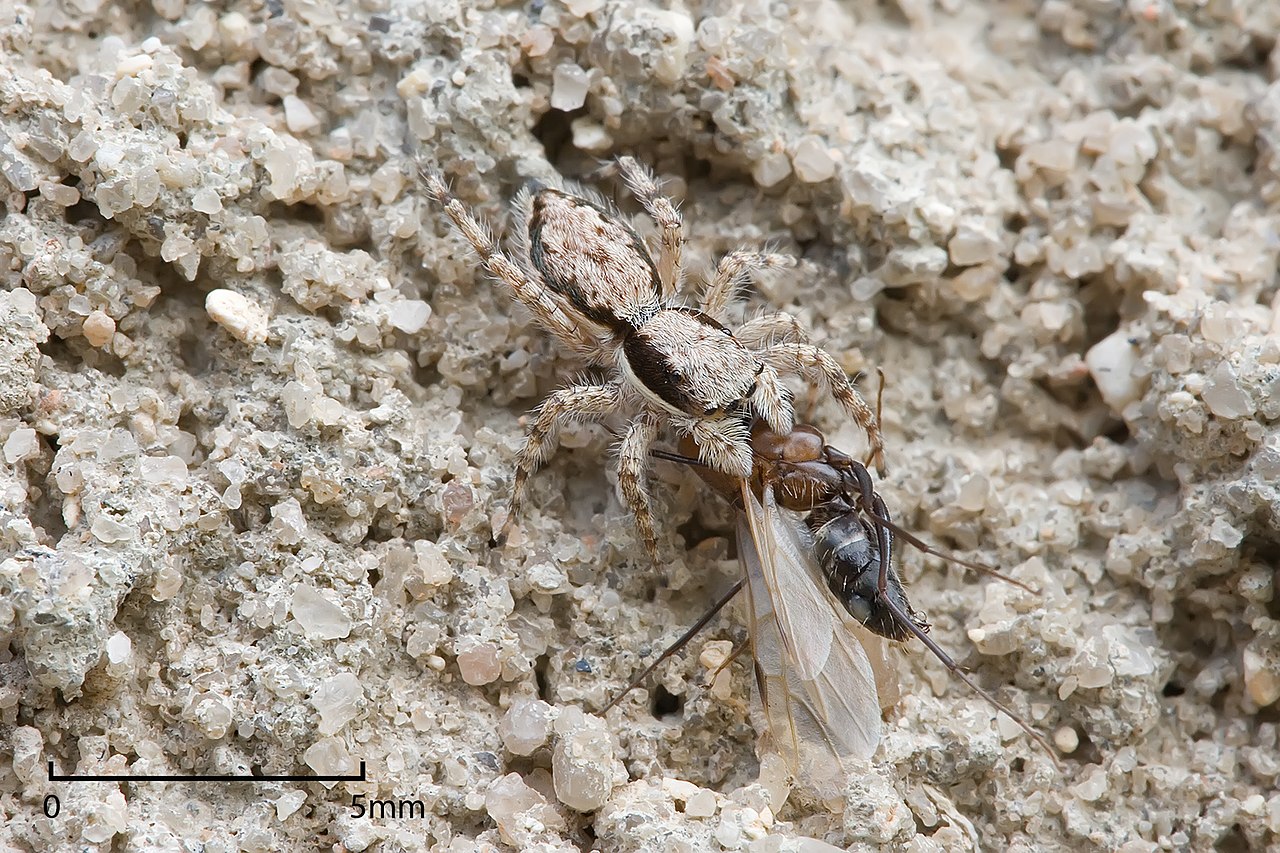
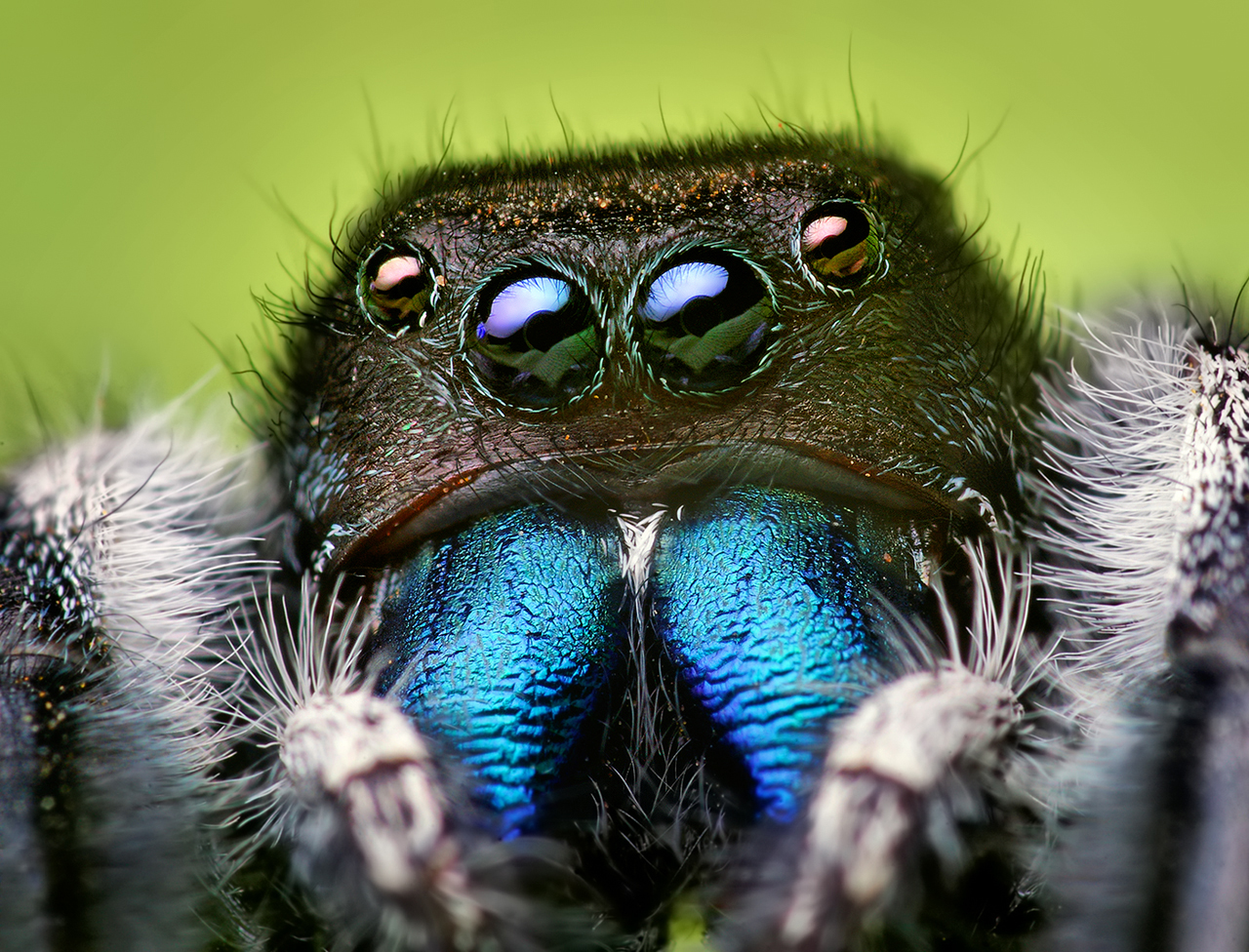


Distinctive features
Several traits distinguish jumping spiders from other spider groups. Their most conspicuous feature is the arrangement of their eyes: the large anterior median eyes give sharp, forward-facing vision and contribute to good depth perception. Powerful legs and a hydraulic mechanism in the body allow sudden, accurate jumps. Rather than building webs for catching food, these spiders use silk for draglines, shelters and egg sacs.
Vision and behavior
Salticids are predominantly diurnal and rely heavily on vision for hunting and communication. Their keen eyesight supports complex behaviors such as precise stalking, object recognition and elaborate courtship displays—males of many species perform visual signals that include leg waving, body postures and distinctive coloration. These visual displays and behaviors are subjects of active study in animal behavior and sensory biology.
Hunting technique
Jumping spiders locate prey visually, approach carefully and then leap to capture it. Before jumping, a spider commonly anchors a silk dragline that functions as a safety tether should the jump fail. Their diet mainly consists of small arthropods and insects; because of this, many species are considered beneficial in gardens and crop systems. Researchers often refer to general descriptions of salticid hunting methods for more detail (hunting methods).
Distribution and habitat
Salticids occur in a broad range of habitats, from ground-level leaf litter and grassland to shrubs, tree canopies and human-made structures. They are adaptable and have been recorded on every continent except Antarctica. For summaries and regional accounts of their habitats and ranges, consult field guides and faunal surveys (habitats, distribution).
Diversity and taxonomy
There are about 5,000 described species of jumping spiders, organized in several hundred genera. As the largest spider family by species count, Salticidae comprises a substantial fraction of known spider diversity. Taxonomy within the group continues to be refined as new species are described and genetic methods clarify relationships.
Life cycle and reproduction
Jumping spiders have a life cycle that includes egg, several immature (instar) stages and the adult. Females construct silk nests or retreats in which they lay and guard eggs; parental care varies by species. Courtship rituals are often elaborate and primarily visual, although chemical cues can also play a role.
Relationship with people and research value
Because many salticids are small, conspicuous and common near human habitation, they are familiar to naturalists and gardeners. They are harmless to humans and frequently help control pest insects. Scientific interest in jumping spiders extends to studies of vision, neural processing, behavior and robotic design inspired by their locomotion and perception.
Conservation and study
While many jumping spider species are widespread and common, habitat loss and environmental change can affect local populations. Ongoing taxonomic work, field surveys and ecological studies contribute to understanding their diversity and conservation needs. For general resources on identification and regional species lists, see accessible guides and specialist literature (identification, regional guides, faunal surveys).
Questions and answers
Q: What family do jumping spiders belong to?
A: Jumping spiders belong to the family Salticidae.
Q: How do jumping spiders catch their prey?
A: Jumping spiders catch their prey by jumping on them.
Q: Where do jumping spiders live?
A: Jumping spiders live in many habitats, from leaves lying on the ground to the tops of trees in the forest, and even on Mt. Everest.
Q: On which continent are jumping spiders not found?
A: Jumping spiders are not found on Antarctica.
Q: How many species of jumping spiders have been found?
A: At present, 5026 species in 530 genera have been found.
Q: What percentage of all spider species do jumping spiders make up?
A: Jumping spiders are the largest family of spiders, comprising about 13% of all species.
Q: Are jumping spiders found only in certain parts of the world?
A: No, jumping spiders are found on every continent in the world except for Antarctica.
Related articles
Author
AlegsaOnline.com Jumping Spider (Salticidae): Overview, Behavior, and Distribution Leandro Alegsa
URL: https://en.alegsaonline.com/art/51575
Sources
- peckhamia.com : "Salticidae of the Antarctic land bridge"
- zoolstud.sinica.edu.tw : zoolstud.sinica.edu.tw/Journals/41.1/1.pdf
- forestis.rsvs.ulaval.ca : forestis.rsvs.ulaval.ca
- youtube.com : National Geographic video of capture of bee by jumping spider
- tolweb.org : tolweb.org/accessory/Jumping_Spider_Vision?acc_id=1946