
Jana Gana Mana — National anthem of India
Overview of 'Jana Gana Mana': its origin as a poem by Rabindranath Tagore, language and text, adoption as India's national anthem, musical setting, ceremonial use and notable historical points.
Overview
"Jana Gana Mana" is the national anthem of India. The words began life as a Bengali poem written in 1911 and were later adopted in part as the national anthem when the Republic of India was formed. The anthem's text, melody and ceremonial use occupy an important place in modern Indian civic life.
Image gallery
6 Images


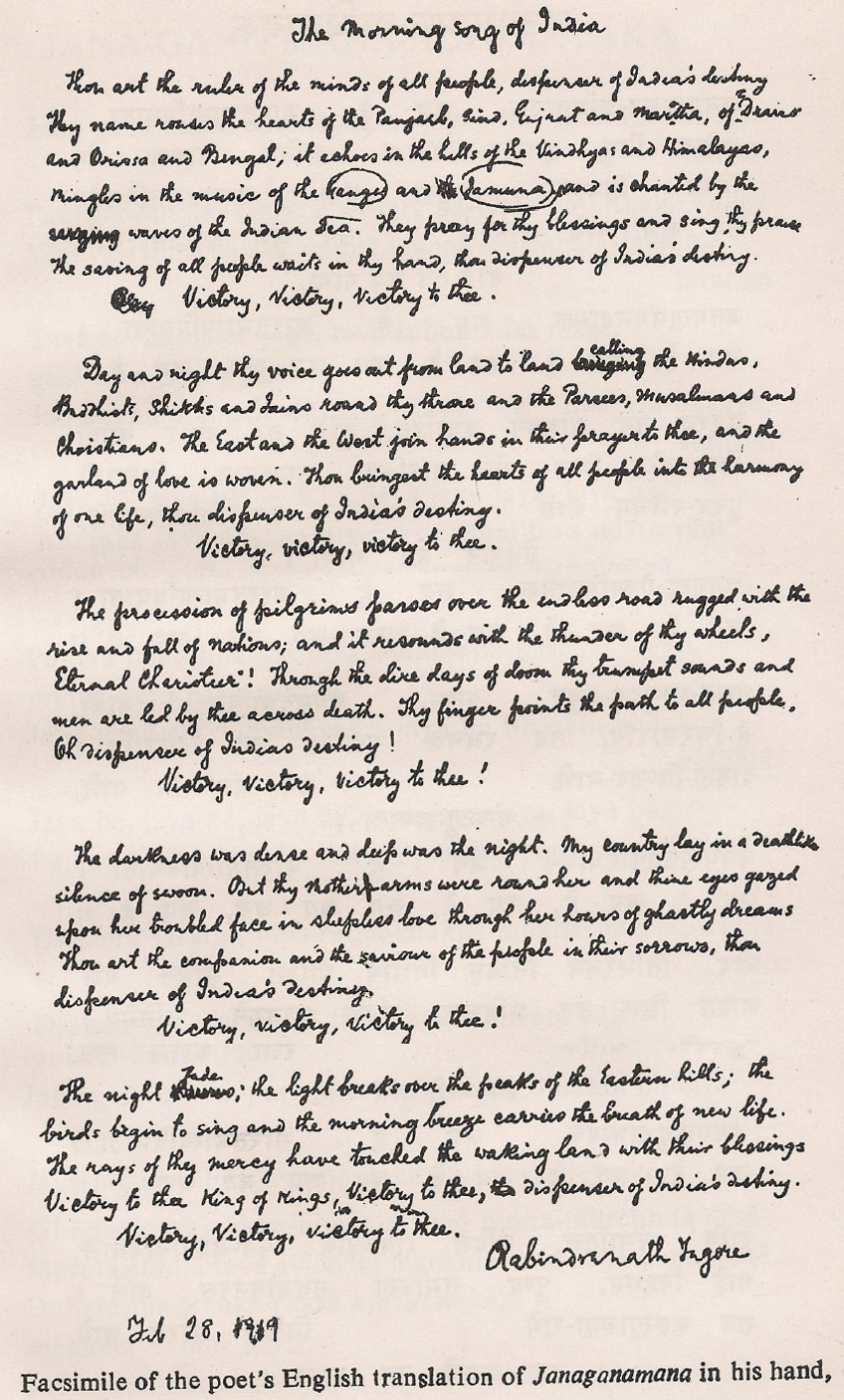
Origins and author
The poem was composed by the poet, composer and Nobel laureate Rabindranath Tagore, who wrote many songs and poems in Bengali. The poem was first sung publicly during a session of the Indian National Congress in 1911. Tagore's work combines regional literary traditions with a vocabulary that includes many words derived from classical sources.
For background on the Bengali literary context see Bengali. More on the author is available via Rabindranath Tagore.
Text, language and meaning
The original poem has multiple stanzas, but the official anthem uses only the opening stanza. While the poem was written in a form of Bengali, its diction incorporates many elements from Sanskrit-rooted vocabulary, creating a register that is widely intelligible across northern and eastern India. Readers often translate the title as "Thou art the ruler of the minds of all people," reflecting the poem's address to a unifying, guiding presence.
Adoption and official status
Following independence, the Constituent Assembly of India selected the first stanza of Tagore's poem as the national anthem in 1950. From that point, it has been used at official ceremonies and international events to represent the Republic of India. The anthem is part of state protocol and is performed at flag ceremonies, government functions and other public events.
Music, performance and protocol
Tagore himself set the poem to music; subsequent performances have followed his melody while allowing for orchestral arrangements and choral renderings. The anthem is generally performed in a restrained and respectful manner; audiences and participants follow established conventions to show reverence during its playing.
- Official practice: the first stanza only is sung as the national anthem.
- Performance length: public renditions are concise and intended to be dignified.
- Ceremonial etiquette: audiences typically stand and observe respectful behavior while it plays.
History, interpretations and related works
Since its composition the poem has attracted scholarly attention and occasional debate. Some commentators have offered differing readings of its references and celebrations; such interpretations are not universally agreed. Tagore also composed other national and patriotic songs in the Bengali literary sphere—most notably another famous regional anthem associated with what is now Bangladesh; for that work see the Bangladeshi anthem.
For general information about national anthems and related ceremonial practice, see national anthem resources and overviews about India. The linguistic influences in the anthem, including words drawn from classical languages, can be explored further via sources on Sanskrit.
"Jana Gana Mana" continues to be a symbol of national identity in India and a work widely studied for its poetic craft, historical context and role in public life.
Related articles
Author
AlegsaOnline.com Jana Gana Mana — National anthem of India Leandro Alegsa
URL: https://en.alegsaonline.com/art/49386