
Apollo 16: Fifth Lunar Landing — Descartes Highlands Exploration (1972)
Apollo 16 (launched April 16, 1972) was NASA's tenth crewed Apollo mission and the fifth lunar landing, focused on exploring the Descartes Highlands with a rover and deploying surface and orbital experiments.
Overview
Apollo 16 was the tenth crewed mission of NASA and the fifth to land humans on the Moon, launched on April 16, 1972. The flight was a J-type mission, designed for extended surface operations and enhanced scientific investigation. The crew comprised commander John Young, lunar module pilot Charles Duke, and command module pilot Ken Mattingly. The lunar module was named Orion and the command module was Casper.
Image gallery
10 Images


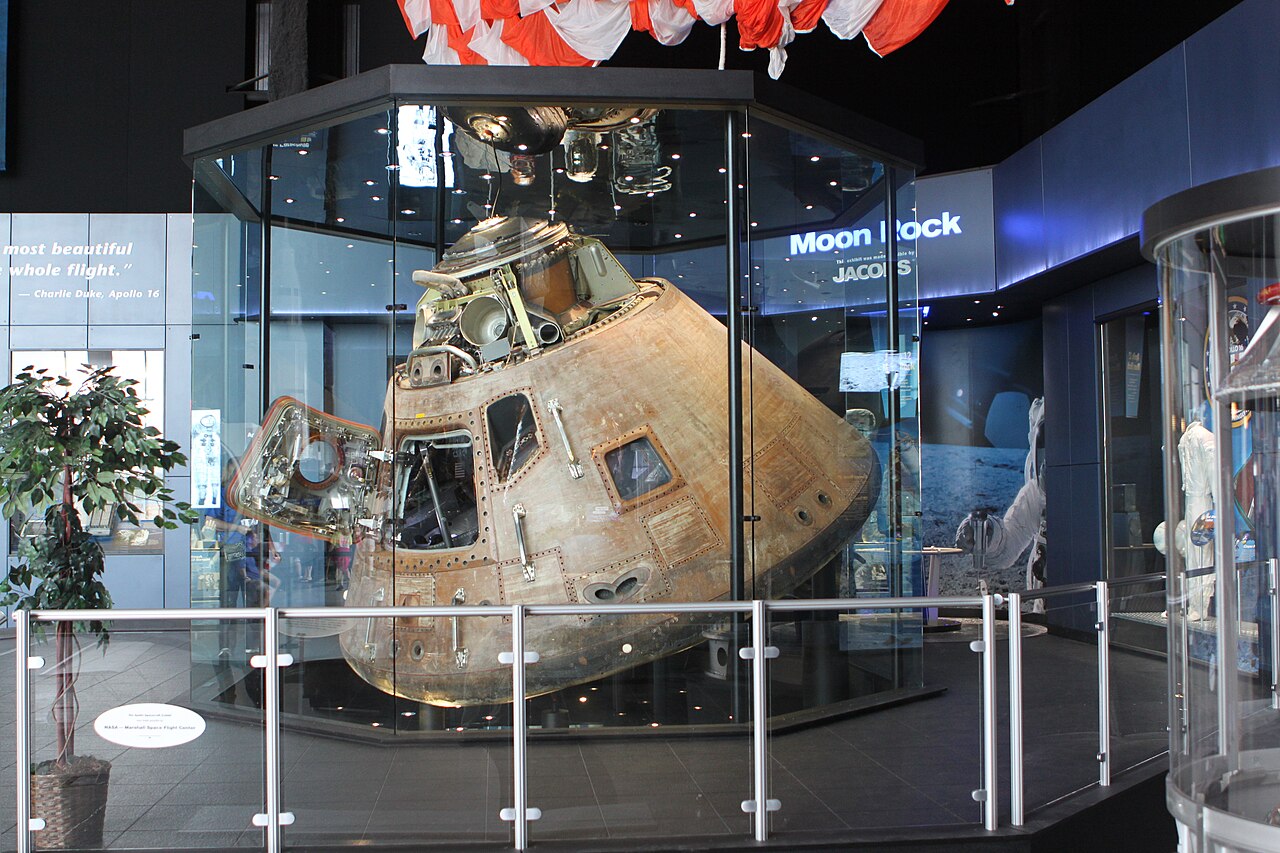

Crew and vehicles
John Young and Charles Duke descended to the lunar surface in Orion while Ken Mattingly remained aboard Casper in lunar orbit. The mission used a Saturn V launcher for translunar injection. On the surface, the astronauts used the Lunar Roving Vehicle to extend their range for geology traverses and to carry tools and samples. The mission also carried a suite of surface experiments as part of the Apollo Lunar Surface Experiment Package (ALSEP) and a set of orbital instruments in the service module.
Mission timeline and operations
After launch and translunar coast, the crew performed lunar orbit insertion and preparations for landing. The lunar module landed in the Descartes Highlands, a region selected to sample highland crust thought to be different from mare basalts returned by earlier missions. While Young and Duke worked on the surface, Mattingly conducted orbital observations and experiments from Casper, supporting surface activities and collecting additional data.
Surface EVAs and rover use
Young and Duke conducted multiple extravehicular activities (EVAs) during which they drove the rover, collected rock and soil specimens, and emplaced scientific instruments. The rover enabled longer traverses and systematic sampling of diverse highland outcrops and impact-related features. The crew performed vehicle handling tests such as turns and braking maneuvers to evaluate rover performance on slopes and rough terrain, and documented geological context with photography and field notes.
Scientific instruments and orbital work
The mission emphasized coordinated surface and orbital science. The service module carried a Scientific Instrument Module (SIM) with cameras and remote-sensing experiments to map geology and measure properties of the lunar surface. A small subsatellite was deployed during the return leg to collect data on the Moon's gravity field, charged particles, and magnetic interactions between the Moon and Earth; these measurements contributed to understanding lunar mass concentrations and the near‑lunar space environment.
Results, challenges and significance
- Geology: Samples and observations from the Descartes region added to knowledge of the Moon's highland crust and impact history, prompting refinement of existing interpretations of lunar processes.
- Operations: The rover demonstrated reliable increased mobility for field geology and informed future planetary surface vehicle design and procedures.
- Mission issues: Some spacecraft anomalies affected the original timeline, and planners curtailed certain activities to preserve safety and mission objectives; nonetheless, primary science goals were accomplished.
Legacy and further reading
Apollo 16 provided valuable samples, field observations, and coordinated orbital datasets that remain part of the scientific record on lunar origins and crustal structure. For more on the mission and its experiments, consult broader program histories and mission archives such as the Apollo program overview, NASA mission pages at agency sites, and crew biographies like those of John Young and Charles Duke. Technical summaries describe the command module operations and the subsatellite investigation, while vehicle and rover performance reviews are discussed in sources addressing the Lunar Roving Vehicle and mission logistics. Additional archival material and mission analyses can be found through program collections and specialist repositories such as lunar landing archives and institutional summaries at agency and historical pages.
Related articles
Author
AlegsaOnline.com Apollo 16: Fifth Lunar Landing — Descartes Highlands Exploration (1972) Leandro Alegsa
URL: https://en.alegsaonline.com/art/4908
Sources
- nasa.gov : "NASA - Apollo 16"
- jsc.nasa.gov : "Astronaut Bio: Thomas K. Mattingly II"