
Iodine trichloride (ICl3): properties, structure, and uses
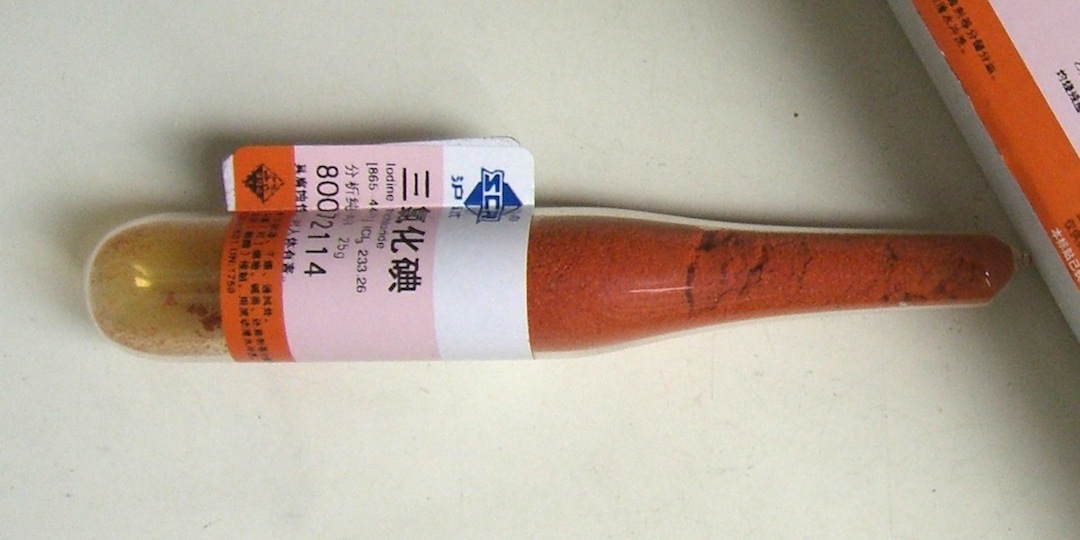
Iodine trichloride (ICl3) is a covalent halogen compound of iodine and chlorine. It is a yellow-brown solid used as a chlorinating and oxidizing reagent and notable for its dimeric solid structure.
Overview
Iodine trichloride is a halogen compound with the formula ICl3. It consists of one iodine atom and three chlorine atoms and is classified as a covalent molecular halide rather than a simple ionic salt. The central iodine typically bears a formal +3 oxidation state, which affects its reactivity and bonding (oxidation state +3).
Image gallery
3 Images

Structure and physical properties
In the gas phase or as a discrete molecule the geometry around iodine is T-shaped, derived from a trigonal bipyramidal electron arrangement with two lone pairs. In the solid state iodine trichloride exists as a dimer, commonly written I2Cl6, where two iodine centers are bridged by chlorine atoms to give each iodine an expanded coordination environment. These structural forms explain many of its characteristic physical properties, such as its yellow-to-brown appearance and tendency to form layered crystals.
Preparation and chemical behavior
ICl3 can be prepared by direct combination of elemental iodine and chlorine in controlled conditions or by disproportionation reactions of other iodine chlorides. It behaves as a moderate oxidizing and chlorinating agent: it can transfer chlorine to organic substrates and engage in electrophilic halogenation. It hydrolyzes on contact with water, giving rise to iodine-containing oxoacids and free chlorine species, so it is handled under dry conditions.
Uses and applications
In laboratory and industrial chemistry iodine trichloride finds application as a reagent for chlorination and for introducing activated halogen substituents on aromatic systems. It is also used in some analytical and preparative contexts where a source of electrophilic chlorine is required. Because it contains both iodine (iodine) and chlorine (chlorine), it is sometimes employed in studies of halogen bonding and intermolecular interactions (halogen bonding research).
Handling and notable facts
- Corrosive and a respiratory/eye irritant; handle under inert atmosphere and use appropriate PPE.
- Reacts with water and many reducing agents; incompatible with organic materials in uncontrolled conditions.
- Distinct from iodine monochloride (ICl) and iodine pentachloride (ICl5) in oxidation state, geometry, and reactivity.
Though not as commonly encountered as simpler halogen reagents, iodine trichloride plays a useful role in specialized synthesis and in fundamental studies of halogen chemistry.
Related articles
Author
AlegsaOnline.com Iodine trichloride (ICl3): properties, structure, and uses Leandro Alegsa
URL: https://en.alegsaonline.com/art/47960