
Inverted roller coaster
A roller coaster style in which trains run beneath the track and riders' legs dangle; popularized by Swiss firm Bolliger & Mabillard in the early 1990s and known for smooth, intense inversions.
Overview
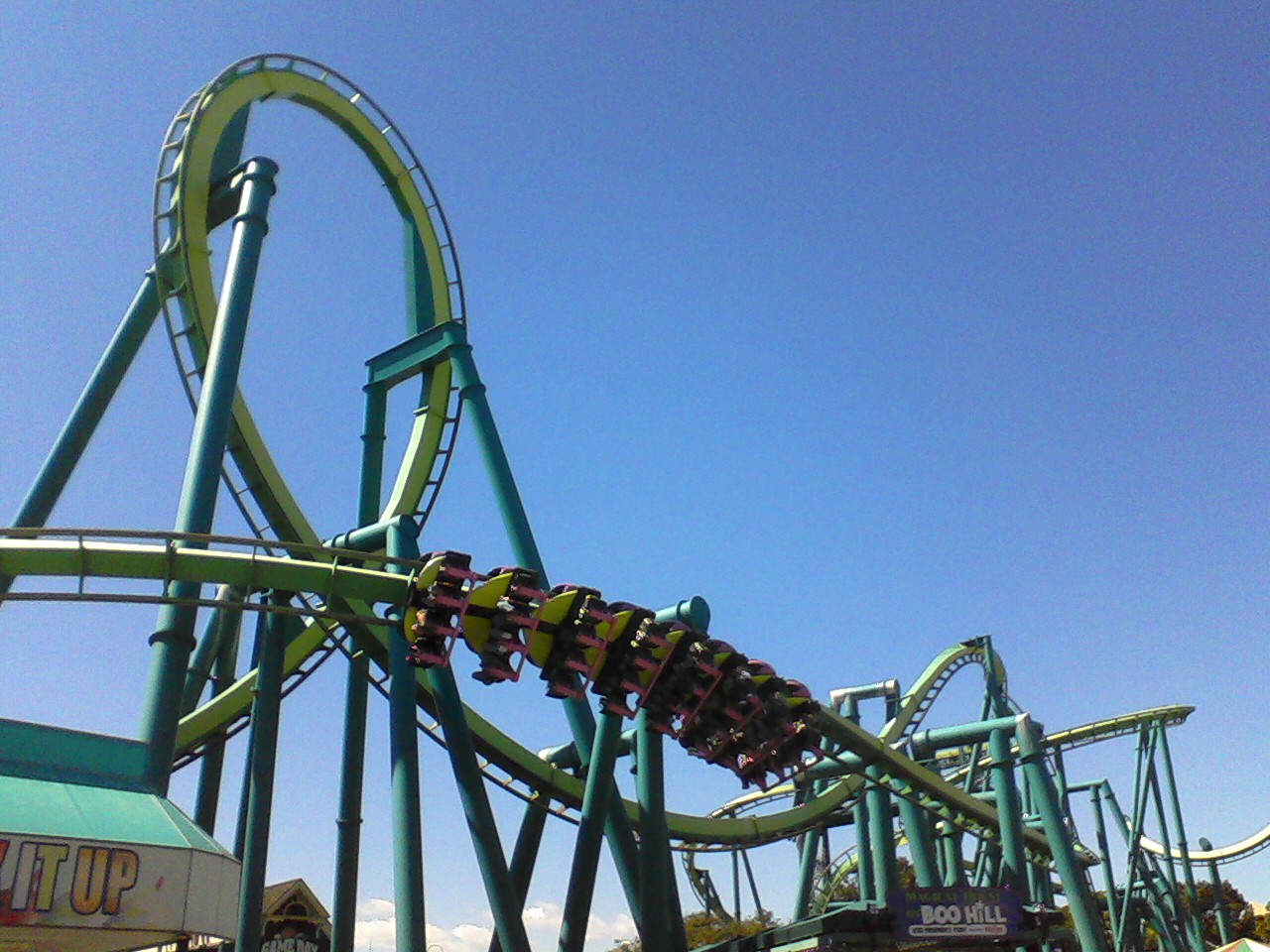
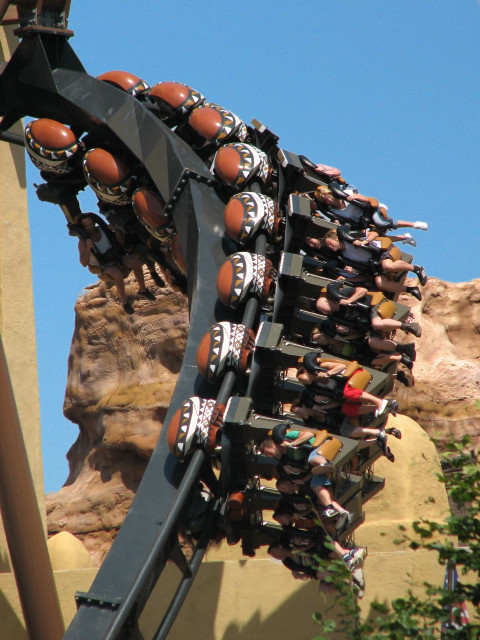
An inverted roller coaster carries its train beneath a fixed steel track so that passengers are suspended with their feet hanging freely. Seats are attached to the underside of the track rather than mounted above it, producing an exposed sensation and a wide field of view. The configuration emphasizes lateral and rotational forces during maneuvers and often makes near‑miss elements and terrain interactions more dramatic.
Image gallery
10 Images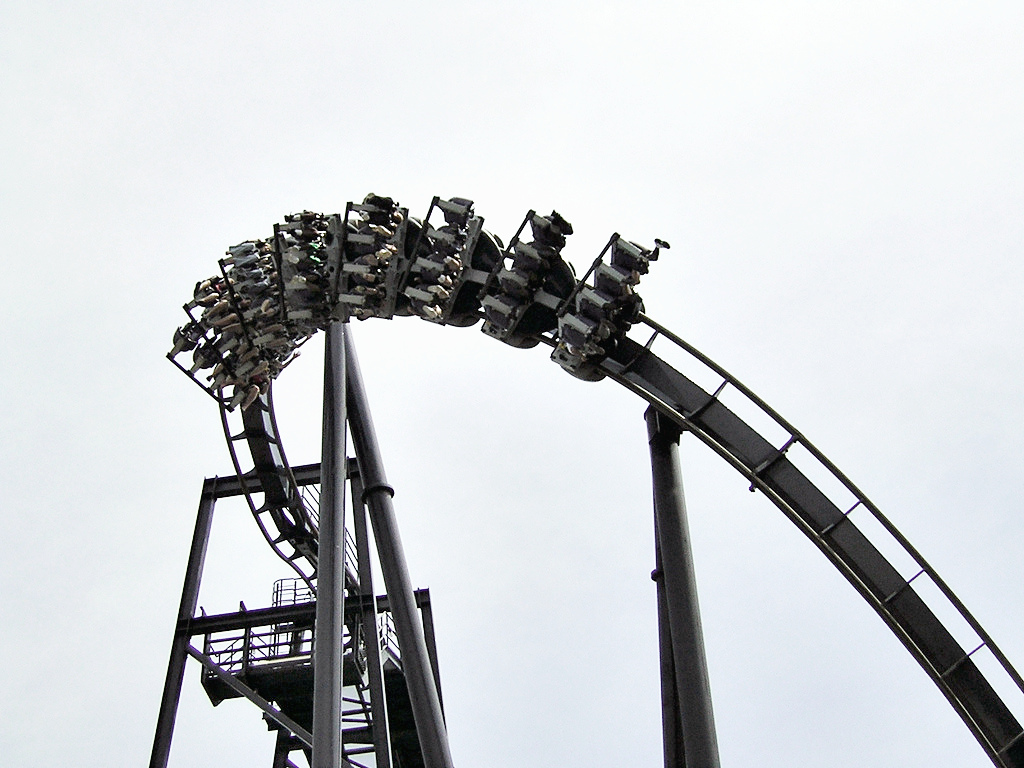





Design and characteristics
Inverted coasters use a rigid train chassis that is bolted to the overhead track; individual cars do not swing independently. Riders are restrained by systems ranging from traditional over‑the‑shoulder harnesses to vest‑style and hybrid restraints found on newer models. The open area beneath the riders increases the perception of speed and vulnerability, while the overhead track enables compact, intricately twisted layouts that move quickly through inversions and directional changes.
Ride experience
The suspended seating and lack of a floor give inverted coasters a distinctive feel: strong hanging forces in turns, clear sightlines through inversions, and heightened sensations during near‑miss elements. Designers exploit this by placing inversions, corkscrews and rolls close to structures or terrain to intensify the visual and physical experience. Ride pacing, restraint comfort and track profiling are important to balance thrill and rider comfort.
Common elements
- Vertical loop and corkscrew — classic inversions rotating riders end over end.
- Zero‑G roll — a brief element that produces a feeling of weightlessness.
- Immelmann and dive loop — half‑loop maneuvers that reverse direction.
- Cobra roll, batwing and inline twist — multi‑axis elements used in compact sequences.
History and development
The modern inverted coaster form was refined and popularized in the early 1990s by the Swiss manufacturer Bolliger & Mabillard. Their early installations established a template of smooth track geometry, under‑track fixed trains and a sequence of dramatic inversions. The format proved commercially successful and was subsequently adapted by other manufacturers and designers to produce a range of installations, from compact, inversion‑dense layouts to larger, terrain‑following experiences.
Variations and comparisons
Inverted coasters are distinct from older suspended coasters, which featured freely swinging cars, and from flying coasters, which orient riders face‑down to simulate flight. Wing coasters place seats beside the track rather than beneath it. Each type offers different sightlines and force profiles; inverted designs are often chosen when a park wants an exposed, inversion‑focused thrill that fits a relatively small footprint.
Safety, operations and maintenance
Safety on inverted coasters relies on robust engineering, regular inspections and well‑maintained restraint systems. Routine maintenance includes checking fasteners, track alignment, wheel assemblies and restraint function. Operational considerations such as train capacity, dispatch interval and rider loading procedures affect throughput and guest experience; parks balance these factors when integrating an inverted coaster into their offerings.
Legacy and significance
Inverted roller coasters remain a popular choice in modern parks because they combine a dramatic rider perspective with the ability to incorporate multiple inversions and compact layouts. Their visual profile—trains visible beneath a ribbon of steel track—has become an iconic element of many contemporary thrill parks and continues to influence coaster design and rider expectations.
Related articles
Author
AlegsaOnline.com Inverted roller coaster Leandro Alegsa
URL: https://en.alegsaonline.com/art/47920