
Insomnia (2002 film)
Insomnia is Christopher Nolan’s 2002 psychological crime thriller, a remake of a Norwegian film, noted for its performances by Al Pacino and Robin Williams and its exploration of guilt and sleep deprivation.
Overview
Insomnia is a 2002 American psychological crime thriller directed by Christopher Nolan. The film follows two veteran Los Angeles homicide detectives who travel to the small Arctic community of Nightmute, Alaska to investigate the murder of a teenage girl. The prolonged daylight of the Alaskan summer makes sleep difficult and turns sleeplessness into a central dramatic device: the lead detective’s inability to sleep intensifies doubt, impairs judgment and heightens moral ambiguity throughout the investigation.
Image gallery
2 Images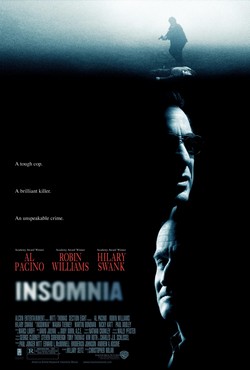

Story and themes
The plot unfolds as a tense procedural that emphasizes conscience and the corrosion of ethics under pressure. Themes include guilt, the unreliability of perception, personal responsibility and the psychological effects of sleep deprivation. Nolan frames these ideas with a restrained approach to action, favoring mood, dialogue and character conflict over spectacle. The film explores how a law enforcer’s mistakes and compromises can mirror—and sometimes feed—the crimes under investigation.
Cast and performances
- Al Pacino plays the lead detective, giving a performance centered on inner turmoil and a growing sense of vulnerability as sleep evades him and his decisions grow morally fraught.
- Robin Williams portrays the prime suspect, a seemingly affable and intelligent local whose charm masks a chilling capacity for manipulation; critics singled out Williams for a performance that subverted his comic persona.
- Hilary Swank appears as a local detective whose commitment to duty complicates the case and challenges the outsiders’ assumptions.
- Supporting cast includes Maura Tierney, Paul Dooley, Martin Donovan and Nicky Katt, who add depth to the investigative ensemble and the town’s atmosphere.
Production and adaptation
Insomnia is a remake of a 1997 Norwegian film of the same name; Nolan and screenwriter Hillary Seitz rework the story for an American setting while keeping its moral core. The production uses light, color and camera work to translate psychological states into visual terms: persistent daylight and cool palettes underscore disorientation and ethical strain. The screenplay tightens the procedural elements to focus on character dilemmas rather than broad action set pieces.
Release and reception
Released in May 2002, the film earned generally positive reviews for its writing, direction and performances, with particular praise for Pacino and Williams. Reviewers noted Nolan’s ability to sustain suspense through character tension and moral questions. Insomnia performed solidly at the box office, earning more than its reported production budget and helping to raise Nolan’s profile as a director capable of intelligent genre work.
Comparison with the original and legacy
Compared with the Scandinavian original, Nolan’s adaptation is often described as more star-driven and stylistically precise while retaining the first film’s preoccupation with conscience and error. The movie contributed to Nolan’s reputation for combining genre forms with ethical complexity and remains a frequently cited example of how a remake can reinterpret tone and performance without abandoning the source’s central dilemmas.
Context and significance
Insomnia sits at a transitional point in the director’s career, between earlier independent efforts and his later, larger-scale projects. It demonstrates an interest in moral ambiguity, psychological realism and craft-driven filmmaking. The film also stands as a notable dramatic role for its lead actors, particularly for an unexpected turn by a performer best known at the time for comedy, and for its study of how ordinary human limitations—like sleeplessness—can have dramatic consequences in high-stakes situations.
For further reading on the original source and contemporary commentary, see the 1997 Norwegian original and critiques that compare both versions of the story; details on cast and crew can be found in standard filmographies and reviews. The film also provokes discussion about policing, accountability and the narrative uses of environment in crime drama, subjects that continue to interest critics and viewers.
Related topics: the 1997 Norwegian original is often cited as the source material in articles and retrospectives (1997 Norwegian original), while general information about the setting and the protagonists appears in profiles of Los Angeles law enforcement and regional crime dramas. Contemporary interviews and production notes are available in various film archives and interviews with the director and cast (Pacino profile, Williams interview, Swank discussion, Tierney comments, Dooley remarks, Nightmute setting).
Related articles
Author
AlegsaOnline.com Insomnia (2002 film) Leandro Alegsa
URL: https://en.alegsaonline.com/art/47454