
Interstellar (2014 film)
Christopher Nolan's 2014 science-fiction epic about space travel, time, and human survival, noted for visual effects, scientific consultation, score by Hans Zimmer, and a star ensemble cast.
Interstellar is a 2014 British–American science-fiction epic directed, co-written and produced by Christopher Nolan. The film follows a group of astronauts who travel through a wormhole near Saturn seeking a new home for humanity amid ecological collapse on Earth. Released in November 2014, it earned attention for ambitious storytelling, large-format cinematography and a powerful musical score.
Image gallery
10 Images
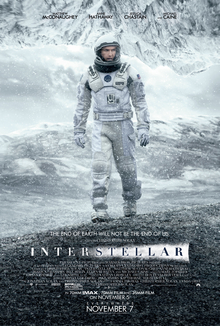





Overview and themes
At its core the film combines speculative physics with intimate human drama. Major themes include survival, the passage of time, parental love and the ethical dimensions of exploration. The narrative interweaves scientific ideas—relativity, black holes and wormholes—with emotional stakes, using family relationships to give scale to the cosmic events depicted on screen.
Production, science and visuals
The project involved extended scientific consultation to depict relativistic effects plausibly; physicist Kip Thorne advised the production and helped translate equations into visual terms. Cinematography emphasized practical effects and large-format film photography, complemented by digital work to create realistic space environments. The depiction of the black hole and accretion disk attracted particular notice for its basis in theoretical models, which later contributed to technical discussions in the scientific community. Hans Zimmer composed the score, which was widely praised for its emotional intensity and use of pipe organ textures.
Cast and characters
- Matthew McConaughey as the mission's central figure.
- Anne Hathaway in a key supporting role.
- Jessica Chastain portraying the protagonist's family member.
- Bill Irwin and Ellen Burstyn in important character parts.
- Michael Caine appears as an influential mentor figure.
- Mackenzie Foy as the protagonist's child, with Matt Damon, Casey Affleck and John Lithgow in supporting roles.
Release, reception and legacy
Upon release the film was both a commercial success and a subject of critical discussion. Reviewers commonly praised its visuals, sound design and ambition while some debated aspects of the screenplay and explanations of scientific concepts. It was recognized in awards seasons, winning accolades for visual effects and receiving multiple nominations across technical categories. In the years since, the film has become a reference point in conversations about science in cinema and the challenges of portraying complex physics while maintaining dramatic momentum.
Interstellar remains notable for blending blockbuster spectacle with philosophical questions about humanity's future, and for fostering dialogue between filmmakers and scientists about how to render advanced physical phenomena on screen. For more on the director, production notes and cast biographies see entries linked above and further resources at production notes and composer overviews at film music.
Related articles
Author
AlegsaOnline.com Interstellar (2014 film) Leandro Alegsa
URL: https://en.alegsaonline.com/art/47837