
Icosagon (20-sided polygon)
An icosagon is a polygon with 20 sides and 20 vertices. This article covers its defining properties, regular form, key formulas, constructibility, symmetry, and notable variations such as star icosagrams.
An icosagon is a polygon with twenty sides and twenty vertices. The regular icosagon is equiangular and equilateral: each interior angle measures 162° and each exterior angle measures 18°. The sum of all interior angles of any icosagon equals 3,240° (found from (n-2)×180° for n=20). Irregular icosagons exist with sides and angles of varying lengths but maintain the same number of edges and corners.
Image gallery
9 Images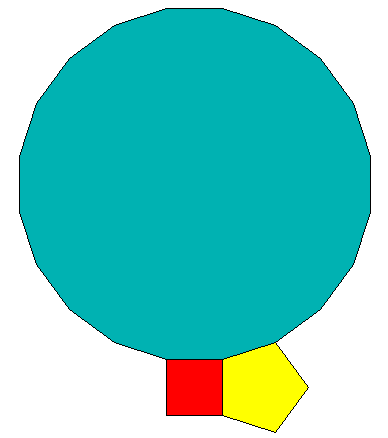


Characteristics and simple formulas
Key combinatorial and angular facts for any 20-sided polygon include:
- Number of sides: 20; number of vertices: 20.
- Sum of interior angles: 3,240°.
- Interior angle of a regular icosagon: 162°; exterior angle: 18°.
- Number of diagonals: 170, given by n(n-3)/2 = 20×17/2.
Regular icosagon: measurements and formulas
The regular icosagon (Schläfli symbol {20}) has simple relations that follow from general n‑gon formulas. For side length a:
- Area: A = (n a^2) / (4 tan(π/n)) = 5 a^2 / tan(π/20).
- Circumradius: R = a / (2 sin(π/n)) = a / (2 sin(π/20)).
- Inradius: r = a / (2 tan(π/n)) = a / (2 tan(π/20)).
These expressions come from dividing the polygon into 20 isosceles triangles meeting at the center. Numerical evaluation uses π/20 = 9° in radians; many constructions and computations exploit exact trigonometric values related to the pentagon because 20 = 4×5.
Construction and symmetry
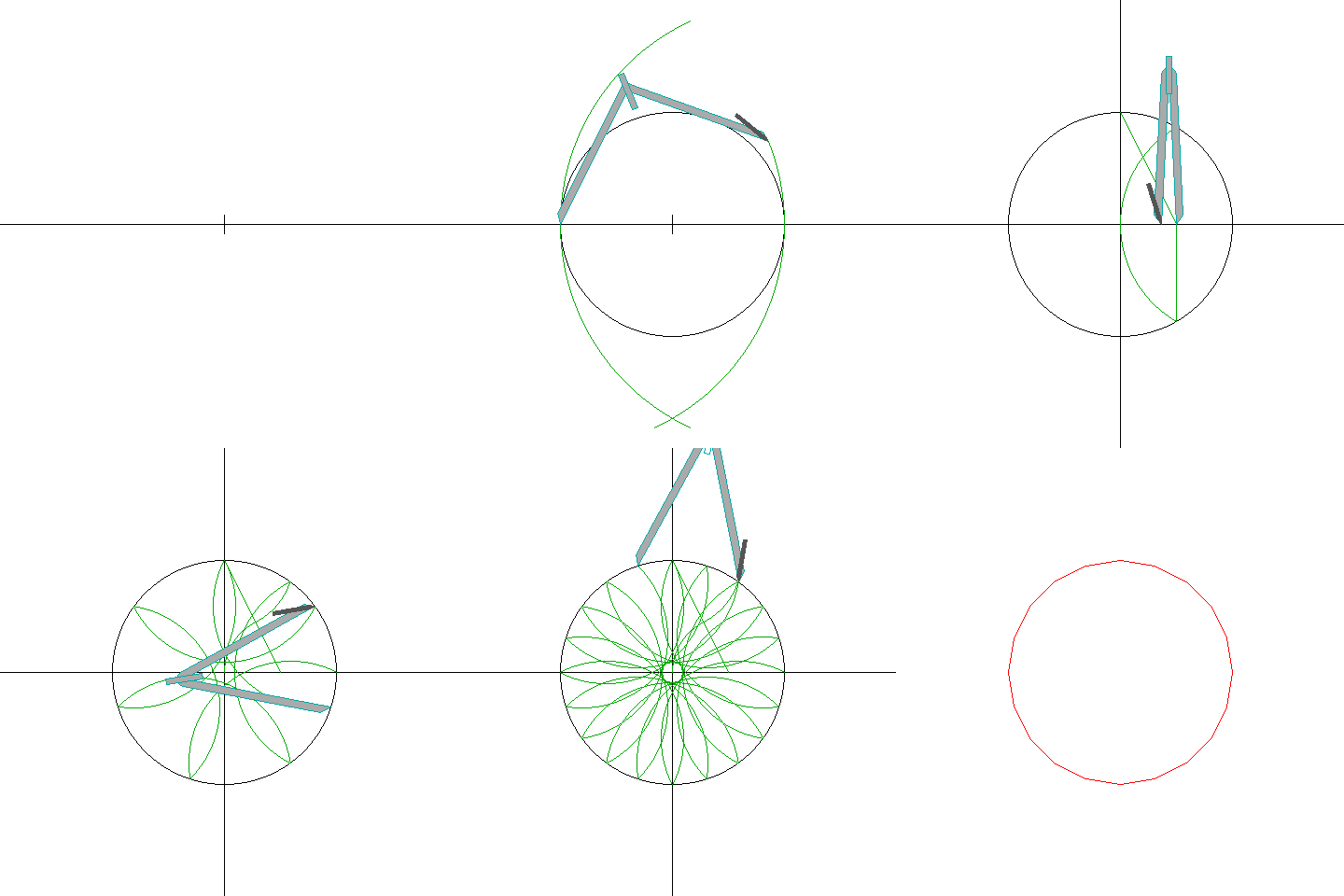
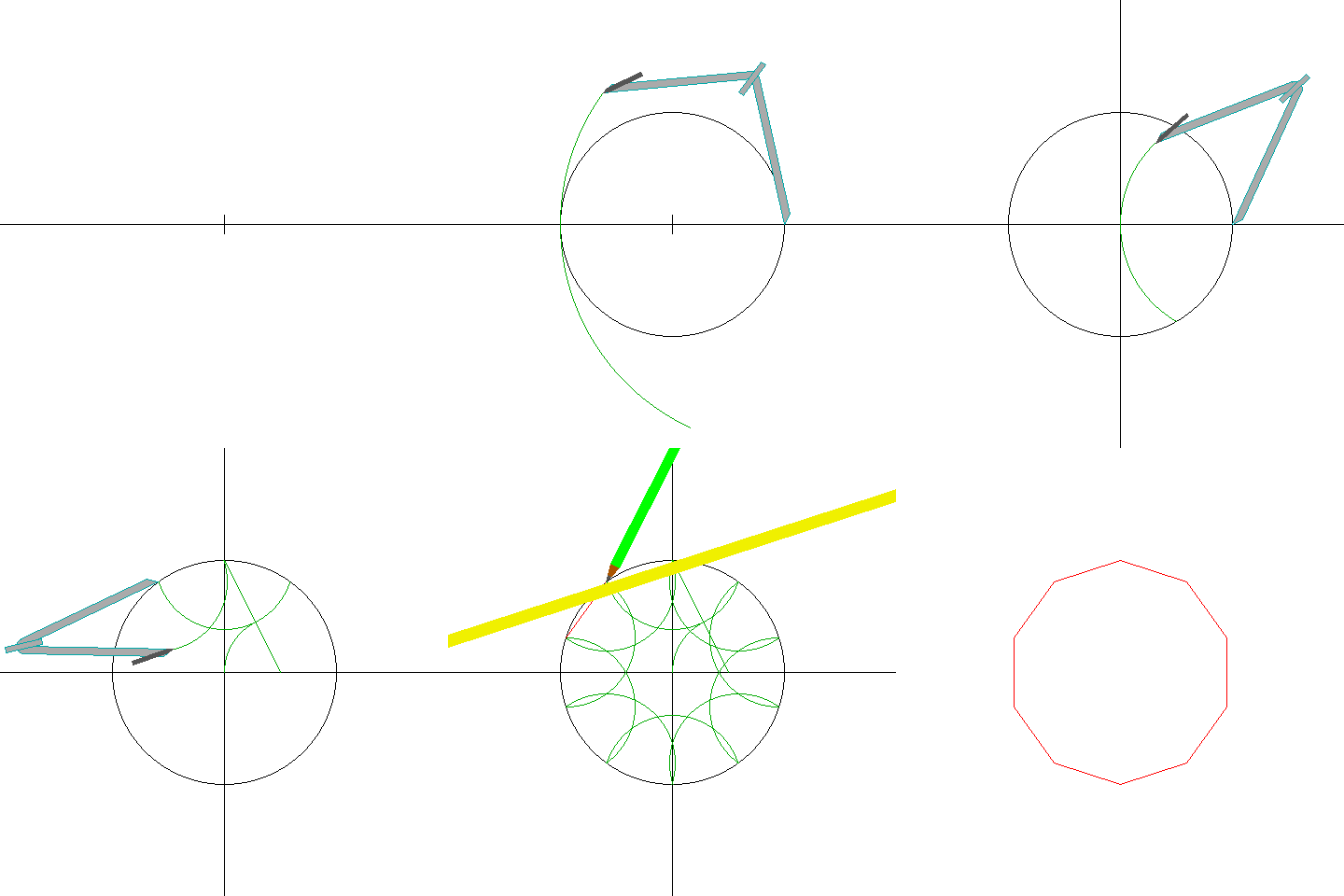
The regular icosagon is compass-and-straightedge constructible because 20 = 2^2×5 and 5 is a Fermat prime. Its full symmetry group is the dihedral group D20 of order 40, including 20 rotations and 20 reflections. Practical constructions often proceed by constructing a regular pentagon or decagon and performing successive angle bisections to obtain the 20 equal central angles.
Variations, star forms and uses
Beyond the regular convex form, the icosagon family includes star polygons (icosagrams) with Schläfli symbols such as {20/3}, {20/7}, and other {20/k} where k is coprime to 20; these produce 20-pointed star figures with different connection patterns. Icosagons and icosagrams appear in decorative motifs, tessellation studies, and polygonal constructions in geometry education. For more general information and resources about the icosagon see Icosagon.
Notable practical points: the 18° exterior angle makes the regular icosagon useful when dividing a circle into 20 equal parts for layout and design tasks. The connection to the pentagon and decagon simplifies exact constructions and algebraic expressions for trigonometric constants that appear in closed-form area and length formulas.
Related articles
Author
AlegsaOnline.com Icosagon (20-sided polygon) Leandro Alegsa
URL: https://en.alegsaonline.com/art/46492
Sources
- researchmagazine.uga.edu : "To Span the Globe"
- mathworld.wolfram.com : Icosagon
- mathforum.org : Naming Polygons and Polyhedra
- books.google.com : icosagon