
Cosmic Inflation (cosmology)
Cosmic inflation is a brief period of extremely rapid expansion in the early universe that explains its large-scale uniformity, flatness, and the origin of structure observed today.
Overview
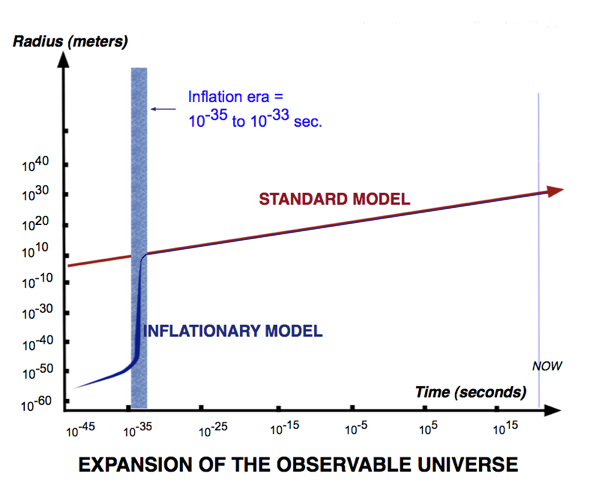
Cosmic inflation is a theoretical extension of the Big Bang model proposing that, very early in the universe's history, space underwent a brief epoch of extremely rapid, nearly exponential expansion. This idea was developed to address puzzles in the standard cosmological picture and to provide a mechanism by which tiny quantum variations could grow into the large-scale structure of galaxies and clusters seen in the present-day universe. For introductions in the context of physical cosmology and the observational cosmos, see related summaries and reviews.
Image gallery
5 Images



Mechanism and characteristics
The most common models posit a field (often called the inflaton) whose energy density temporarily dominated the universe and drove accelerated expansion. During this "inflationary" phase the scale of space increased immensely in a short time, smoothing out irregularities and diluting unwanted relics. Quantum fluctuations of the field were stretched to macroscopic scales and later became the seeds for density variations that formed galaxies and cosmic structure.
Problems solved
- Horizon problem: inflation explains why distant regions share nearly the same temperature.
- Flatness problem: rapid expansion drives spatial curvature toward flatness.
- Relic problems: unwanted heavy particles and magnetic monopoles are diluted to negligible abundances.
Observational consequences
Inflation makes several testable predictions: a nearly scale-invariant spectrum of primordial density perturbations, largely Gaussian fluctuations, and possibly a background of primordial gravitational waves. Measurements of the cosmic microwave background and large-scale structure largely support the predicted pattern of fluctuations, though searches for inflationary gravitational waves continue. These observations help constrain models but have not yet identified the physical nature of the inflaton.
History, variants and open questions
The basic idea was introduced by researchers in the late 20th century and refined into multiple scenarios such as "slow-roll" inflation, new and chaotic variants, and proposals for eternal inflation leading to a multiverse picture. Outstanding issues include the identity of the inflaton, fine-tuning and initial conditions, and how inflation connects to a complete theory of quantum gravity. For additional context on how inflation shapes our understanding of the present-day universe, consult broader cosmology resources.
Related articles
Author
AlegsaOnline.com Cosmic Inflation (cosmology) Leandro Alegsa
URL: https://en.alegsaonline.com/art/47289