
Hypoiodite (IO−): properties, preparation and reactivity
Hypoiodite (IO−) is the monovalent oxyanion of iodine (+1). It is unstable and readily disproportionates to iodide and iodate; it appears mainly as a transient oxidant and intermediate in iodination and analytical chemistry.
Overview
Hypoiodite is the oxyanion of iodine with the formula IO−. It is an ion in which iodine formally has oxidation state +1. In water and typical laboratory conditions the hypoiodite anion is chemically unstable and generally exists only as a short-lived species or as a salt that rapidly decomposes.
Image gallery
3 Images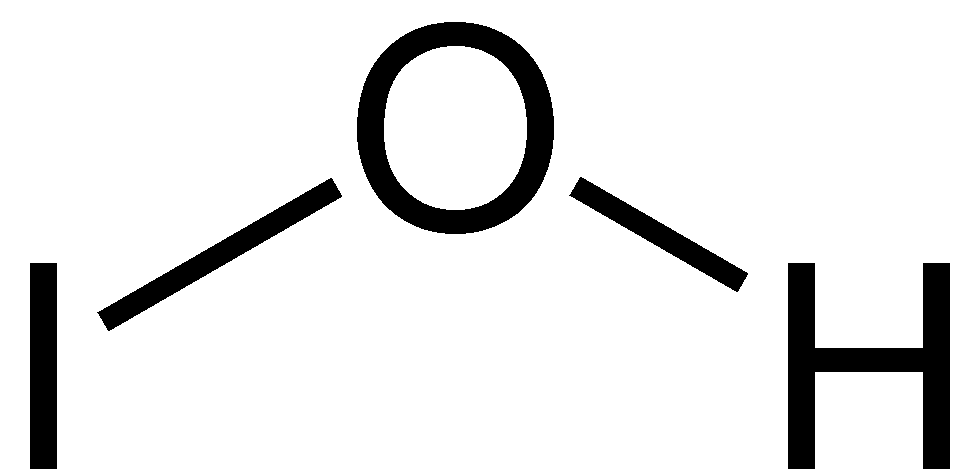


Characteristics and reactions
Hypoiodite is closely related to hypohalous ions such as hypochlorite and hypobromite but is the least stable member of this series. It readily disproportionates — a redox process in which the same element is simultaneously oxidized and reduced — forming iodide (I−) and iodate (IO3−). Because of this tendency to convert into lower and higher oxidation-state species, pure hypoiodite compounds are rare and often transient.
Preparation
Hypoiodite is typically generated by treating molecular iodine with a hydroxide or another base. Under such alkaline conditions iodine reacts to give species that include hypoiodite and related oxyanions; in practice the mixture evolves to more stable products over time. The anion can be considered the conjugate base or salt form of hypoiodous acid (HOI), the protonated molecular form of IO−, and is derived when that acid loses a proton.
Uses and significance
Because of its instability, hypoiodite is not commonly handled as a stable reagent. It is important as a reactive intermediate in certain iodine-mediated organic transformations and in analytical procedures that involve iodine/iodide chemistry. In these contexts IO− functions briefly as an oxidant or electrophilic iodine source before converting to iodide and iodate.
Related facts and distinctions
- IO− is an example of a hypohalite-type oxyanion; trends in the halogen series influence its relative instability compared with ClO− and BrO−.
- Salts of hypoiodous acid can sometimes be detected at low temperature or under controlled conditions but commonly decompose by disproportionation.
- Because hypoiodite reacts rapidly, practical applications typically exploit it in situ rather than as an isolated compound.
Summary: Hypoiodite (IO−) is a +1 iodine oxyanion best known as an unstable, reactive species produced when iodine encounters base; it disproportionates to iodide and iodate and mainly appears as a short-lived intermediate in oxidation and iodination chemistry.
For further reading on related topics see links to fundamental concepts such as ions, disproportionation, and specific iodine species like iodide and iodate.
Related articles
Author
AlegsaOnline.com Hypoiodite (IO−): properties, preparation and reactivity Leandro Alegsa
URL: https://en.alegsaonline.com/art/46200