
Hypoiodous acid (HIO)
Hypoiodous acid (HIO) is the weakest simple oxyacid of iodine, a reactive and unstable compound in which iodine is in the +1 oxidation state; it forms the hypoiodite ion (IO−) in solution.
Overview
Hypoiodous acid is an inorganic oxyacid of iodine with the molecular formula HIO. It is the protonated form of the hypoiodite ion (IO−) and contains iodine in the +1 oxidation state. For a general reference on its classification as a chemical substance see compound entry.
Image gallery
3 Images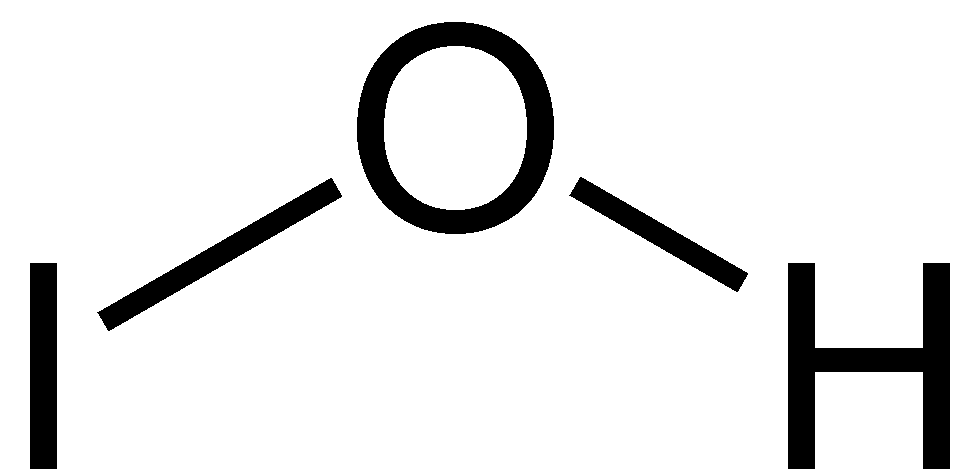


Structure and properties
Chemically it can be represented as H–O–I: a hydrogen bonded to oxygen, which is in turn bonded to iodine. In aqueous solution HIO is a weak acid and partially dissociates to give H+ and IO−. It is less stable than the analogous hypochlorous (HOCl) and hypobromous (HOBr) acids and tends to undergo redox changes rather than persisting as a free species; further details on related ions are available at ion reference.
Reactivity and preparation
Hypoiodous acid is typically observed transiently in reactions that oxidize iodide or in equilibria involving iodine and water. It is a mild oxidizing agent and readily disproportionates or is converted to other iodine oxyanions under many conditions. Laboratory descriptions and synthetic notes can be found via preparation notes.
Occurrence and uses
Because of its oxidizing and antimicrobial properties, hypoiodous acid is of interest in disinfection chemistry and in biological contexts where iodine species are active. It is also relevant in analytical and synthetic chemistry when iodine redox chemistry is involved. Practical applications and safety guidance are discussed in resources such as usage guidance.
Notable distinctions
- Oxidation state: iodine is +1 in HIO, lower than in iodic acid (HIO3) and iodous acid (HIO2).
- Stability: HIO is transient and more reactive than HOCl/HOBr analogs.
- Conjugate base: the hypoiodite ion (IO−) forms salts that share some chemistry but are often unstable.
Because hypoiodous acid is reactive and not typically isolated as a stable pure liquid, most practical references treat it in the context of aqueous equilibria, redox chemistry, and its role in iodometry and antiseptic formulations.
Related articles
Author
AlegsaOnline.com Hypoiodous acid (HIO) Leandro Alegsa
URL: https://en.alegsaonline.com/art/46201